
Hari Ram v. Chunni Devi, 2026
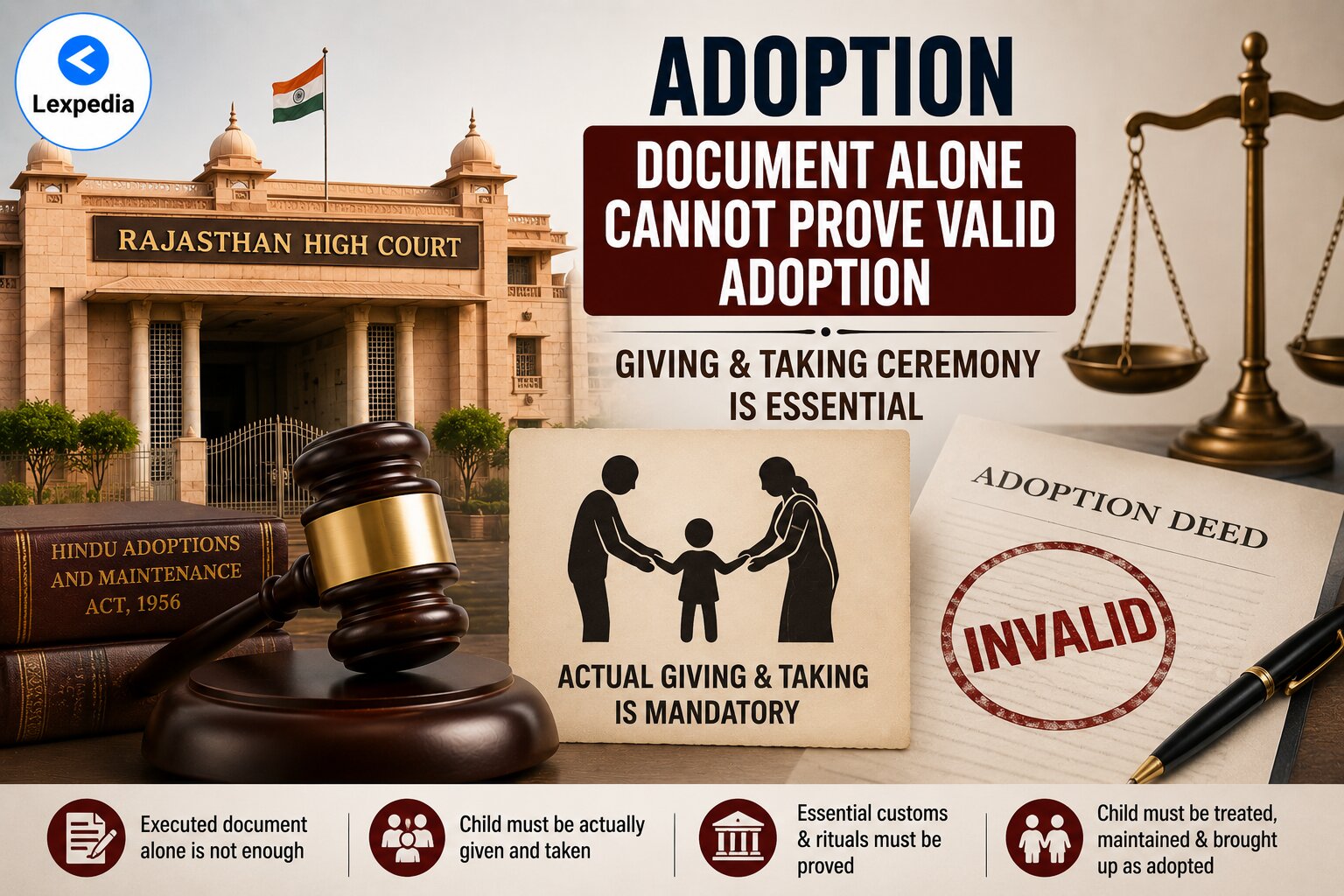
Adoption Deed Alone Cannot Prove Valid Adoption Without Giving And Taking Ceremony.
Judgement Details
Court
Rajasthan High Court
Date of Decision
20 May 2026
Judges
Justice Farjand Ali
Citation
Acts / Provisions
Facts of the Case
-
The dispute concerned the validity of an alleged adoption deed executed between the parties.
-
The appellant claimed that he had been legally adopted by the respondent in accordance with Hindu customs and traditions.
-
The respondent denied the adoption and alleged that the appellant’s father had fraudulently obtained her thumb impressions on the adoption deed.
-
It was alleged that the contents and true nature of the document were never disclosed to the respondent.
-
According to the respondent, the adoption deed was created with an oblique motive to grab her agricultural property.
-
The respondent further asserted that the appellant never resided with her after the alleged adoption.
-
It was also argued that the appellant continued to remain under the care, custody, and upbringing of his biological parents.
-
No material was produced to show that the respondent had maintained, educated, or nurtured the appellant as an adopted son.
-
The appellate court had earlier declared the adoption deed invalid and unenforceable.
-
Aggrieved by the findings, the appellant approached the Rajasthan High Court.
Issues
-
Whether execution of an adoption deed alone is sufficient to establish a valid adoption under Hindu Law?
-
Whether the ceremony of actual giving and taking of the child is mandatory under the Hindu Adoptions and Maintenance Act, 1956?
-
Whether absence of recital regarding essential adoption ceremonies rendered the adoption deed invalid?
-
Whether the appellant was ever treated as the legally adopted son of the respondent?
-
Whether the appellate court rightly declared the adoption deed invalid and unenforceable?
Judgement
-
The Rajasthan High Court dismissed the appeal and upheld the findings of the appellate court.
-
The Court held that adoption cannot be recognized merely on the basis of an executed document.
-
The bench observed that under the Hindu Adoptions and Maintenance Act, 1956, actual giving and taking of the child is an essential requirement for a valid adoption.
-
The Court emphasized that the ceremony of giving and taking is not a mere formality but the “very essence and soul” of a valid adoption.
-
The Court noted that the adoption deed did not contain any recital regarding performance of the mandatory ceremony of giving and taking.
-
It further observed that the document was silent regarding essential customs and rituals necessary for legal recognition of adoption under Hindu Law.
-
The Court found no evidence showing that the appellant was ever maintained, educated, or brought up by the respondent as her adopted son.
-
The bench noted that the appellant continued to remain with his biological parents even after the alleged adoption.
-
The Court concluded that both lower courts had correctly appreciated the evidence on record.
-
Consequently, the appeal was dismissed.
Held
-
Mere execution of an adoption deed is insufficient to establish a valid adoption.
-
The ceremony of actual giving and taking is mandatory under Hindu adoption law.
-
Essential customs and rituals relating to adoption must be proved for legal validity.
-
Absence of evidence showing transfer of the child into the adoptive family weakens the claim of adoption.
-
The adoption deed in the present case was held invalid and unenforceable.
Analysis
-
The judgment reiterates the foundational principles governing adoption under Hindu Law.
-
The Rajasthan High Court correctly emphasized that adoption is not merely a documentary transaction but a legal and social transfer of the child from one family to another.
-
By stressing the importance of the giving and taking ceremony, the Court reaffirmed the statutory mandate under the Hindu Adoptions and Maintenance Act, 1956.
-
The ruling safeguards against fraudulent or fabricated adoption claims made solely for securing inheritance or property rights.
-
The Court’s reasoning highlights that legal recognition of adoption requires proof of genuine intention and actual transfer of parental responsibility.
-
The judgment also demonstrates the evidentiary importance of conduct after adoption, such as upbringing, maintenance, and social treatment of the child.
-
The ruling strengthens the principle that statutory requirements under personal laws cannot be bypassed merely through execution of documents.
-
The decision may serve as an important precedent in future inheritance and property disputes involving contested adoptions.
-
Overall, the judgment reinforces authenticity and procedural safeguards in matters concerning adoption under Hindu Law.