
Gunjan @ Girija Kumari & Ors. v. State (NCT of Delhi) & Anr., 2026
The decision strengthens the jurisprudence that location and visibility are critical ingredients under Sections 3(1)(r) and 3(1)(s).
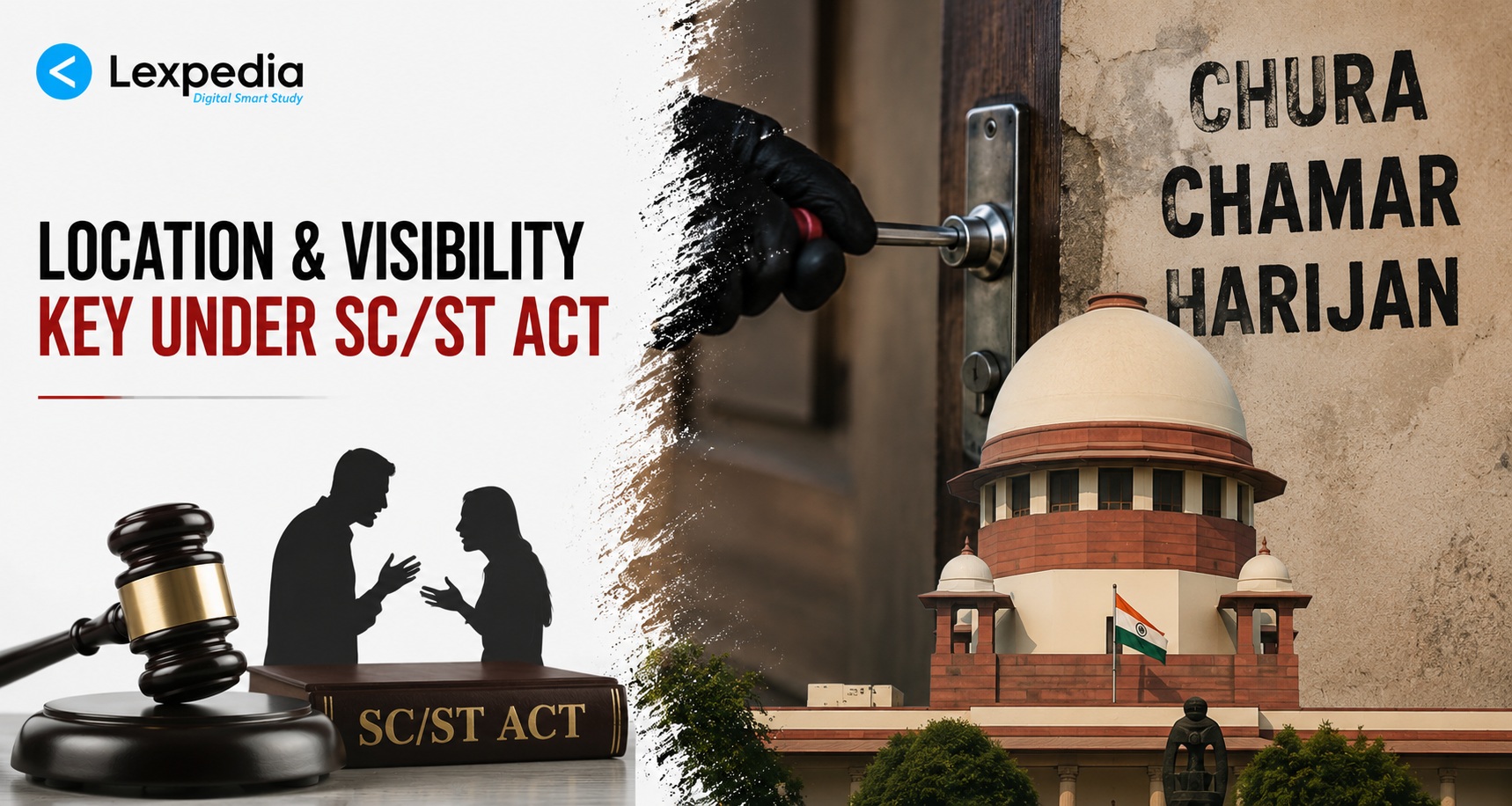
Judgement Details
Court
Supreme Court of India
Date of Decision
12 May 2026
Judges
Justice Prashant Kumar Mishra & Justice N.V. Anjaria
Citation
Acts / Provisions
Facts of the Case
-
The case arose from an FIR alleging that the accused:
-
attempted to break open the complainant’s house lock, and
-
used caste-based slurs such as “chura, chamar, harijan” against the complainant and his wife.
-
-
The complainant belonged to a Scheduled Caste community, while the accused and complainant were real brothers, and their spouses belonged to non-SC/ST communities.
-
The alleged incident occurred inside a residential house.
-
The trial court framed charges under:
-
SC/ST Act Sections 3(1)(r) & 3(1)(s)
-
Section 506 IPC read with Section 34 IPC
-
-
The Delhi High Court refused to interfere with the framing of charges.
-
The accused approached the Supreme Court challenging applicability of the SC/ST Act.
Issues
-
Whether caste-based abuses inside a private house satisfy the requirement of “within public view” under the SC/ST Act?
-
Whether essential ingredients of Sections 3(1)(r) and 3(1)(s) of the SC/ST Act were made out?
-
Whether framing of charges under the SC/ST Act was legally sustainable when incident occurred in a private residential space?
-
Whether proceedings under SC/ST Act can continue in absence of statutory requirement of public visibility?
Judgement
-
The Supreme Court allowed the appeal and quashed the proceedings under the SC/ST Act.
-
The Court held that a key requirement under Sections 3(1)(r) and 3(1)(s) is that the offence must occur in a “place within public view.”
-
The Bench clarified that “public view” means:
-
a place exposed to public gaze, or
-
a location where the public can witness the incident.
-
-
The Court observed that the alleged incident occurred inside a residential house, which was not accessible to the public.
-
It held that a private dwelling does not automatically become a “place within public view.”
-
The Court found that the FIR did not disclose any circumstance showing public presence or visibility during the alleged incident.
-
The Bench stated that the essential ingredient of the offence was missing.
-
It emphasised that statutory interpretation of the SC/ST Act requires strict satisfaction of all ingredients before prosecution can continue.
-
Accordingly, the Court held that continuation of proceedings under the SC/ST Act would be unsustainable in law.
-
The appeal was therefore allowed and charges under the SC/ST Act were quashed.
Held
-
Caste-based abuse inside a private house, without public visibility, does not satisfy the “public view” requirement under the SC/ST Act.
-
Absence of this essential ingredient renders prosecution under Sections 3(1)(r) and 3(1)(s) invalid.
-
Proceedings under the SC/ST Act were quashed.
Analysis
- The ruling reinforces a strict interpretation of the SC/ST Act, especially the “public view” requirement.
-
It clarifies that not every caste-based insult automatically attracts SC/ST Act provisions.
-
The judgment distinguishes between private disputes and public humiliation offences under the Act.
-
It prevents overextension of the statute into purely private/domestic conflicts.
-
The Court emphasizes that criminal liability under special statutes requires strict statutory compliance, not assumptions.
-
The decision strengthens the jurisprudence that location and visibility are critical ingredients under Sections 3(1)(r) and 3(1)(s).
-
It also highlights judicial caution in preventing misuse of special penal laws.
-
At the same time, it does not dilute protection under the Act but ensures it is applied within defined legal boundaries.
-
The judgment contributes to consistent interpretation of “public view” in SC/ST Act cases.
-
Overall, it balances protection of dignity with safeguards against unwarranted criminal prosecution.