
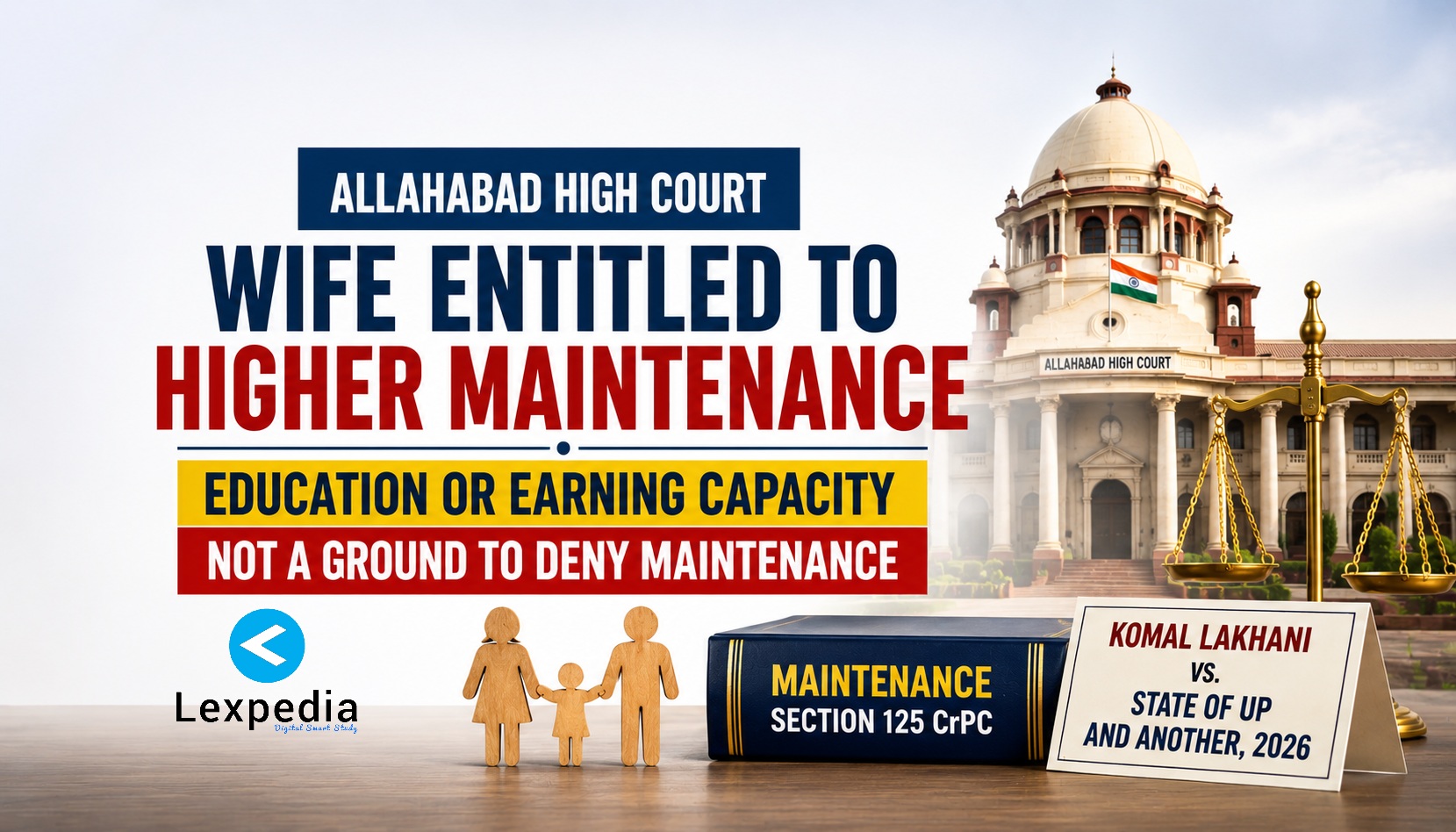
Komal Lakhani vs State of UP and Another, 2026
The judgment protects women from being denied maintenance merely because they possess professional degrees or prior work experience.
Judgement Details
Court
Allahabad High Court
Date of Decision
12 May 2026
Judges
Justice Garima Prashad
Citation
Acts / Provisions
Facts of the Case
-
The marriage between the parties was solemnized in August 2014.
-
The wife alleged that within one month of marriage, she was expelled from her matrimonial home due to unlawful dowry demands.
-
The wife claimed that she had been abandoned by her husband without any reasonable cause.
-
She further alleged that despite the husband earning approximately ₹5 crore annually, he failed to provide any maintenance.
-
The husband contended that the wife had deserted him without sufficient reason and behaved cruelly.
-
Before the High Court, the husband argued that the wife was highly educated, possessed an MBA degree, and had been gainfully employed before marriage.
-
The husband claimed that the wife had the capacity to earn more than ₹50,000 per month.
-
He further claimed that his own income was only around ₹15,000–₹20,000 per month and that he also had to maintain his aged mother.
-
The Family Court, Agra had awarded the wife ₹15,000 per month as maintenance.
-
Dissatisfied with the quantum of maintenance, the wife filed a criminal revision petition before the Allahabad High Court seeking enhancement.
Issues
-
Whether the mere educational qualification or earning capacity of a wife disentitles her from claiming maintenance under Section 125 CrPC?
-
Whether a wife must prove absolute destitution to claim maintenance under Section 125 CrPC?
-
Whether the maintenance awarded by the Family Court was fair considering the socio-economic status of the parties?
-
Whether the husband had truthfully disclosed his actual income and financial capacity?
-
Whether the wife’s entitlement to maintenance should be assessed according to the standard of living enjoyed in the matrimonial home?
Judgement
-
The Allahabad High Court allowed the criminal revision petition filed by the wife.
-
The Court held that mere educational qualification or earning capacity does not automatically disentitle a wife from claiming maintenance.
-
The bench observed that what is relevant is the wife’s actual and present ability to maintain herself.
-
The Court clarified that unless the wife is gainfully employed and earning sufficient income, the husband cannot avoid his statutory obligation to maintain her.
-
The Court reiterated that entitlement to maintenance must be determined in light of the husband’s social and economic status.
-
The judges observed that a wife need not prove complete destitution to seek maintenance under Section 125 CrPC.
-
The Court relied upon the Supreme Court judgment in Chaturbhuj v. Sita Bai to interpret the phrase “unable to maintain herself.”
-
The Court found the husband’s claims regarding his limited income highly doubtful.
-
The bench took note of the husband’s luxurious lifestyle, his education in Canada, and his involvement in an educational consultancy business.
-
The Court also observed that the husband avoided producing complete financial records and gave evasive replies regarding a commercial property.
-
The judges concluded that the award of ₹15,000 per month was neither fair nor just considering the socio-economic status of the parties.
-
Accordingly, the Court remanded the matter back to the Family Court for fresh determination of maintenance within six months.
-
The husband was directed to clear all arrears and continue paying the existing maintenance amount until fresh adjudication.
Held
-
Educational qualification or earning capacity alone cannot disentitle a wife from maintenance.
-
A wife need not establish absolute destitution to claim maintenance under Section 125 CrPC.
-
Maintenance must be assessed according to the socio-economic status and standard of living of the parties.
-
The matter was remanded for fresh determination of maintenance quantum.
Analysis
-
The judgment reinforces the welfare-oriented purpose of Section 125 CrPC.
-
The Court adopted a socially realistic approach by recognising that educational qualifications do not necessarily translate into actual financial independence.
-
The ruling strengthens the principle that maintenance is a legal obligation and not a matter of charity.
-
The judgment protects women from being denied maintenance merely because they possess professional degrees or prior work experience.
-
The Court correctly emphasised the relevance of the standard of living enjoyed during marriage while determining maintenance.
-
The decision highlights judicial scrutiny of attempts by spouses to conceal their true income and assets.
-
By relying on the Supreme Court precedent in Chaturbhuj v. Sita Bai, the Court reaffirmed that maintenance laws should receive liberal interpretation in favour of dependent spouses.
-
The judgment promotes substantive gender justice by recognising economic vulnerability despite educational qualifications.
-
The ruling also discourages husbands from understating income to reduce maintenance liability.
-
The case is likely to serve as an important precedent in future disputes involving maintenance claims by educated spouses.