
Gajendra Mourya v. State of Rajasthan & Anr., 2026
Consent Within Marriage Legally Immaterial: Rajasthan High Court Quashes Rape FIR
Judgement Details
Court
Rajasthan High Court
Date of Decision
16 May 2026
Judges
Justice Anoop Kumar Dhand
Citation
Acts / Provisions
Facts of the Case
-
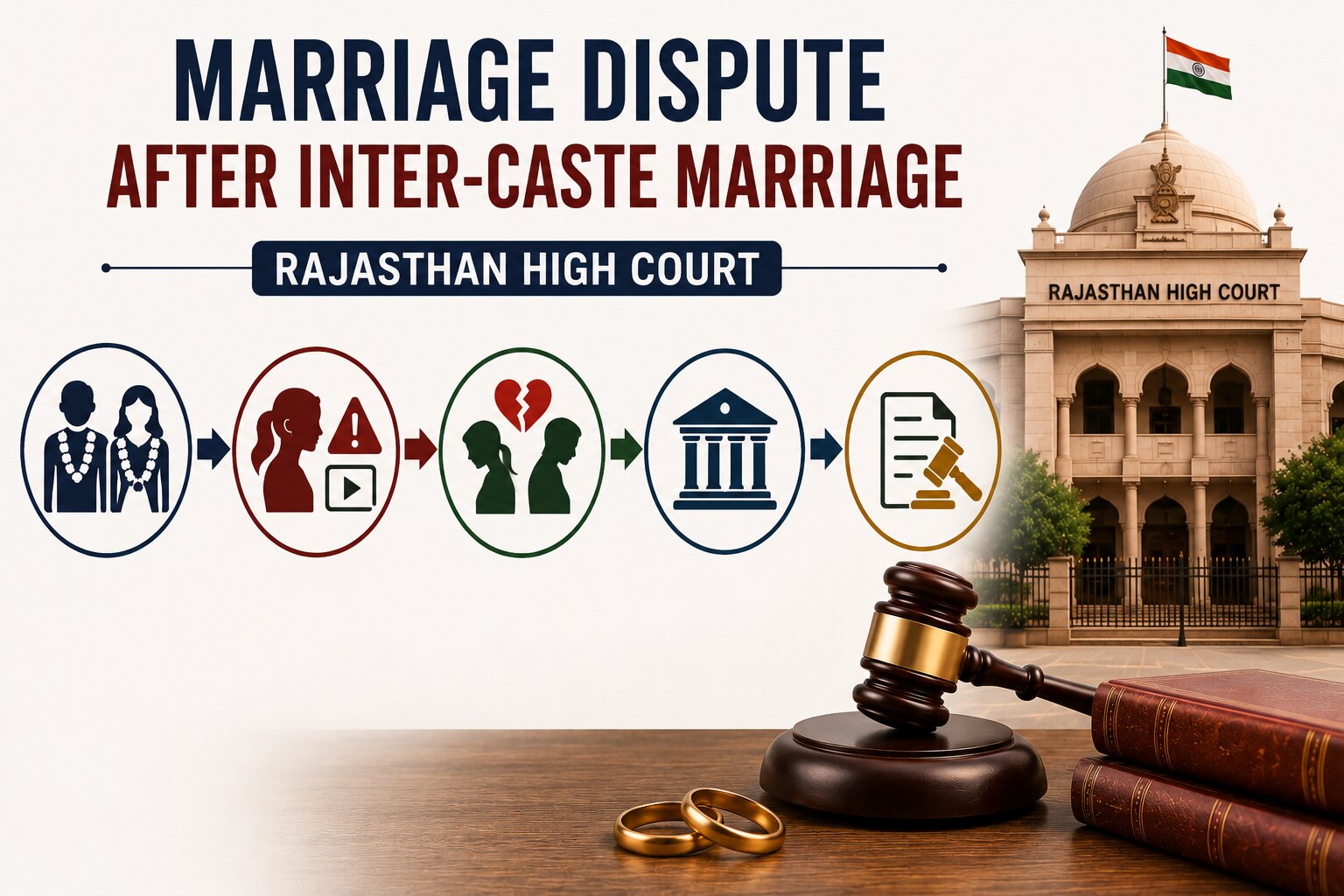
The petitioner and the prosecutrix solemnized an inter-caste marriage under the Special Marriage Act on 12.04.2021 because the prosecutrix’s family allegedly opposed the marriage.
-
The prosecutrix later disputed the validity of the marriage and alleged that she was forced to sign the marriage papers due to an obscene video allegedly used against her.
-
Matrimonial disputes arose between the parties after the marriage.
-
The petitioner approached the Family Court seeking restitution of conjugal rights.
-
The prosecutrix filed a petition seeking annulment of marriage.
-
Both applications were rejected by the Family Court, after which appeals were filed and remained pending.
-
Nearly two months after the marriage, the prosecutrix lodged an FIR alleging that the petitioner had committed rape upon her for more than one month.
-
The Court examined the records and photographs and observed that the marriage appeared to have been solemnized with mutual consent.
-
The Court noted that the prosecutrix subsequently changed her stand and lodged allegations of rape after matrimonial disputes had already arisen.
Issues
-
Whether sexual intercourse by a legally wedded husband with his adult wife constitutes rape under Section 375 IPC?
-
Whether Exception 2 to Section 375 IPC excludes criminal liability for rape within a valid marriage?
-
Whether consent within marriage becomes legally immaterial for prosecution of rape allegations against a husband?
-
Whether the FIR lodged by the prosecutrix amounted to abuse of process of law?
-
Whether the High Court should exercise its inherent jurisdiction to quash the FIR and criminal proceedings?
Judgement
-
The High Court held that the petitioner was the legally wedded husband of the prosecutrix.
-
The Court observed that Exception 2 to Section 375 IPC excludes sexual intercourse by a husband with his wife from the ambit of rape, provided the wife is not a minor.
-
The Court relied upon Navtej Singh Johar v. Union of India and held that the aspect of consent within marriage is legally immaterial for prosecution of rape allegations against a husband.
-
The Court observed that the prosecutrix was a major at the time of marriage and had solemnized the marriage voluntarily.
-
The Court noted that the FIR was filed after matrimonial disputes had arisen and after a delay of around two months from the date of marriage.
-
The Court held that continuation of criminal proceedings would amount to abuse of process of law.
-
Accordingly, the FIR and all consequential proceedings were quashed and set aside.
Held
-
Sexual intercourse between the petitioner and the prosecutrix did not constitute rape because they were legally married.
-
Exception 2 to Section 375 IPC protected the petitioner from prosecution for rape.
-
The FIR was held to be an abuse of process of law.
-
The criminal proceedings arising out of the FIR were quashed.
Analysis
-
The judgment strictly follows the statutory framework under Section 375 IPC and its Exception 2, which continues to provide immunity from rape prosecution within marriage.
-
The Court adopted a literal interpretation of the statutory provision and emphasized that courts are bound by the law as it presently exists.
-
Reliance on Navtej Singh Johar v. Union of India demonstrates judicial acknowledgment of the continued existence of the marital rape exception in Indian criminal law.
-
The judgment reinforces the legal position that consent within marriage is treated differently from consent outside marriage for the purpose of rape prosecution.
-
The Court gave importance to documentary evidence and photographs indicating voluntary solemnization of marriage.
-
The ruling reflects judicial concern regarding misuse of criminal proceedings in matrimonial disputes.
-
The judgment may attract criticism from advocates of constitutional morality, bodily autonomy, and gender justice, because it upholds the marital rape exception.
-
The case highlights the continuing constitutional debate surrounding the validity of Exception 2 to Section 375 IPC.
-
The decision also illustrates the distinction between matrimonial conflicts and criminal prosecution for sexual offences.