
G v. S, 2026
Husband Must Disclose Income in Section 125 CrPC Cases; Wife Cannot Bear Entire Burden of Proof.
Judgement Details
Court
Madhya Pradesh High Court
Date of Decision
4 July 2026
Judges
Justice Gajendra Singh
Citation
Acts / Provisions
Facts of the Case
-
The petitioner-wife filed a criminal revision challenging the order of the Family Court, which rejected her claim for maintenance while awarding ₹20,000 per month to the minor child under Section 125 CrPC.
-
The wife also sought enhancement of the maintenance awarded to the child.
-
The marriage between the parties was solemnised on 6 May 2013, and a son was born on 11 October 2015.
-
The wife filed an application under Section 125 CrPC on 9 March 2024, alleging that she was subjected to ill-treatment, abuse, neglect, and that the husband was involved in an extramarital affair.
-
She stated that she had been residing separately from the husband since 2024 due to sufficient cause.
-
The wife claimed maintenance of ₹3 lakh per month, asserting that the husband operated ECOCARB Private Ltd. and was employed as Deputy General Manager (DGM) at EKI Energy Pvt. Ltd., earning approximately ₹3 lakh per month.
-
The husband denied the allegations, contending that the wife had left the matrimonial home without justification and stated that she possessed a Bachelor of Engineering (B.E.) degree.
-
The Family Court observed that the husband had filed proceedings for restitution of conjugal rights and concluded that he was earning only ₹60,000 per month, awarding maintenance only to the minor child.
-
Aggrieved by the Family Court's approach, the wife approached the High Court seeking maintenance for herself and enhancement of the child's maintenance.
Issues
-
Whether the Family Court erred in placing the entire burden of proving the husband's income upon the wife in proceedings under Section 125 CrPC?
-
Whether proceedings under Section 125 CrPC require the husband to disclose material facts regarding his income and financial status?
-
Whether the wife was entitled to maintenance despite the husband's plea regarding restitution of conjugal rights?
-
Whether the maintenance awarded to the minor child required enhancement considering the financial status and standard of living of the parties?
Judgement
-
The High Court held that the Family Court had adopted an erroneous approach by placing the entire burden upon the wife to establish the husband's income.
-
The Court emphasized that proceedings under Section 125 CrPC are social welfare proceedings and not strictly adversarial litigation.
-
It observed that the husband ought to have been directed to disclose all material particulars relating to his income, assets, and financial capacity.
-
The Court relied upon the principles laid down by the Supreme Court in Rajnesh v. Neha regarding mandatory disclosure of income in maintenance proceedings.
-
The Court noted that the husband was an M.Tech. and MBA, employed as Deputy General Manager at EKI Energy Pvt. Ltd., and had filed an affidavit regarding his income.
-
It observed that although a person's income may be concealed, his social and financial status cannot be concealed, and such status is relevant in determining maintenance.
-
The Court held that after more than ten years of marriage and while caring for a ten-year-old child, the wife could not be presumed to be earning merely because she possessed an engineering degree.
-
The Court further observed that the Family Court had improperly relied upon the husband's petition for restitution of conjugal rights without adequately appreciating the evidence showing that the wife had sufficient reasons to live separately.
-
Holding that the husband could not evade his statutory obligation to maintain his wife and minor child according to their standard of living, the Court allowed the revision.
-
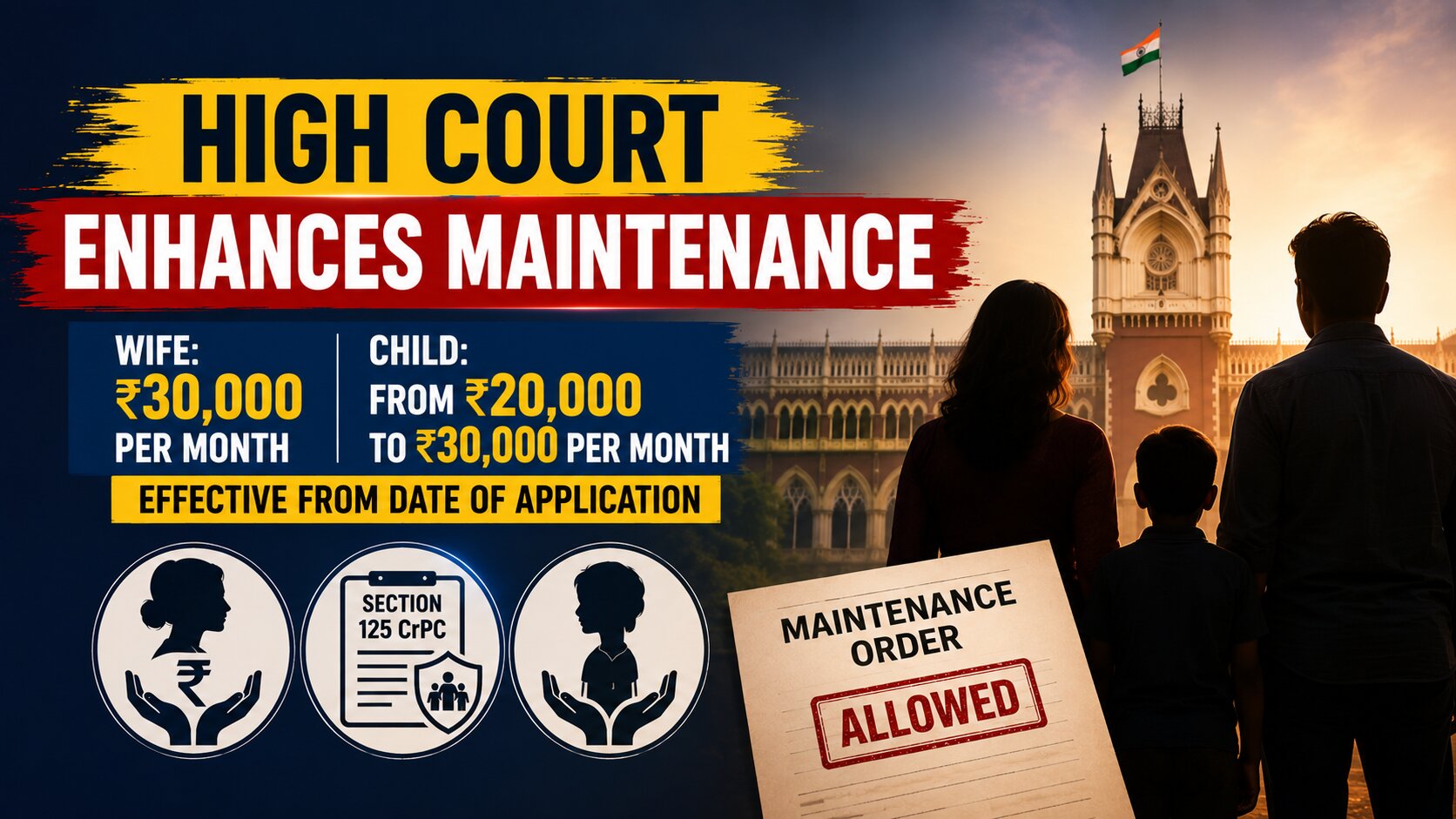
Accordingly, the Court awarded ₹30,000 per month as maintenance to the wife and enhanced the maintenance payable to the minor child from ₹20,000 to ₹30,000 per month, with effect from the date of filing of the application.
Held
-
Proceedings under Section 125 CrPC are social welfare proceedings and not ordinary adversarial litigation.
-
The husband bears the responsibility of disclosing material facts regarding his income.
-
The Family Court erred in rejecting the wife's claim for maintenance.
-
Maintenance of the minor child was enhanced from ₹20,000 to ₹30,000 per month.
-
The wife was awarded ₹30,000 per month as maintenance from the date of the application.
-
The criminal revision was allowed.
Analysis
-
The judgment reinforces the welfare-oriented object of Section 125 CrPC, emphasizing that maintenance proceedings are intended to prevent destitution and ensure social justice.
-
The Court correctly shifted the evidentiary burden regarding income disclosure onto the husband, recognizing that financial information ordinarily lies within his exclusive knowledge.
-
By relying upon Rajnesh v. Neha, the Court reaffirmed the importance of full and truthful financial disclosure in maintenance litigation.
-
The observation that income may be concealed but social status cannot provides practical guidance for courts while assessing maintenance claims where direct proof of earnings is unavailable.
-
The decision clarifies that a wife's educational qualification alone cannot justify denial of maintenance in the absence of evidence that she is actually earning sufficient income.
-
The Court appropriately held that the mere filing of a petition for restitution of conjugal rights does not disentitle a wife from maintenance where she has sufficient cause to reside separately.
-
The enhancement of maintenance reflects the principle that dependants are entitled to enjoy a standard of living reasonably comparable to that of the earning spouse.
-
The judgment strengthens procedural fairness by discouraging Family Courts from imposing an unrealistic burden upon economically weaker spouses to prove concealed income.
-
The ruling is likely to influence future maintenance cases by encouraging stricter compliance with financial disclosure requirements.
-
A notable strength of the judgment is its balanced application of social welfare principles, burden of proof, and maintenance jurisprudence to protect the financial security of wives and minor children.