
B.S. Lalitha and Others v. Bhuvanesh and Others, 2026
Supreme Court Holds Daughters' Right to Inherit Father's Intestate Property Cannot Be Defeated by Pre-2004 Partition Among Sons
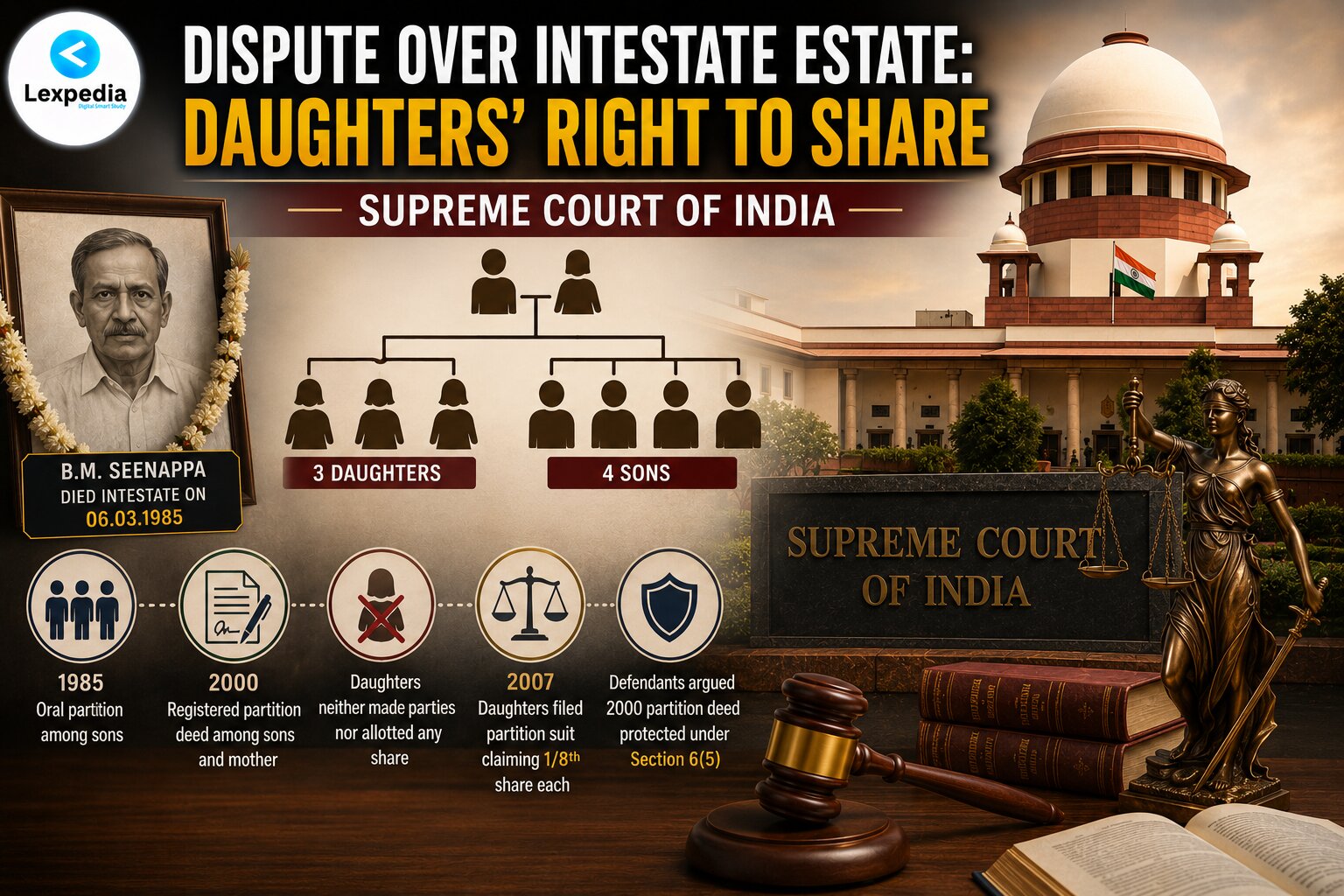
Judgement Details
Court
Supreme Court of India
Date of Decision
15 May 2026
Judges
Justice Sanjay Karol & Justice Augustine George Masih
Citation
Acts / Provisions
Facts of the Case
-
The dispute concerned the estate of B.M. Seenappa, who died intestate on 06.03.1985.
-
He was survived by his widow, three daughters, and four sons.
-
After his death, the sons allegedly carried out an oral partition in 1985.
-
Subsequently, a registered partition deed was executed in 2000 among the sons and their mother.
-
The daughters were neither made parties to the partition deed nor allotted any share in the family properties.
-
In 2007, the daughters instituted a partition suit claiming 1/8th share each in the properties as Class I heirs under Section 8 of the Hindu Succession Act.
-
The defendants repeatedly sought rejection of the plaint under Order VII Rule 11 CPC, contending that the suit was barred because the 2000 partition deed was protected under Section 6(5) of the Hindu Succession Act.
-
An earlier application seeking rejection of the plaint had already been dismissed in 2013.
-
In 2021, another application under Order VII Rule 11 CPC was filed by legal representatives of one of the sons.
-
In 2024, the Karnataka High Court allowed the second application and rejected the plaint, holding that the suit was barred under Section 6(5).
-
Aggrieved by this decision, the daughters approached the Supreme Court.
Issues
-
Whether daughters retain an independent right to inherit their father's intestate property as Class I heirs under Section 8 of the Hindu Succession Act despite the 2005 amendment to Section 6?
-
Whether a partition deed executed before 20 December 2004 among sons alone can defeat the daughters' succession rights in the father's property?
-
Whether Section 6(5) of the Hindu Succession Act operates as a complete statutory bar to a partition suit filed by daughters?
-
Whether the Karnataka High Court erred in rejecting the plaint under Order VII Rule 11 CPC without trial despite the existence of disputed questions of fact?
-
Whether the second application for rejection of plaint was barred by the principle of res judicata?
Judgement
-
The Supreme Court allowed the appeal and set aside the Karnataka High Court's judgment.
-
The Court held that the High Court erred in rejecting the plaint at the threshold under Order VII Rule 11 CPC without examining disputed questions of fact that required trial.
-
The Court observed that the second application for rejection of plaint was barred by the principle of res judicata because an earlier similar application had already been dismissed.
-
The Court clarified that Section 6(5) is merely a saving clause protecting certain prior partitions from the operation of the 2005 amendment and not a jurisdictional bar preventing courts from entertaining partition suits.
-
The Court emphasized that the daughters' rights under Section 8 accrued independently upon the intestate death of their father in 1985.
-
The Court held that the 2005 amendment granting daughters coparcenary rights does not extinguish or curtail their pre-existing succession rights as Class I heirs.
-
The Court observed that a partition deed executed among sons alone cannot automatically bind daughters who were not parties to such partition.
-
The Court stated that the validity and binding nature of the partition deed were disputed issues requiring adjudication during trial.
-
The Supreme Court restored the partition suit to the file of the trial court and directed expeditious disposal.
-
The Court also ordered maintenance of status quo regarding the properties until further orders of the trial court.
Held
-
Daughters possess an independent right to inherit their father's intestate property under Section 8 of the Hindu Succession Act.
-
Section 6(5) does not bar courts from entertaining partition suits filed by daughters.
-
A pre-2004 partition among sons alone cannot defeat the inheritance rights of daughters who were excluded from the partition.
-
The second application seeking rejection of the plaint was barred by res judicata.
-
The suit required full trial because disputed questions of fact existed.
Analysis
-
The judgment significantly strengthens the inheritance rights of daughters under the Hindu Succession Act.
-
The Court drew a crucial distinction between coparcenary rights under Section 6 and succession rights under Section 8.
-
The ruling clarifies that the 2005 amendment was intended to expand daughters' rights and not to curtail already existing inheritance rights.
-
The Court correctly interpreted Section 6(5) as a saving clause rather than a complete legal bar.
-
The judgment prevents misuse of pre-2004 partition deeds to exclude daughters from inheritance.
-
The Court reinforced procedural safeguards by emphasizing that disputed factual questions cannot ordinarily be decided at the stage of Order VII Rule 11 CPC.
-
The reliance upon the doctrine of res judicata discourages repeated applications seeking identical reliefs under the same title.
-
The decision advances principles of gender equality and equitable succession in Hindu family law.
-
The judgment is likely to have a substantial impact on pending inheritance and partition disputes involving daughters excluded from earlier family partitions.
-
The ruling aligns with the constitutional vision of equal property rights for women.