
Bonoshree Hazra @ Mollah v. State of West Bengal & Anr., 2026
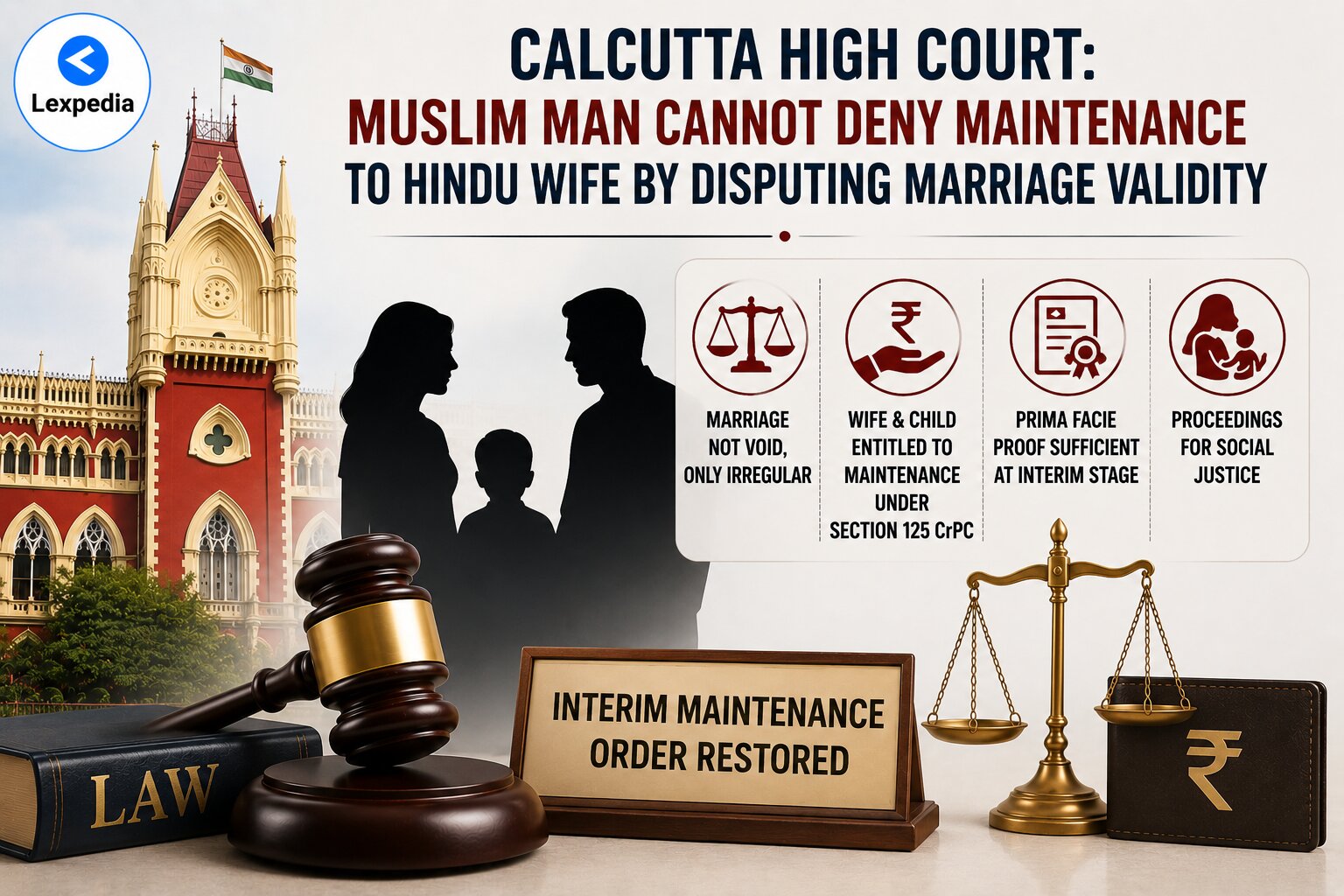
Muslim Man Cannot Deny Maintenance By Merely Disputing Marriage Validity
Judgement Details
Court
Calcutta High Court
Date of Decision
19 May 2026
Judges
Justice Chaitali Chatterjee Das
Citation
Acts / Provisions
Facts of the Case
-
he petitioner claimed that she married the respondent, a Sub-Inspector of Police, after allegedly converting to Islam.
-
The marriage was stated to have been performed according to Muslim rites and customs and registered before a Muslim Marriage Registrar and Kazi in Asansol in August 2016.
-
A male child was born from the relationship in January 2017.
-
The petitioner alleged that she was subjected to cruelty and threats by the respondent.
-
According to her, the respondent deserted both her and the minor child in February 2018.
-
The petitioner thereafter initiated proceedings under Section 125 CrPC seeking maintenance.
-
The Judicial Magistrate, Asansol granted interim maintenance of Rs. 5,000 per month to the woman and Rs. 4,000 per month to the minor child.
-
Subsequently, the Additional Sessions Judge set aside the interim maintenance order after the respondent disputed the marriage and paternity of the child.
-
The revisional court also questioned the validity of the alleged conversion because the petitioner continued using her Hindu name “Bonoshree Hazra.”
-
Aggrieved by the order denying maintenance, the petitioner approached the Calcutta High Court.
Issues
-
Whether a Muslim man can avoid payment of maintenance merely by disputing the validity of marriage at the interim stage?
-
Whether a marriage between a Muslim man and a Hindu woman under Hanafi Muslim law is void or merely irregular (fasid)?
-
Whether the wife and child are entitled to maintenance under Section 125 CrPC despite disputes regarding validity of marriage?
-
Whether continued use of a Hindu name by the petitioner could invalidate the alleged conversion or marriage at the interim stage?
-
Whether the revisional court erred in setting aside the Magistrate’s interim maintenance order?
Judgement
-
The Calcutta High Court allowed the criminal revision petition and restored the Magistrate’s interim maintenance order.
-
The Court held that the revisional court wrongly treated the dispute regarding marriage as conclusively established at the interim stage.
-
The bench observed that the petitioner had produced a marriage certificate bearing photographs and signatures of both parties.
-
The Court also noted the existence of the child’s birth certificate naming the respondent as the father.
-
It further took note that in proceedings initiated under Section 498A IPC, no dispute regarding marriage had been raised earlier by the respondent.
-
Relying upon the Supreme Court judgments in Chand Patel v. Bismilla Begum and Mohammed Salim v. Shamsudeen, the Court reiterated that under Hanafi Muslim law, marriage between a Muslim man and a Hindu woman is considered irregular (fasid) and not void (batil).
-
The bench clarified that such a marriage continues to subsist unless declared void by a competent court.
-
The Court held that during subsistence of such marriage, the wife and child remain entitled to maintenance under Section 125 CrPC.
-
The Court observed that merely using a Hindu name in legal proceedings cannot become a ground to deny maintenance.
-
The judgment emphasized that proceedings under Section 125 CrPC are summary in nature and the standard of proof regarding marriage is not strict.
-
The Court held that depriving a woman and minor child of maintenance despite prima facie proof of marriage and paternity would amount to gross illegality.
-
Consequently, the respondent was directed to continue payment of interim maintenance in terms of the Magistrate’s order.
Held
-
A husband cannot evade maintenance merely by disputing marriage when the marriage has not been declared void by a competent court.
-
Under Hanafi Muslim law, marriage between a Muslim man and Hindu woman is irregular (fasid), not void.
-
Wife and child are entitled to maintenance during subsistence of such marriage.
-
Proceedings under Section 125 CrPC are summary in nature and require only prima facie proof at the interim stage.
-
Interim maintenance to the petitioner and her minor child was restored.
Analysis
-
The judgment strongly reinforces the social justice objective behind Section 125 CrPC.
-
The Calcutta High Court adopted a welfare-oriented approach while protecting the rights of women and children at the interim stage.
-
By relying on principles of Hanafi Muslim law, the Court clarified the distinction between irregular (fasid) and void (batil) marriages.
-
The ruling prevents husbands from escaping maintenance obligations through technical disputes regarding validity of marriage.
-
The Court correctly emphasized that interim maintenance proceedings cannot become full-fledged trials on marital validity.
-
The judgment also highlights that identity and religious conversion cannot be assessed solely on superficial grounds such as use of a previous name.
-
By restoring maintenance, the Court ensured that economic vulnerability of women and children is not aggravated during prolonged litigation.
-
The ruling reaffirms that proceedings under Section 125 CrPC are intended to provide immediate relief and prevent destitution.
-
The decision strengthens constitutional principles of dignity, protection of women, and child welfare.
-
Overall, the judgment is an important precedent safeguarding maintenance rights despite pending disputes over personal law and marital validity.