
Bhawani Singh Shekhawat v. Fanishwar Sharma, 2026
Mere Delay In Amendment Plea Not Sufficient To Reject It.
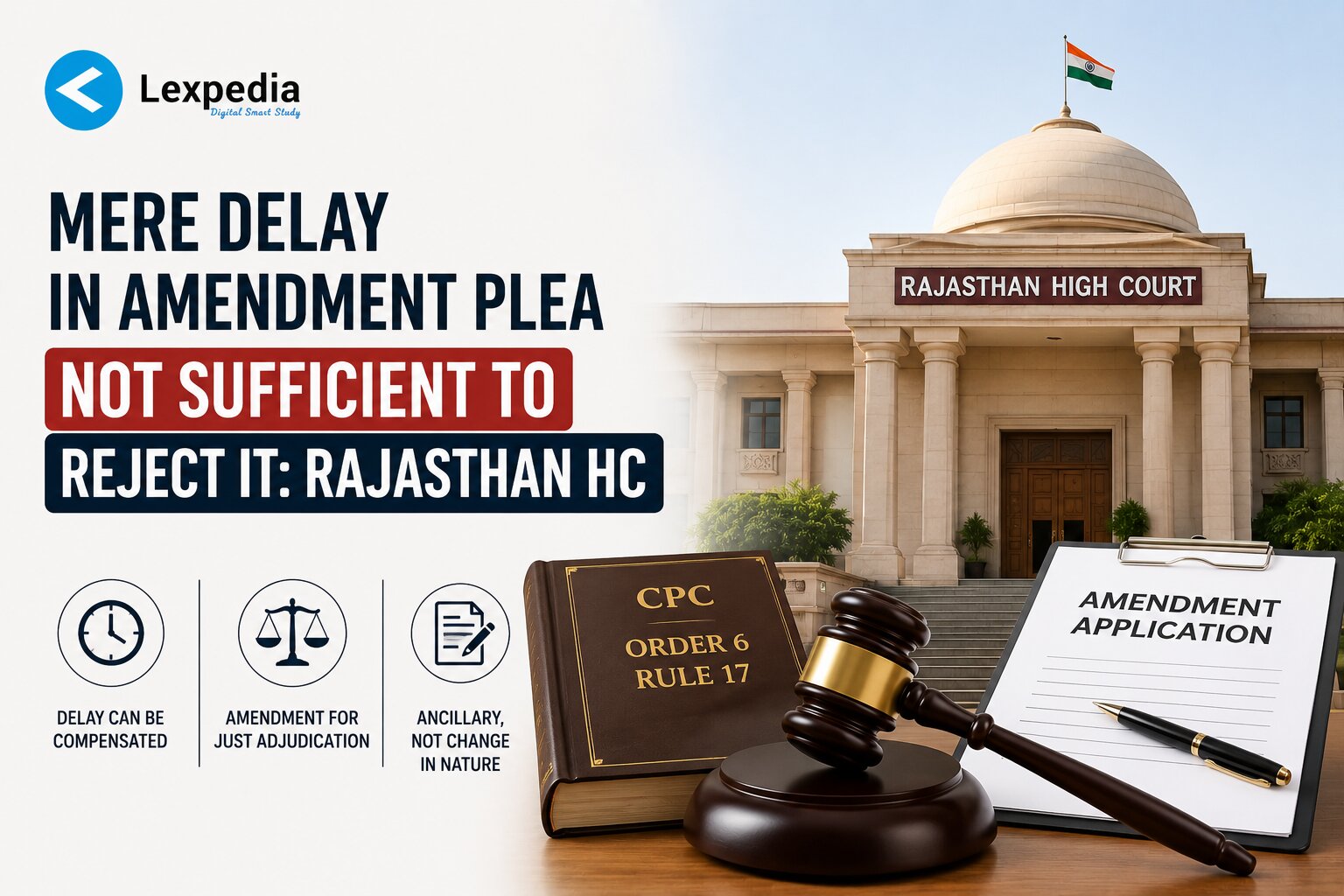
Judgement Details
Court
Rajasthan High Court
Date of Decision
23 May 2026
Judges
Justice Maneesh Sharma
Citation
Acts / Provisions
Facts of the Case
-
The respondent instituted a civil suit seeking:
-
Declaration
-
Possession
-
Permanent injunction
in relation to the suit property.
-
-
The respondent claimed to be the lawful owner of the suit property.
-
The petitioner contested the claim by asserting ownership based on a sale deed and long-standing possession over the property.
-
During the stage of plaintiff evidence, the respondent filed an application under Order 6 Rule 17 CPC seeking amendment of the plaint.
-
The amendment application was filed after a separate civil suit filed by the petitioner for permanent injunction was dismissed.
-
The respondent argued that the dismissal order declared the petitioner’s possession to be unlawful, thereby entitling the respondent to claim mesne profits.
-
Consequently, amendment of the plaint was sought to incorporate relief relating to mesne profits.
-
The Trial Court allowed the amendment application and imposed a cost of Rs. 5000 upon the respondent for delay.
-
Aggrieved by the order, the petitioner approached the Rajasthan High Court challenging the amendment.
-
The petitioner argued:
-
The amendment would change the nature of the suit.
-
The application was filed at a belated stage.
-
Issues
-
Whether mere delay in filing an amendment application under Order 6 Rule 17 CPC is sufficient ground to reject the amendment?
-
Whether the proposed amendment seeking mesne profits changed the nature of the original suit?
-
Whether the Trial Court was justified in allowing amendment of the plaint at the stage of plaintiff evidence?
-
Whether compensation by way of costs could adequately address delay caused by amendment applications?
Judgement
-
The Rajasthan High Court upheld the Trial Court’s order allowing amendment of the plaint.
-
The Court reiterated that the purpose of Order 6 Rule 17 CPC is to permit amendments necessary for proper and effective adjudication of disputes.
-
Justice Maneesh Sharma observed that amendments should ordinarily be allowed when they help avoid multiplicity of litigation.
-
The Court held that mere delay in filing an amendment application is not by itself a sufficient ground for rejection.
-
It observed that delay can be compensated monetarily through imposition of costs.
-
The Court relied upon the Supreme Court decision in Ramesh Kumar Agarwal v. Rajmala Exports Private Ltd. & Ors.
-
The High Court noted that the amendment relating to mesne profits was merely ancillary to the principal reliefs of declaration, possession, and injunction.
-
It held that the amendment did not alter the fundamental nature of the suit.
-
The Court further observed that the evidence had not yet commenced substantially, and therefore no serious prejudice would be caused to the petitioner.
-
It also noted that the petitioner would have full liberty to file an amended written statement and contest the amended pleadings on merits.
-
Accordingly, the petition challenging the amendment order was dismissed.
Held
-
Mere delay in filing an amendment application under Order 6 Rule 17 CPC is not sufficient ground for rejection.
-
Delay can be compensated by imposition of costs.
-
Amendment seeking mesne profits was ancillary in nature and did not change the character of the suit.
-
The Trial Court rightly allowed amendment of the plaint.
-
The petition was dismissed.
Analysis
-
The judgment reinforces the liberal approach traditionally adopted by courts while considering amendment applications under Order 6 Rule 17 CPC.
-
The Court correctly emphasized that procedural law is intended to advance justice rather than defeat substantive rights on technical grounds.
-
The ruling promotes effective adjudication by allowing parties to place all necessary claims before the court in one proceeding.
-
The judgment appropriately balances procedural fairness with judicial efficiency by permitting amendment while imposing costs for delay.
-
The Court’s distinction between an ancillary amendment and a substantive change in the nature of the suit is legally significant.
-
The ruling prevents multiplicity of litigation by allowing connected reliefs such as mesne profits to be adjudicated within the same suit.
-
The decision also protects the opposing party by preserving their right to contest amended pleadings through an amended written statement.
-
The judgment strengthens jurisprudence favouring substantial justice over procedural rigidity.