
Arti Mehta & Ors. v. State of Madhya Pradesh & Anr., 2026
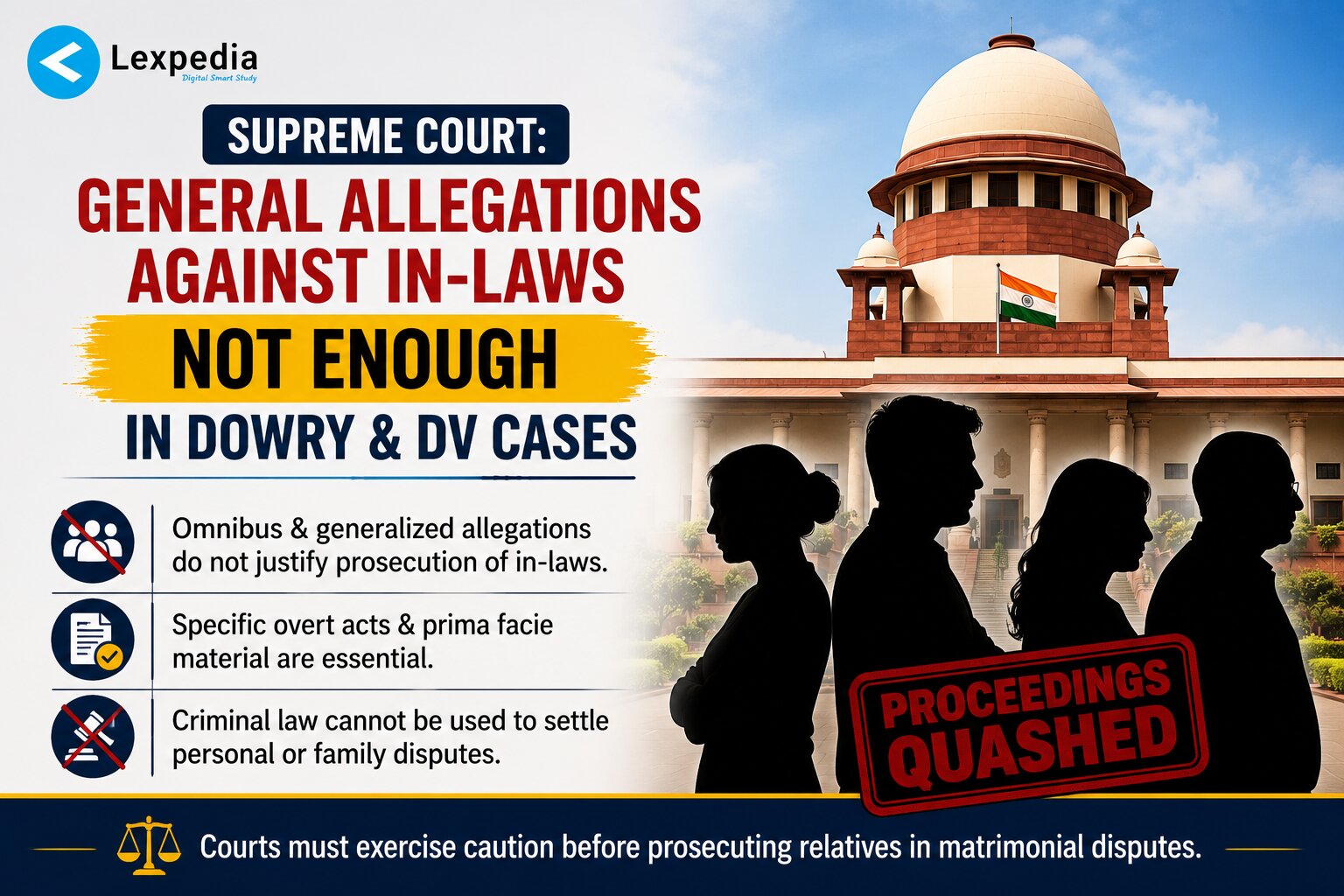
General Allegations Against In-Laws Not Enough In Dowry & DV Cases
Judgement Details
Court
Supreme Court of India
Date of Decision
27 May 2026
Judges
Justice Sanjay Karol & Justice Nongmeikapam Kotiswar Singh
Citation
Acts / Provisions
Facts of the Case
-
The case arose out of a matrimonial dispute between the complainant-wife and her husband, who got married in November 2019.
-
In January 2023, the complainant lodged an FIR at Guna, Madhya Pradesh alleging offences under Section 498A IPC, Section 34 IPC, and Sections 3 & 4 of the Dowry Prohibition Act against her husband and his relatives.
-
The complainant alleged that substantial dowry in the form of cash, jewellery, and household articles had been given at the time of marriage.
-
She further alleged that after marriage she was subjected to harassment and unlawful demands for additional money.
-
Subsequently, proceedings under the Domestic Violence Act were also initiated against the husband and his relatives.
-
The complainant alleged:
-
mental harassment,
-
surveillance through hidden cameras,
-
restrictions on movement, and
-
threats involving a licensed firearm.
-
-
The Madhya Pradesh High Court refused to quash the FIR and Domestic Violence proceedings against the in-laws.
-
Aggrieved by the High Court order, the in-laws approached the Supreme Court seeking quashing of the criminal proceedings.
-
During pendency of the proceedings, the marriage between the complainant and her husband stood dissolved by a decree of divorce passed by the competent Family Court.
Issues
- Whether omnibus and generalized allegations against in-laws are sufficient to continue criminal prosecution in matrimonial disputes?
-
Whether failure to attribute specific overt acts to each accused relative justifies quashing of criminal proceedings?
-
Whether merely supporting the husband or advising adjustment in matrimonial disputes amounts to criminal liability?
-
Whether continuation of Domestic Violence proceedings against in-laws after dissolution of marriage would amount to abuse of process of law?
-
Whether courts must exercise caution before prosecuting relatives in matrimonial disputes?
Judgement
-
The Supreme Court allowed the appeals filed by the complainant’s in-laws.
-
The Court held that the allegations against the appellants were omnibus, generalized, and lacking in specific particulars.
-
The Bench observed that no direct or specific overt act constituting domestic violence, cruelty, harassment, or dowry demand was individually attributed to the appellants.
-
The Court emphasized that allegations merely stating that relatives:
-
supported the husband,
-
failed to intervene, or
-
advised the complainant to adjust,
were insufficient to attract criminal liability.
-
-
The Court held that prosecutions arising from matrimonial disputes require:
-
specific allegations,
-
distinct roles, and
-
prima facie material indicating active involvement of each accused.
-
-
The Bench observed that criminal law cannot be used as an instrument to settle personal grievances or familial scores.
-
The Court stressed that courts must exercise heightened judicial scrutiny before allowing prosecution of relatives solely because of their relationship with the spouse.
-
The Supreme Court further observed that passive conduct or failure to intervene, though morally questionable, cannot automatically amount to criminal culpability.
-
The Court noted that continuation of proceedings under the Domestic Violence Act against the appellants would serve no useful purpose, especially after dissolution of marriage.
-
Accordingly, the Supreme Court quashed:
-
the FIR,
-
criminal proceedings, and
-
Domestic Violence proceedings against the in-laws.
-
Held
-
Omnibus and generalized allegations are insufficient to prosecute in-laws in matrimonial disputes.
-
Criminal proceedings against relatives require specific and distinct allegations supported by prima facie material.
-
Mere support to the husband or advice to adjust does not automatically attract criminal liability.
-
Continuation of proceedings against the appellants amounted to abuse of process of law.
-
The criminal and Domestic Violence proceedings against the in-laws were quashed.
Analysis
-
The judgment reinforces judicial safeguards against indiscriminate implication of relatives in matrimonial disputes.
-
The Supreme Court emphasized the need for specific factual foundations before extending criminal liability to family members.
-
The ruling seeks to prevent misuse of criminal law as a weapon in emotionally charged matrimonial conflicts.
-
By insisting upon individualized allegations and active participation, the Court strengthened procedural fairness in criminal prosecutions.
-
The judgment carefully balanced:
-
protection of victims of domestic violence, and
-
safeguarding innocent relatives from unnecessary criminal litigation.
-
-
The Court clarified that moral failure or passive conduct cannot automatically translate into criminal culpability.
-
The ruling contributes significantly to jurisprudence concerning:
-
misuse of Section 498A IPC,
-
Domestic Violence proceedings,
-
dowry harassment allegations, and
-
abuse of criminal process.
-
-
The decision also reiterates that courts must exercise heightened caution before prosecuting extended family members solely on the basis of relationship.