
Ankit Kumar Sharma & Ors. v. State of Bihar & Anr., 2026
SC/ST Case Quashed: Patna HC Calls FIR Counterblast and Abuse of Process
Judgement Details
Court
Patna High Court
Date of Decision
18 May 2026
Judges
Justice Anil Kumar Sinha
Citation
Acts / Provisions
Facts of the Case
-
The informant alleged that she was residing in a house and managing farmland belonging to a family.
-
After the marriage of the accused’s son in 2019, disputes arose between the parties.
-
The informant alleged that the accused:
-
Used caste-based abuses,
-
Threatened her to vacate the property,
-
Assaulted her, dragged her by hair, and tore her saree,
-
Assaulted her husband and threatened them at gunpoint.
-
-
The accused contended that:
-
The FIR was a false and malicious counterblast to a prior dowry harassment complaint under Section 498A IPC filed by one of the accused.
-
The accused were residing in Jaipur, Rajasthan, and not present at the alleged place of incident.
-
They produced CCTV footage, biometric records, ration cards, ESI records, and educational documents as proof of alibi.
-
Issues
-
Whether the criminal proceedings under the SC/ST Act and IPC are liable to be quashed on the ground that the FIR appears to be a counterblast to an earlier dowry harassment complaint?
-
Whether allegations of caste-based abuse without evidence of public view and intent to humiliate satisfy the ingredients of Sections 3(1)(r) and 3(1)(s) of the SC/ST Act, 1989?
-
Whether reliance on unimpeachable electronic and documentary evidence can justify quashing of criminal proceedings at the threshold stage?
-
Whether continuation of prosecution in such circumstances amounts to abuse of process of law?
Judgement
-
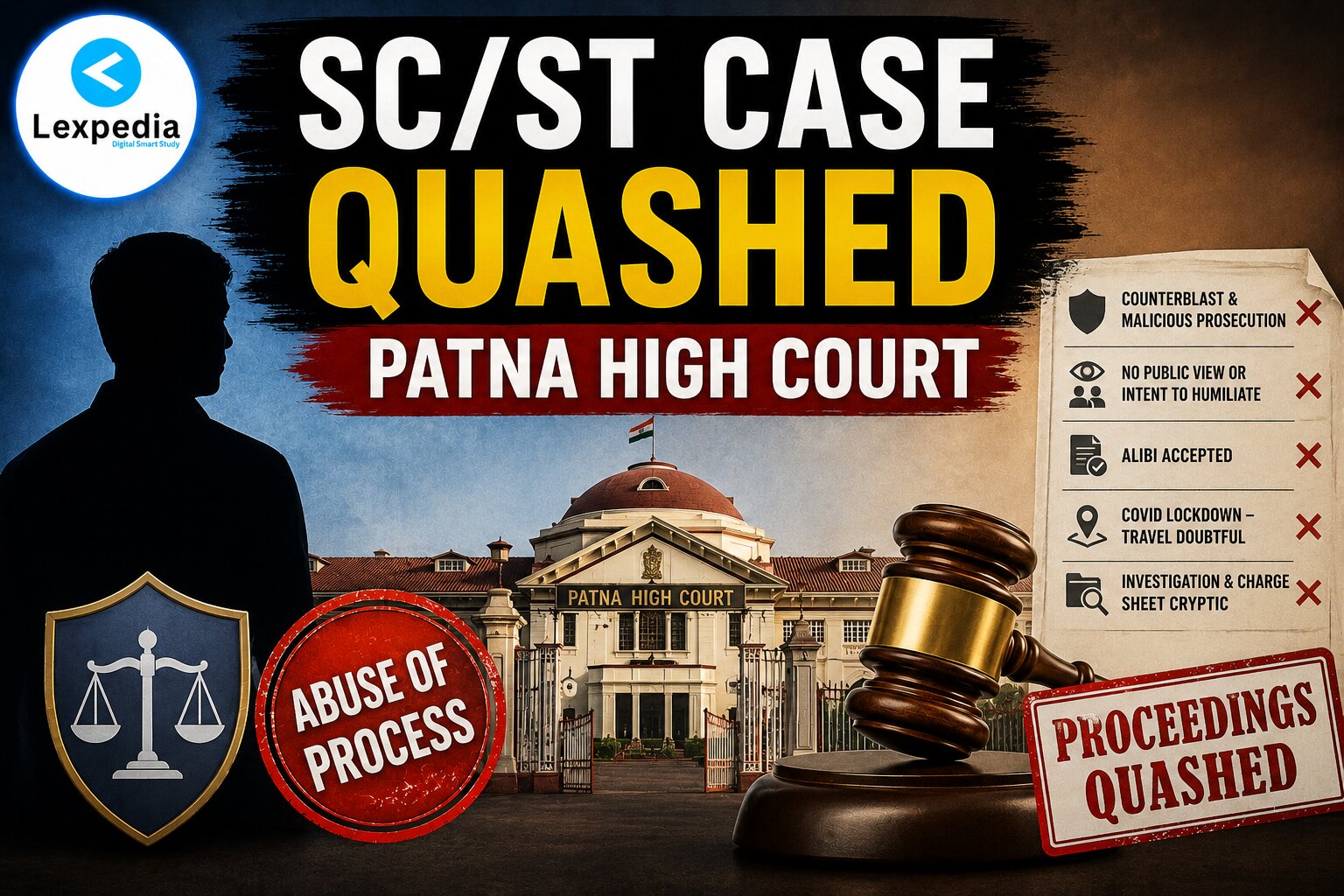
The Court held that the FIR appeared to be a counterblast and malicious prosecution.
-
It observed that the allegations under the SC/ST Act did not prima facie satisfy the requirement of public view and intent to humiliate.
-
The Court accepted the accused’s alibi based on unimpeachable electronic and documentary evidence.
-
It noted that the accused were residing in Jaipur and that travel to Bihar during the COVID-19 lockdown made the allegations doubtful.
-
The investigation and charge sheet were criticized as “cryptic and perfunctory”.
-
The Court held that continuation of proceedings would amount to abuse of process of law.
-
Accordingly, the Court quashed the cognizance order and entire criminal proceedings.
Held
-
Criminal proceedings were quashed.
-
Cognizance order dated 27.09.2023 was set aside.
Analysis
-
The Court applied the principle that criminal law cannot be used as a tool for vendetta or counter-litigation pressure.
-
It emphasized strict interpretation of the SC/ST Act, particularly the requirement that caste-based insults must occur in public view with intent to humiliate.
-
The judgment highlights the importance of credible documentary and electronic evidence at the quashing stage under Section 482 CrPC principles.
-
The Court also considered contextual improbability (COVID-19 lockdown restrictions and long-distance travel) to assess credibility of allegations.
-
It reflects judicial concern over misuse of penal provisions in matrimonial and property disputes.
-
The decision reinforces that courts can intervene at an early stage to prevent abuse of process and malicious prosecution.