
Anand Narayan Shukla v. Jagat Dhari, 2026
It strengthens the interpretation of Section 28 of the Specific Relief Act as conferring continuing supervisory jurisdiction on the court that passed the decree.
Judgement Details
Court
Supreme Court of India
Date of Decision
9 May 2026
Judges
Justice Manoj Misra and Justice Manmohan
Citation
Acts / Provisions
Facts of the Case
-
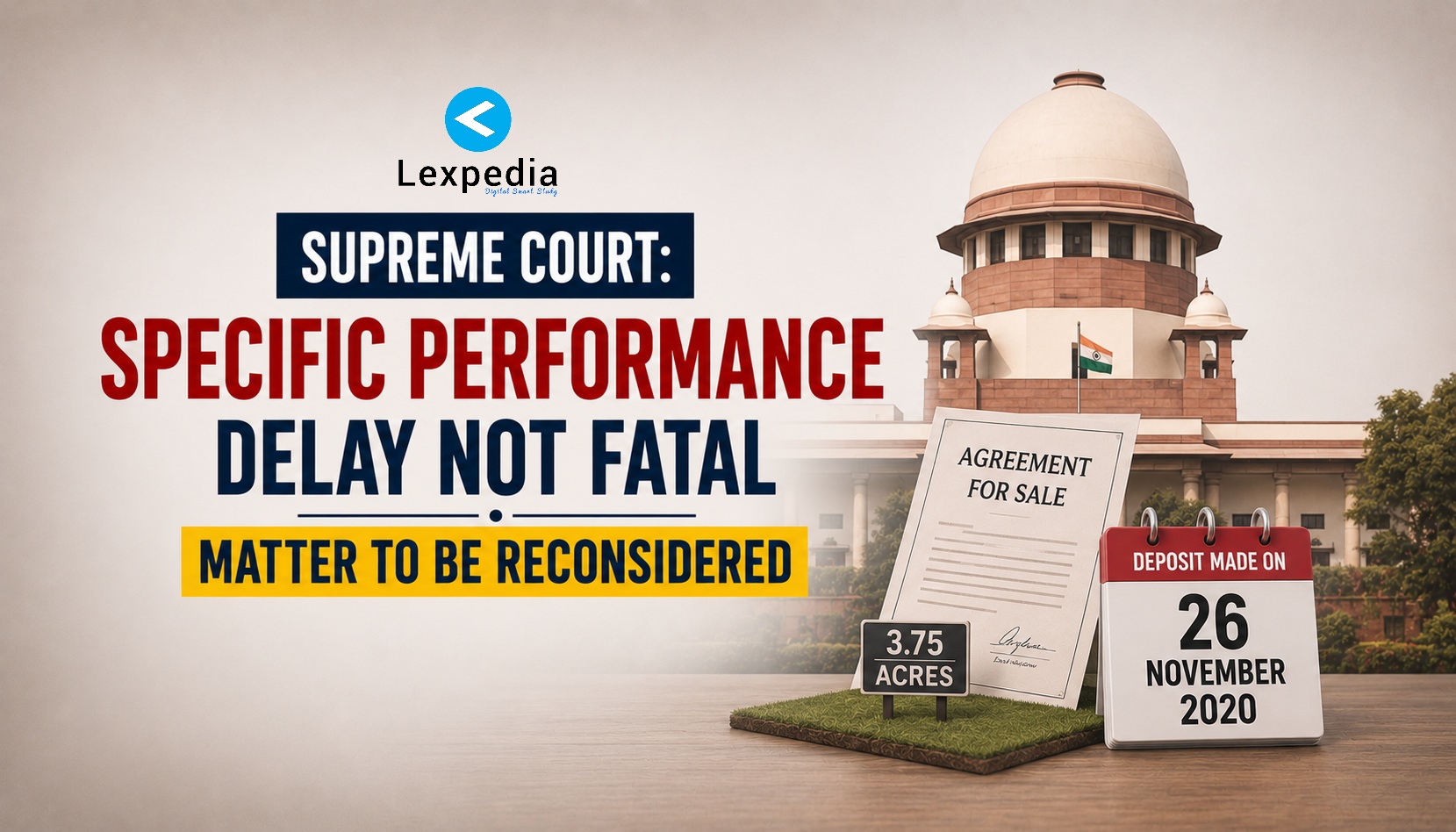
The dispute originated from a 2011 agreement for sale of immovable property measuring 3.75 acres, agreed at a rate of ₹16 lakh per acre.
-
The seller agreed to transfer the property, and the purchaser sought specific performance when the contract was not completed.
-
The trial court, by its decree dated 3 March 2017, granted specific performance and directed the purchaser to deposit/pay the balance sale consideration of ₹57.5 lakh within one month.
-
The decree-holder initiated steps toward execution and issued a notice seeking execution of the sale deed within the stipulated period.
-
However, the actual deposit of the balance amount was made only on 26 November 2020, after repeated directions by the execution court.
-
The execution court dismissed the execution petition on the ground that the decree-holder failed to comply with the time condition.
-
The High Court upheld this dismissal.
-
The decree-holder argued before the Supreme Court that:
-
delay was not deliberate,
-
the seller had also challenged the decree,
-
Covid-19 lockdown contributed to delay,
-
under Section 28 of the Specific Relief Act, courts have power to extend time.
-
-
The respondent argued that the delay was inordinate and showed lack of diligence, disentitling the decree-holder to equitable relief.
Issues
-
Whether failure to deposit the balance consideration within the time fixed in a decree for specific performance leads to automatic rescission of the decree?
-
Whether courts retain jurisdiction under Section 28 of the Specific Relief Act to extend time for payment even after expiry of the period fixed in the decree?
-
Whether execution proceedings can be dismissed without examining equitable considerations and conduct of parties?
-
Whether the conduct of the decree-holder reflects wilful negligence or abandonment of contractual obligations, justifying rescission under Section 28?
-
Whether external circumstances such as Covid-19 pandemic and pending appellate proceedings can be considered while deciding extension of time in execution of decree for specific performance?
Judgement
-
The Supreme Court held that a decree for specific performance is not a rigid final decree, but remains under the continuous supervisory jurisdiction of the court until execution is completed.
-
The Court clarified that there is no automatic rescission of a decree merely because the purchaser failed to deposit the amount within the time fixed.
-
Similarly, there is also no automatic extension of time, and the court must exercise discretion based on facts and equity.
-
The Court found that both the execution court and the High Court failed to properly apply the principles under Section 28 of the Specific Relief Act.
-
The matter required reconsideration to determine whether extension of time should be granted after balancing equities between the parties.
Held
-
A decree for specific performance remains under the continuing jurisdiction of the court until it is fully executed.
-
There is neither automatic rescission nor automatic extension of time upon expiry of the period fixed in the decree.
-
Courts must decide applications under Section 28 SRA based on equitable principles, conduct of parties, and surrounding circumstances.
-
Mere delay in deposit is not sufficient; the court must examine whether there is wilful negligence or lack of bona fide intention.
-
The matter was remanded for fresh consideration regarding extension of time and equitable relief.
Analysis
-
The judgment reinforces that specific performance is an equitable remedy, and therefore cannot be enforced in a purely mechanical or technical manner.
-
It strengthens the interpretation of Section 28 of the Specific Relief Act as conferring continuing supervisory jurisdiction on the court that passed the decree.
-
The Court emphasized that execution courts must not dismiss proceedings solely on the basis of delay in compliance, without examining the broader factual context.
-
At the same time, it protects the rights of the judgment-debtor by holding that long unexplained delays, coupled with lack of diligence, may justify rescission.
-
The ruling strikes a balance between:
-
enforcement of contractual rights of the purchaser, and
-
protection of the seller from prolonged uncertainty.
-
-
It also clarifies that procedural flexibility exists in seeking extension, and even oral requests for extension of time may be entertained in appropriate cases.
-
Overall, the judgment promotes a justice-oriented, equity-driven approach in execution of specific performance decrees.