Supreme Court Dismisses Challenge to BNSS Provision on Appointment of Judicial Officers as Directors of Prosecution
Lexpedia · 24 February 2026 · 3 min read
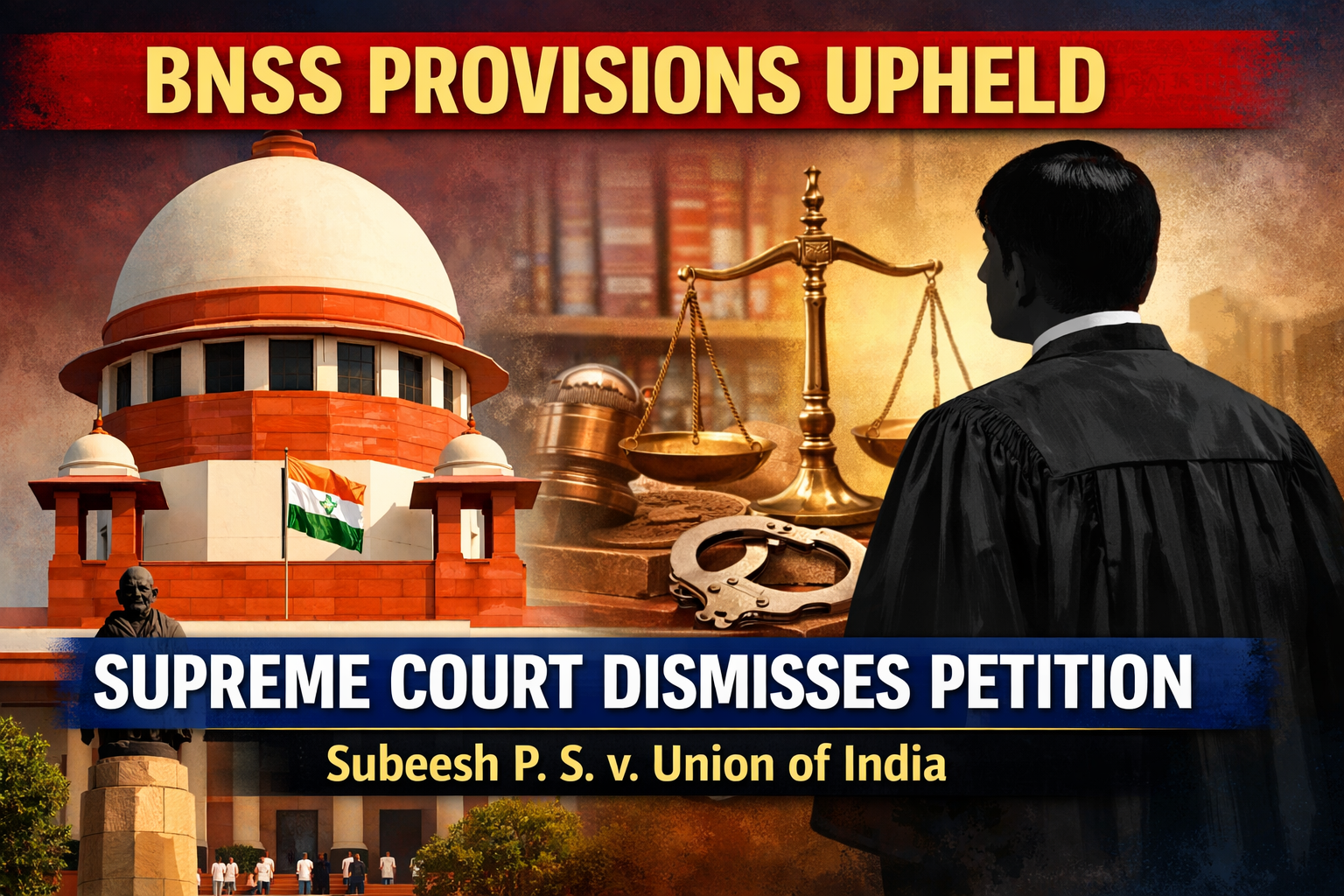
The Supreme Court of India on Wednesday dismissed a writ petition challenging the constitutional validity of Sections 20(2)(a) and 20(2)(b) of the Bharatiya Nagarik Suraksha Sanhita, 2023 (BNSS), which permit the appointment of judicial officers as Director of Prosecution, Deputy Director of Prosecution, and Assistant Director of Prosecution.
A Bench comprising Chief Justice of India Surya Kant, Justice Joymalya Bagchi, and Justice Vipul Pancholi observed that the challenge was misconceived and lacked any legal foundation.
Background of the Petition
The petition was filed by Advocate Subeesh P. S. through Advocate-on-Record Suvidutt Sundaram. The plea contended that the impugned provisions violate Article 50 of the Constitution, which mandates the separation of the judiciary from the executive, and Article 235, which vests control over the subordinate judiciary in the High Courts. It was further argued that the provisions infringe Articles 14 and 21, thereby undermining equality before law and the right to a fair trial.
According to the petitioner, permitting serving or retired judicial officers to occupy leadership positions in a Directorate functioning under the administrative control of the State Home Department blurs the constitutionally mandated separation of powers and erodes prosecutorial autonomy.
Impugned Provisions Under Section 20 BNSS
Section 20(2)(a) provides that a person is eligible to be appointed as Director of Prosecution or Deputy Director of Prosecution if he has been in practice as an advocate for not less than fifteen years or is or has been a Sessions Judge. Section 20(2)(b) similarly provides that a person is eligible to be appointed as Assistant Director of Prosecution if he has practiced as an advocate for not less than seven years or has been a Magistrate of the First Class.
The principal objection raised by the petitioner concerned the phrase “is or has been a Sessions Judge”, which, it was argued, could enable a serving judicial officer to assume an executive prosecutorial role, thereby compromising judicial independence.
Arguments Advanced Before the Court
The petitioner submitted that the impugned provisions revive a colonial-era model under the Criminal Procedure Codes of 1861, 1872, 1882 and 1898, where executive and judicial functions were fused. It was argued that this model was consciously dismantled post-Independence through Articles 50 and 235 of the Constitution and the Code of Criminal Procedure, 1973.
It was further contended that since the Directorate of Prosecution functions under the Home Department, and exercises supervisory control over Public Prosecutors and related prosecutorial officers, the structure results in a merging of executive, prosecutorial and judicial functions, thereby affecting the basic structure of the Constitution.
Court’s Observations
During the hearing, the Chief Justice questioned the basis of the challenge, observing that a person who has been a Sessions Judge may be better equipped than a practicing advocate for such a role. When counsel argued that the word “is” permitted appointment of a serving Sessions Judge, the Bench clarified that the provision merely prescribes eligibility criteria and does not contemplate a judge simultaneously holding judicial office and a prosecutorial post.
The Chief Justice remarked that the only requirement is that a person cannot function as a judge and prosecutor at the same time. Justice Bagchi also observed that the provision concerns eligibility and not simultaneous holding of offices.
Supreme Court’s Decision
Dismissing the writ petition, the Court held that the challenge on the ground of violation of constitutional provisions had no foundation. The Bench therefore upheld the validity of Sections 20(2)(a) and 20(2)(b) of the BNSS.
Case Title: Subeesh P. S. v. Union of India