President Promulgates Ordinance To Increase Supreme Court Judge Strength By Four
Lexpedia News · 17 May 2026 · 7 min read
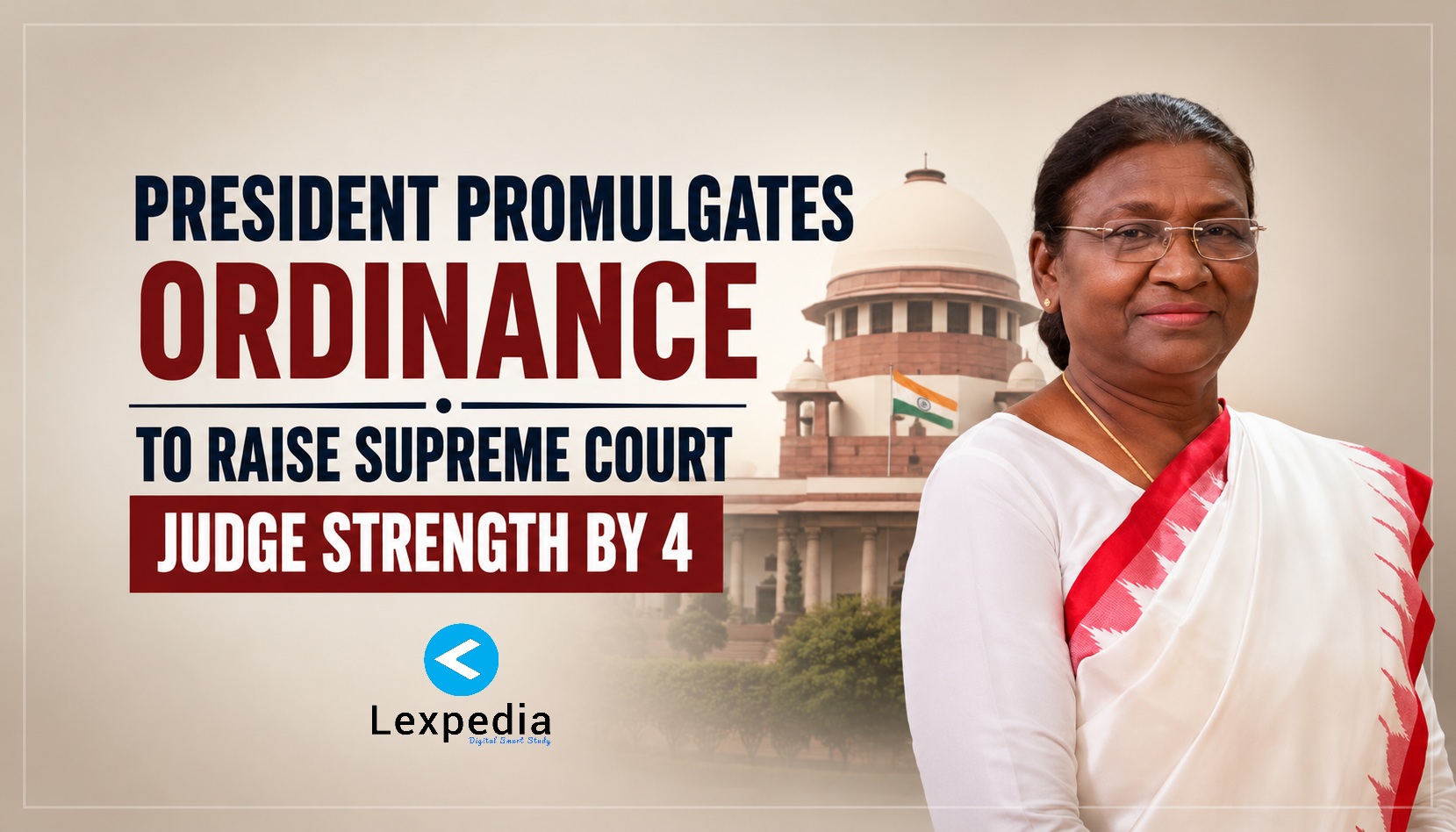
In a significant move aimed at addressing the mounting pendency of cases in the judiciary, President Droupadi Murmu has promulgated the Supreme Court (Number of Judges) Amendment Ordinance, 2026, increasing the sanctioned strength of judges in the Supreme Court of India from 33 to 37, excluding the Chief Justice of India (CJI). With this amendment, the apex court will now have a total sanctioned strength of 38 judges including the CJI.
The Ordinance was officially notified in the Gazette of India on May 16 and has been promulgated under Article 123 of the Constitution, which empowers the President to issue ordinances when Parliament is not in session. The new ordinance amends Section 2 of the Supreme Court (Number of Judges) Act, 1956 by replacing the existing figure “33” with “37”.
The development comes just days after the Union Cabinet, chaired by Prime Minister Narendra Modi, approved a proposal on May 5 to increase the strength of Supreme Court judges by four. The Cabinet had cleared the proposal for introduction of the Supreme Court (Number of Judges) Amendment Bill, 2026 in Parliament.
According to the Union Government, the increase in judicial strength is intended to help the Supreme Court deal more effectively with the growing backlog of cases and ensure faster delivery of justice. Reports indicate that the Supreme Court currently has more than 92,000 pending cases, leading to concerns over delays in hearings and disposal of matters.
Union Minister of State (Independent Charge) for Law and Justice Arjun Ram Meghwal announced the promulgation of the ordinance through a public statement, emphasizing that the additional judicial posts would improve the efficiency and functioning of the apex court. The government has stated that the expenditure on salaries, infrastructure, staff, and related facilities for the additional judges will be met from the Consolidated Fund of India.
The Supreme Court’s strength has been revised multiple times since independence in response to increasing litigation and expanding judicial responsibilities. When the Supreme Court was established in 1950, it originally consisted of the Chief Justice of India and seven other judges. Parliament later enacted the Supreme Court (Number of Judges) Act, 1956, fixing the number of judges at 10 excluding the CJI. The sanctioned strength was subsequently increased through amendments in 1960, 1977, 1986, 2008, and most recently in 2019, when the number of judges was raised from 30 to 33 excluding the CJI.
Legal experts believe the addition of four more judges may help reduce delays in listing and disposal of cases, particularly in matters involving constitutional benches, commercial disputes, criminal appeals, and public interest litigation. However, experts have also pointed out that merely increasing the sanctioned strength may not be sufficient unless judicial vacancies are filled promptly and supporting judicial infrastructure is simultaneously expanded.
The ordinance is also expected to accelerate the process of fresh appointments to the Supreme Court through the collegium system. Under the current constitutional framework, appointments to the apex court are made by the President on the recommendation of the Supreme Court Collegium headed by the CJI. Once the amended law formally comes into force, the collegium can recommend names for appointment against the newly created judicial posts.
The move assumes significance at a time when concerns regarding judicial delays and pendency continue to dominate legal and policy discussions across the country. Several constitutional courts, including High Courts, are presently functioning with substantial vacancies, while demands for judicial reforms and increased judge-to-population ratios have intensified in recent years.
The promulgation of the ordinance is likely to be followed by the introduction and passage of a formal amendment bill in Parliament during its next session, as ordinances must receive parliamentary approval within the constitutionally prescribed time period to remain in force.
राष्ट्रपति ने सुप्रीम कोर्ट में चार अतिरिक्त न्यायाधीशों की नियुक्ति हेतु अध्यादेश जारी किया
न्यायपालिका में लंबित मामलों के बढ़ते बोझ को कम करने की दिशा में एक महत्वपूर्ण कदम उठाते हुए राष्ट्रपति द्रौपदी मुर्मू ने सुप्रीम कोर्ट (न्यायाधीशों की संख्या) संशोधन अध्यादेश, 2026 जारी कर दिया है। इस अध्यादेश के माध्यम से सुप्रीम कोर्ट में न्यायाधीशों की स्वीकृत संख्या 33 से बढ़ाकर 37 कर दी गई है, जिसमें भारत के मुख्य न्यायाधीश (CJI) शामिल नहीं हैं। अब CJI सहित सुप्रीम कोर्ट की कुल स्वीकृत न्यायाधीश संख्या 38 हो जाएगी।
यह अध्यादेश 16 मई को राजपत्र (Gazette of India) में अधिसूचित किया गया। इसे संविधान के अनुच्छेद 123 के तहत जारी किया गया है, जो संसद का सत्र न चलने की स्थिति में राष्ट्रपति को अध्यादेश जारी करने का अधिकार देता है। नए अध्यादेश के तहत सुप्रीम कोर्ट (न्यायाधीशों की संख्या) अधिनियम, 1956 की धारा 2 में संशोधन करते हुए “33” की जगह “37” शब्द प्रतिस्थापित किया गया है।
यह घटनाक्रम उस निर्णय के कुछ ही दिनों बाद सामने आया है जब प्रधानमंत्री नरेंद्र मोदी की अध्यक्षता में हुई केंद्रीय मंत्रिमंडल की बैठक में सुप्रीम कोर्ट के न्यायाधीशों की संख्या चार बढ़ाने के प्रस्ताव को मंजूरी दी गई थी। मंत्रिमंडल ने इसके लिए सुप्रीम कोर्ट (न्यायाधीशों की संख्या) संशोधन विधेयक, 2026 संसद में पेश करने को भी स्वीकृति प्रदान की थी।
केंद्र सरकार के अनुसार, न्यायाधीशों की संख्या बढ़ाने का उद्देश्य सुप्रीम कोर्ट में लंबित मामलों के तेजी से निपटारे को सुनिश्चित करना और न्याय वितरण प्रणाली को अधिक प्रभावी बनाना है। रिपोर्ट्स के मुताबिक, वर्तमान में सुप्रीम कोर्ट में 92,000 से अधिक मामले लंबित हैं, जिससे सुनवाई और निर्णय में लगातार देरी को लेकर चिंता व्यक्त की जा रही है।
केंद्रीय विधि एवं न्याय राज्य मंत्री (स्वतंत्र प्रभार) अर्जुन राम मेघवाल ने सार्वजनिक बयान जारी कर अध्यादेश की जानकारी दी। उन्होंने कहा कि अतिरिक्त न्यायाधीशों की नियुक्ति से सर्वोच्च न्यायालय की कार्यक्षमता और न्यायिक दक्षता में सुधार होगा। सरकार ने स्पष्ट किया है कि नए न्यायाधीशों के वेतन, स्टाफ, बुनियादी ढांचे और अन्य सुविधाओं पर होने वाला खर्च भारत की संचित निधि (Consolidated Fund of India) से वहन किया जाएगा।
स्वतंत्रता के बाद से सुप्रीम कोर्ट में न्यायाधीशों की संख्या समय-समय पर बढ़ाई जाती रही है। जब वर्ष 1950 में सुप्रीम कोर्ट की स्थापना हुई थी, तब इसमें मुख्य न्यायाधीश सहित कुल 8 न्यायाधीश थे। बाद में संसद ने सुप्रीम कोर्ट (न्यायाधीशों की संख्या) अधिनियम, 1956 पारित कर न्यायाधीशों की संख्या 10 निर्धारित की थी। इसके बाद 1960, 1977, 1986, 2008 और 2019 में संशोधनों के माध्यम से न्यायाधीशों की संख्या क्रमशः बढ़ाई गई। वर्ष 2019 में इसे 30 से बढ़ाकर 33 किया गया था, CJI को छोड़कर।
कानूनी विशेषज्ञों का मानना है कि चार अतिरिक्त न्यायाधीशों की नियुक्ति से संवैधानिक पीठों, वाणिज्यिक विवादों, आपराधिक अपीलों और जनहित याचिकाओं जैसे मामलों की सुनवाई और निपटारे में तेजी आ सकती है। हालांकि, विशेषज्ञों ने यह भी कहा है कि केवल स्वीकृत पदों की संख्या बढ़ाना पर्याप्त नहीं होगा, जब तक कि रिक्त पदों को शीघ्र नहीं भरा जाता और न्यायिक बुनियादी ढांचे का समानांतर विस्तार नहीं किया जाता।
इस अध्यादेश के बाद सुप्रीम कोर्ट में नई नियुक्तियों की प्रक्रिया भी तेज होने की संभावना है। वर्तमान संवैधानिक व्यवस्था के तहत सुप्रीम कोर्ट के न्यायाधीशों की नियुक्ति राष्ट्रपति द्वारा सुप्रीम कोर्ट कॉलेजियम की सिफारिश पर की जाती है, जिसकी अध्यक्षता CJI करते हैं। संशोधित कानून लागू होने के बाद कॉलेजियम नए पदों के लिए न्यायाधीशों के नामों की सिफारिश कर सकेगा।
यह कदम ऐसे समय उठाया गया है जब देशभर में न्यायिक लंबित मामलों और न्यायिक सुधारों को लेकर बहस तेज है। कई हाई कोर्ट अभी भी बड़ी संख्या में रिक्तियों के साथ कार्य कर रहे हैं, जबकि न्यायपालिका में जज-जनसंख्या अनुपात बढ़ाने की मांग लगातार उठती रही है।
संविधान के प्रावधानों के अनुसार, अध्यादेश को प्रभावी बनाए रखने के लिए संसद के अगले सत्र में इसे विधेयक के रूप में पेश कर पारित कराना आवश्यक होगा। यदि निर्धारित अवधि के भीतर संसद की मंजूरी नहीं मिलती है, तो अध्यादेश स्वतः निष्प्रभावी हो जाएगा।