Madras High Court Says Cow Slaughter On Bakrid Is Not Essential Religious Practice; Directs Strict Enforcement Of Ban
Lexpedia News · 27 May 2026 · 5 min read
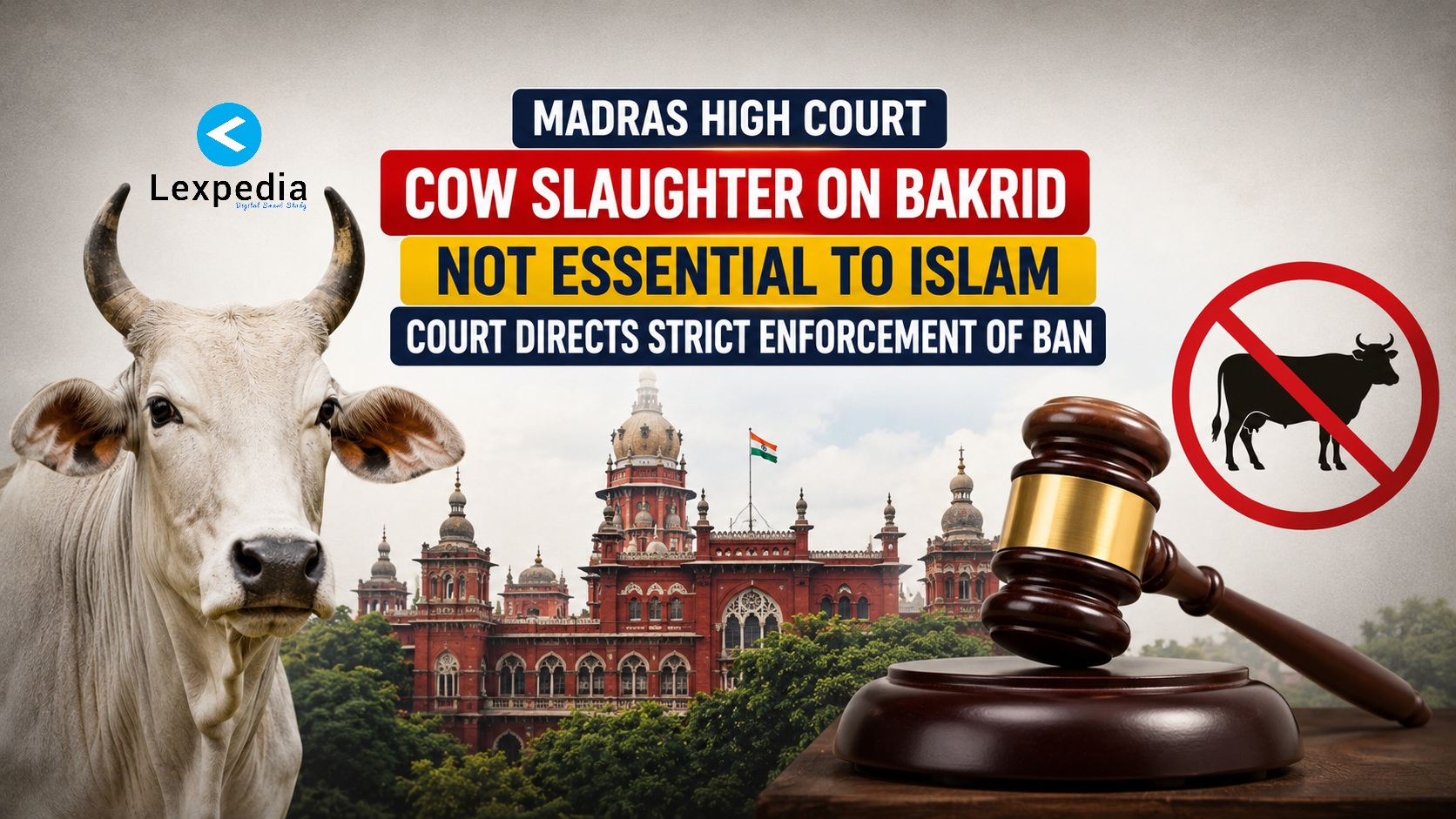
The Madras High Court has reportedly observed that cow slaughter during Bakrid is not an essential religious practice in Islam, while directing authorities to ensure strict enforcement of existing legal prohibitions relating to cow slaughter in the State.
The observations came during the hearing of petitions concerning prevention of cow slaughter ahead of the Bakrid (Eid-ul-Adha) festival. According to legal reports, the Court emphasized that statutory restrictions enacted under State law must be implemented effectively and uniformly by the authorities.
As per reports, the Bench reportedly noted that while the Constitution guarantees the right to freely practice religion under Article 25, such protection is subject to public order, morality, health, and other constitutional limitations. The Court is said to have observed that sacrifice of a cow is not an indispensable or mandatory religious requirement under Islamic law.
The Court reportedly referred to earlier judicial precedents, including decisions of the Supreme Court of India, which have examined the doctrine of “essential religious practices” in relation to cow slaughter and Bakrid sacrifices.
According to reports, the Court stated that Muslims are permitted to sacrifice other animals permissible under law and therefore prohibition on cow slaughter cannot automatically be treated as an infringement of religious freedom.
The Court also reportedly emphasized the constitutional significance of Article 48 of the Constitution of India, a Directive Principle which calls upon the State to take steps for preserving and improving breeds and prohibiting slaughter of cows and calves and other milch and draught cattle.
The matter was reportedly heard in the backdrop of concerns raised regarding illegal transportation and slaughter of cows during the festival period.
Reports indicate that the Court directed State authorities, including police and local administrative officials, to ensure effective monitoring and strict implementation of the relevant provisions of the Tamil Nadu Animal Preservation Act and related legal frameworks.
The Court is also said to have instructed authorities to take preventive measures against illegal slaughter activities and ensure that violations are dealt with in accordance with law.
Legal experts note that Indian courts have repeatedly dealt with constitutional challenges involving:
- Religious freedom under Article 25
- Animal preservation laws
- Public order considerations
- Directive Principles of State Policy
- The doctrine of essential religious practices
The issue of cow slaughter has historically remained politically, socially, and constitutionally sensitive in India. Several States have enacted legislation imposing varying degrees of prohibition or regulation on cow slaughter.
The Supreme Court of India in earlier landmark rulings has upheld the constitutional validity of several anti-cow slaughter legislations enacted by States, observing that such laws can be justified in light of agricultural, economic, and constitutional considerations.
At present, publicly available reports indicate that the Madras High Court’s directions relate to enforcement of already existing statutory provisions rather than creation of any entirely new prohibition framework.
The ruling is likely to generate significant legal and political discussion concerning the balance between religious freedoms and statutory animal preservation measures within the constitutional structure.
मद्रास हाई कोर्ट ने कहा — बकरीद पर गौहत्या इस्लाम की अनिवार्य धार्मिक प्रथा नहीं; प्रतिबंध के सख्त पालन का निर्देश
मद्रास हाई कोर्ट ने कथित रूप से कहा है कि बकरीद (ईद-उल-अज़हा) के अवसर पर गौहत्या इस्लाम की अनिवार्य धार्मिक प्रथा (Essential Religious Practice) नहीं है। अदालत ने राज्य में लागू गौहत्या प्रतिबंध संबंधी कानूनों के सख्त पालन का भी निर्देश दिया है।
रिपोर्टों के अनुसार, यह टिप्पणी बकरीद से पहले गौहत्या रोकने संबंधी याचिकाओं की सुनवाई के दौरान की गई। अदालत ने कथित रूप से कहा कि राज्य के कानूनों के तहत लगाए गए प्रतिबंधों को प्रशासन द्वारा प्रभावी और समान रूप से लागू किया जाना आवश्यक है।
रिपोर्टों के अनुसार, पीठ ने कहा कि संविधान का अनुच्छेद 25 नागरिकों को धर्म का पालन करने की स्वतंत्रता प्रदान करता है, लेकिन यह अधिकार लोक व्यवस्था, नैतिकता, स्वास्थ्य, और अन्य संवैधानिक सीमाओं के अधीन है। अदालत ने कथित रूप से यह भी कहा कि इस्लामी कानून के तहत गाय की कुर्बानी कोई अपरिहार्य या अनिवार्य धार्मिक आवश्यकता नहीं है।
अदालत ने कथित रूप से सुप्रीम कोर्ट ऑफ इंडिया के पूर्व निर्णयों का भी उल्लेख किया, जिनमें “Essential Religious Practices” सिद्धांत के संदर्भ में गौहत्या और बकरीद कुर्बानी के प्रश्नों की जांच की गई थी।
रिपोर्टों के अनुसार, अदालत ने कहा कि मुस्लिम समुदाय कानून द्वारा अनुमत अन्य पशुओं की कुर्बानी दे सकता है और इसलिए गौहत्या पर प्रतिबंध को स्वतः धार्मिक स्वतंत्रता का उल्लंघन नहीं माना जा सकता।
अदालत ने संविधान के अनुच्छेद 48 के महत्व पर भी जोर दिया, जो राज्य के नीति-निर्देशक तत्वों (Directive Principles of State Policy) का हिस्सा है और राज्य को गायों, बछड़ों तथा दुग्ध एवं कृषि उपयोगी पशुओं के संरक्षण और उनके वध पर रोक लगाने हेतु कदम उठाने का निर्देश देता है।
मामले की सुनवाई कथित रूप से त्योहार के दौरान गायों के अवैध परिवहन और वध को लेकर उठी चिंताओं की पृष्ठभूमि में हुई।
रिपोर्टों के अनुसार, अदालत ने राज्य प्रशासन, पुलिस और स्थानीय अधिकारियों को Tamil Nadu Animal Preservation Act तथा संबंधित कानूनों के सख्ती से पालन और प्रभावी निगरानी सुनिश्चित करने का निर्देश दिया।
अदालत ने कथित रूप से अधिकारियों को अवैध गौहत्या रोकने हेतु निवारक कदम उठाने और कानून उल्लंघन के मामलों में विधि अनुसार कार्रवाई सुनिश्चित करने के निर्देश भी दिए।
कानूनी विशेषज्ञों का कहना है कि भारतीय अदालतें समय-समय पर निम्नलिखित संवैधानिक मुद्दों पर विचार करती रही हैं:
- अनुच्छेद 25 के तहत धार्मिक स्वतंत्रता
- पशु संरक्षण कानून
- लोक व्यवस्था संबंधी प्रश्न
- राज्य के नीति-निर्देशक तत्व
- तथा Essential Religious Practices सिद्धांत
भारत में गौहत्या का मुद्दा लंबे समय से राजनीतिक, सामाजिक और संवैधानिक रूप से अत्यंत संवेदनशील विषय रहा है। कई राज्यों ने गौहत्या पर विभिन्न स्तरों के प्रतिबंध लगाने वाले कानून बनाए हैं।
सुप्रीम कोर्ट ऑफ इंडिया ने पूर्व के महत्वपूर्ण फैसलों में विभिन्न राज्यों द्वारा बनाए गए गौहत्या-रोधी कानूनों की संवैधानिक वैधता को बरकरार रखा है। अदालत ने माना था कि ऐसे कानून कृषि, आर्थिक तथा संवैधानिक दृष्टिकोण से उचित ठहराए जा सकते हैं।
फिलहाल उपलब्ध रिपोर्टों के अनुसार, मद्रास हाई कोर्ट के निर्देश मुख्यतः पहले से लागू कानूनों के प्रभावी प्रवर्तन से संबंधित हैं, न कि किसी नए प्रतिबंधात्मक ढांचे के निर्माण से।
यह फैसला धार्मिक स्वतंत्रता और पशु संरक्षण संबंधी वैधानिक उपायों के बीच संतुलन को लेकर व्यापक कानूनी और राजनीतिक बहस को जन्म दे सकता है।