
XXX v. State of Haryana, 2026
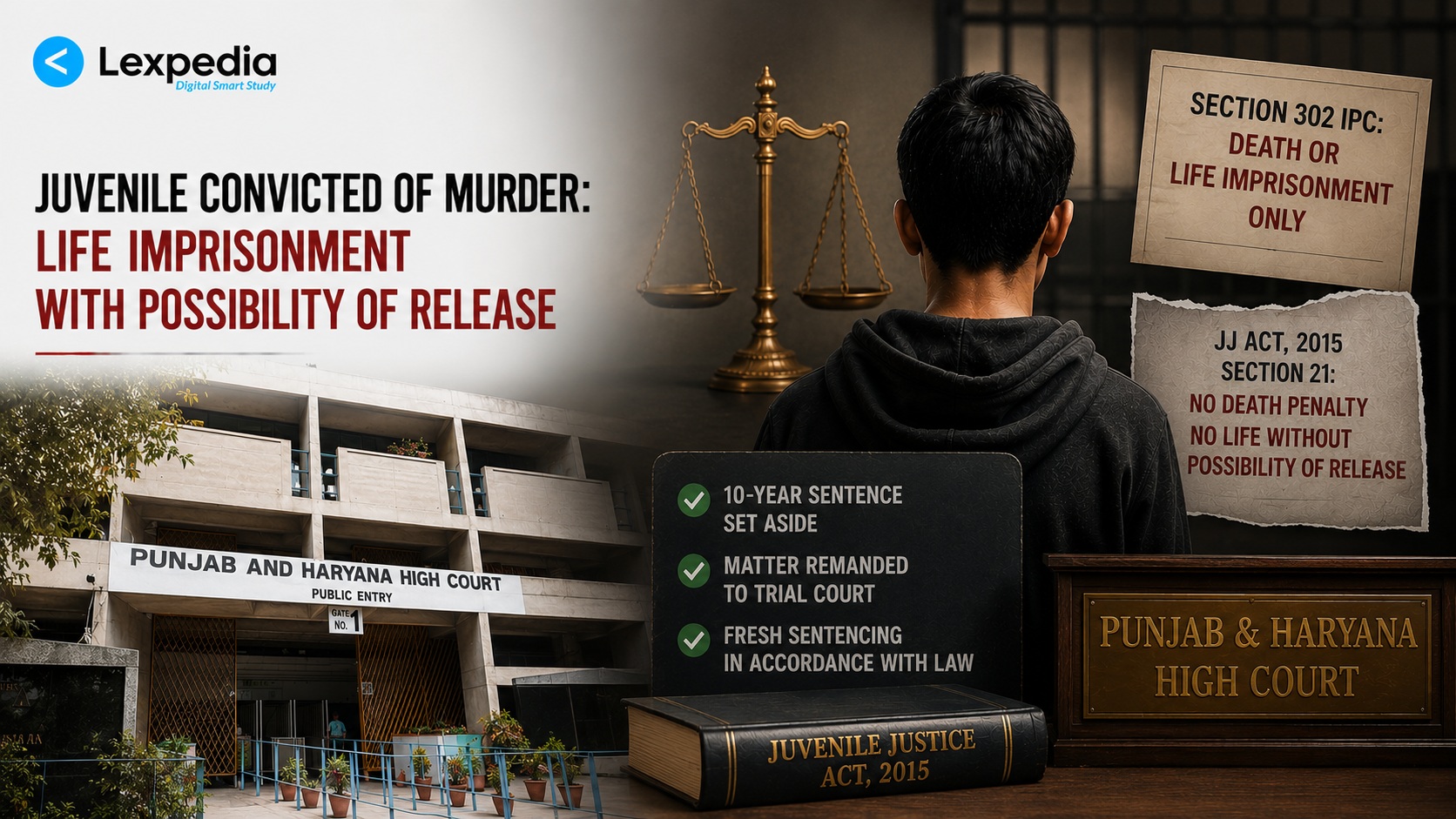
A child tried as an adult for murder can only be sentenced to life imprisonment with possibility of release, not a fixed term.
Judgement Details
Court
Punjab and Haryana High Court
Date of Decision
12 May 2026
Judges
Justice Anoop Chitkara & Justice Sukhvinder Kaur
Citation
Acts / Provisions
Facts of the Case
-
The appellant was convicted under Sections 302, 506 read with Section 34 IPC in an FIR registered in 2022.
-
The trial court treated the accused as a child in conflict with law, but tried him as an adult under Section 19 of the Juvenile Justice Act, 2015.
-
The trial court imposed:
-
10 years rigorous imprisonment for murder under Section 302 IPC
-
6 months imprisonment under Section 506 IPC
-
-
The appellant challenged the sentencing before the Punjab and Haryana High Court.
-
It was argued that the sentence was legally unsustainable as Section 302 IPC does not permit a fixed-term sentence.
Issues
-
Whether a fixed sentence of 10 years can be imposed for an offence under Section 302 IPC?
-
Whether sentencing a juvenile tried as an adult can deviate from statutory punishments prescribed under murder law?
-
Whether Section 21 of the Juvenile Justice Act permits life imprisonment without possibility of release for a child in conflict with law?
-
Whether the trial court committed a legal error in imposing a sentence not recognised under law?
-
Whether the matter should be remanded for reconsideration of sentence in compliance with juvenile justice principles?
Judgement
-
The Punjab and Haryana High Court held that the 10-year sentence under Section 302 IPC is ex facie illegal.
-
The Court observed that Section 302 IPC prescribes only two punishments:
-
Death penalty, or
-
Imprisonment for life
-
-
The Court clarified that no statutory basis exists for a fixed-term sentence of 10 years under Section 302 IPC.
-
The Bench held that the trial court had committed a fundamental sentencing error.
-
The Court examined the interplay between Sections 19 and 21 of the Juvenile Justice Act, 2015.
-
It clarified that even when a juvenile is tried as an adult, the sentence must comply with reformative principles of juvenile justice.
-
The Court held that under Section 21 of the Juvenile Justice Act, a child cannot be sentenced to:
-
Death penalty, or
-
Life imprisonment without possibility of release
-
-
The Court clarified that if convicted for murder, the only permissible sentence is life imprisonment with the possibility of release, not incarceration till natural life.
-
The Bench emphasised that the legislature intended to ensure reform and rehabilitation of children in conflict with law.
-
The Court found that the trial court had misinterpreted statutory provisions while imposing sentence.
-
However, instead of directly modifying the sentence, the High Court chose to remand the matter back to the trial court.
-
The Court reasoned that the accused must be given an opportunity to be heard on sentencing considerations.
-
It observed that imposing life imprisonment directly at the appellate stage could prejudice the rights of the accused under the Juvenile Justice framework.
-
Accordingly, the Court:
-
Set aside the 10-year sentence under Section 302 IPC
-
Remanded the matter to the trial court for fresh sentencing in accordance with law
-
Held
-
A 10-year sentence under Section 302 IPC is illegal and not permissible in law.
-
A child tried as an adult for murder can only be sentenced to life imprisonment with possibility of release, not a fixed term.
-
The sentencing order suffered from a fundamental legal defect.
-
The matter was remanded for re-sentencing in accordance with the Juvenile Justice Act.
Analysis
-
The judgment reinforces the strict sentencing framework under Section 302 IPC, which allows only death or life imprisonment.
-
It clarifies that courts cannot invent intermediate punishments not prescribed by statute.
-
The decision strengthens the reformative approach of juvenile justice law in India.
-
The Court emphasised the protective scope of the Juvenile Justice Act, 2015, even when juveniles are tried as adults.
-
The ruling ensures that children are not subjected to irreversible or excessively harsh punishments.
-
The decision highlights the importance of procedural fairness in sentencing, including the right to be heard.
-
The Court maintained a balance between correcting illegality and protecting the accused’s due process rights.
-
The remand approach reflects judicial caution in not directly imposing enhanced punishment without hearing the convict.
-
The judgment serves as a reminder that sentencing must strictly adhere to statutory limits.
-
It strengthens jurisprudence on the intersection of criminal law and juvenile justice principles.