
Sheikh Abedin v. Iqbal Ahmed & Anr., 2026
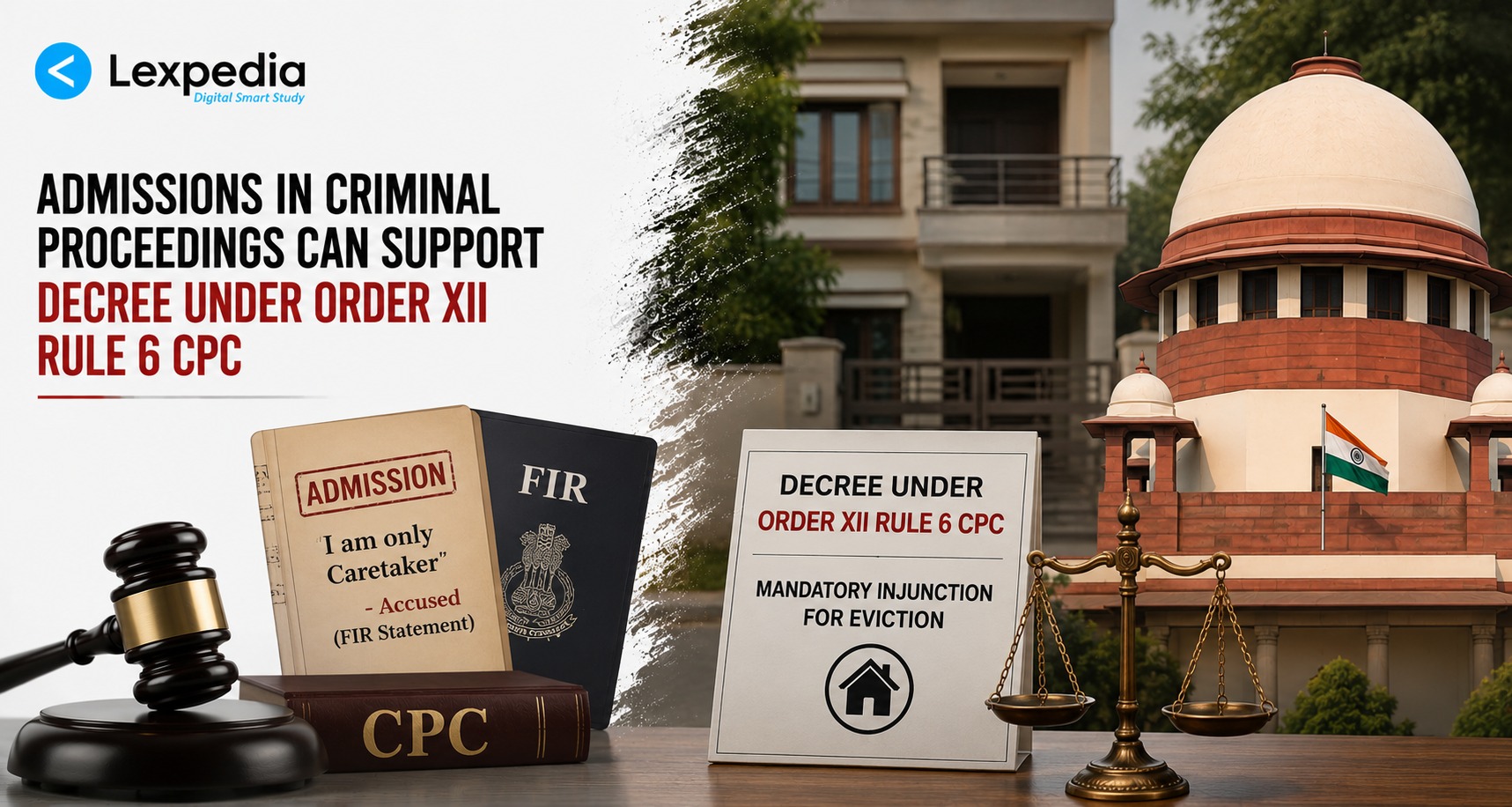
A decree under Order XII Rule 6 CPC can be passed on admissions made in pleadings or elsewhere, including criminal proceedings.
Judgement Details
Court
Supreme Court of India
Date of Decision
12 May 2026
Judges
Justice J.B. Pardiwala & Justice Ujjal Bhuyan
Citation
Acts / Provisions
Facts of the Case
-
The dispute concerned a suit property owned by the respondent.
-
The appellant-defendant was occupying the property and claimed certain rights over it.
-
In a criminal proceeding/FIR context, the appellant admitted that he was only a caretaker of the suit property.
-
Relying on this admission, the respondent filed a civil suit seeking mandatory injunction for eviction.
-
The Trial Court decreed the suit and directed the defendant to vacate the property under Order XII Rule 6 CPC.
-
The decree was upheld by the First Appellate Court and the High Court.
-
The defendant approached the Supreme Court, arguing that admissions made in criminal proceedings cannot be used in civil proceedings for judgment under Order XII Rule 6 CPC.
Issues
-
Whether an admission made in a criminal proceeding can be relied upon for passing judgment under Order XII Rule 6 CPC?
-
Whether admissions must necessarily be confined to pleadings in the civil suit?
-
Whether the admission made by the defendant that he was only a caretaker was clear and unequivocal for passing a decree?
-
Whether concurrent findings of lower courts warranted interference by the Supreme Court?
Judgement
- The Supreme Court dismissed the appeal and refused to interfere with the concurrent findings of the lower courts.
-
The Court held that a judgment under Order XII Rule 6 CPC can be based on admissions made not only in pleadings but also elsewhere.
-
The bench clarified that such admissions may be written or oral, and there is no restriction on the source of admission.
-
The Court observed that the only requirement is that the admission must be clear, unambiguous, and unequivocal.
-
It held that admissions made in criminal proceedings/FIR statements can also be relied upon in appropriate civil cases.
-
The Court found that the defendant’s admission that he was merely a caretaker was sufficient to establish the respondent’s claim.
-
The Court relied on Uttam Singh Duggal & Co. Ltd. v. United Bank of India to reiterate that Order XII Rule 6 CPC is intended for speedy justice based on clear admissions.
-
The Court emphasized that the provision enables a party to obtain relief without waiting for a full trial where facts are undisputed.
-
Accordingly, the Supreme Court upheld the decree directing the appellant to vacate the suit premises.
Held
- A decree under Order XII Rule 6 CPC can be passed on admissions made in pleadings or elsewhere, including criminal proceedings.
-
The only requirement is that the admission must be clear, unequivocal, and unconditional.
-
The appeal was dismissed, and eviction order was upheld.
Analysis
- The judgment strengthens the principle of judgment on admissions as a tool for speedy civil justice.
-
It clarifies that courts are not restricted to pleadings alone and may rely on extraneous admissions if reliable.
-
The ruling prevents parties from avoiding liability by taking contradictory positions in civil and criminal proceedings.
-
It reinforces judicial efficiency by reducing unnecessary trials where facts are already admitted.
-
The decision underscores that substance of admission matters more than its procedural source.
-
The Court reaffirmed the importance of clarity and unequivocal nature of admissions before passing summary judgment.
-
The ruling balances procedural flexibility with fairness, ensuring that only clear admissions are acted upon.
-
It also strengthens landlord/property rights in cases where occupation is admitted as caretaker or permissive possession.
-
The judgment is consistent with earlier Supreme Court jurisprudence on Order XII Rule 6 CPC.
-
Overall, it promotes expedited dispute resolution and judicial economy in civil litigation.