
Rajeev Singh @ Rajeev Kumar v. State of Bihar, 2026
The Court observed that the FIR appeared to be a subsequent version prepared afterthought.
Judgement Details
Court
Patna High Court
Date of Decision
7 May 2026
Judges
Justice Bibek Chaudhuri and Justice Ansul
Citation
Acts / Provisions
Facts of the Case
-
The informant (PW-3) lodged the FIR based on his fardbeyan.
-
On 17.02.2012 at about 8:30 PM, the informant and his brother were at their shop when:
-
Several co-villagers along with others arrived.
-
The accused persons asked the informant’s brother to accompany them.
-
The brother went with them.
-
-
The informant allegedly followed and witnessed:
-
The accused assaulting the deceased near a well.
-
The accused forcibly taking him away on a motorcycle.
-
-
The deceased could not be traced despite searches conducted during the night.
-
Allegation: murder due to a ₹5 lakh monetary dispute.
-
Trial court convicted the accused under Sections 302/34, 364/34, and 120B IPC.
Issues
-
Whether the prosecution has proved the guilt of the accused beyond reasonable doubt based on circumstantial evidence and last seen theory?
-
Whether contradictions in witness testimony affect the credibility of the prosecution case?
-
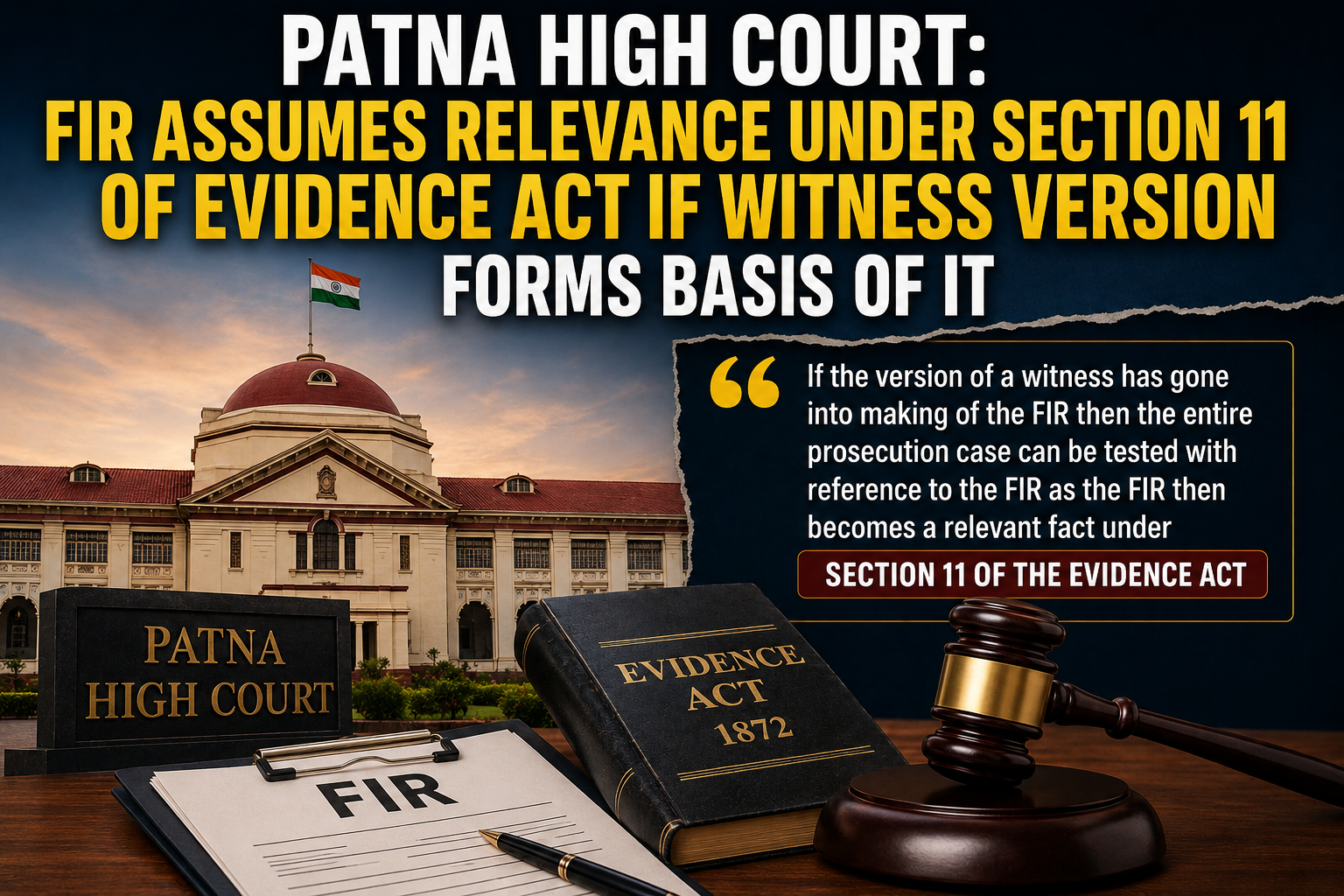
Whether the FIR assumes relevance under Section 11 of the Evidence Act when it is based on a witness’s version?
-
Whether failure to produce station diary entries and call detail records weakens the prosecution case?
-
Whether the prosecution established a complete chain of circumstantial evidence pointing to guilt?
Judgement
-
The Court found serious inconsistencies in witness testimony.
-
Witnesses failed to corroborate each other regarding presence at the place of occurrence.
-
There was a reasonable doubt about witness presence at the crime scene.
-
No contemporaneous records (station diary, CDRs) were produced.
-
The FIR showed discrepancies with the inquest report (no mention of accused names).
-
The Court observed that the FIR appeared to be a subsequent version prepared afterthought.
-
The prosecution failed to establish:
-
The “last seen” circumstance
-
A complete chain of circumstantial evidence
-
Held
-
The prosecution failed to prove the case beyond reasonable doubt.
-
The conviction and sentence were set aside.
-
The appeals were allowed, resulting in acquittal of the accused.
Analysis
-
The Court reaffirmed that FIR is not a substantive piece of evidence.
-
It can be used only for corroboration or contradiction.
-
Exception applied from Ram Kumar Pandey v. State of M.P., where FIR may gain relevance under Section 11 Evidence Act.
-
The Court emphasized the importance of a complete chain of circumstantial evidence.
-
Key investigative lapses noted:
-
Absence of station diary entries
-
Non-production of call detail records
-
Contradictions in witness statements
-
-
The judgment strongly relied on the principle of benefit of doubt.
-
It highlighted that the last seen theory alone is insufficient without corroboration.