
Harishchandra R Pednekar v. Bhaskar R Pednekar, 2026
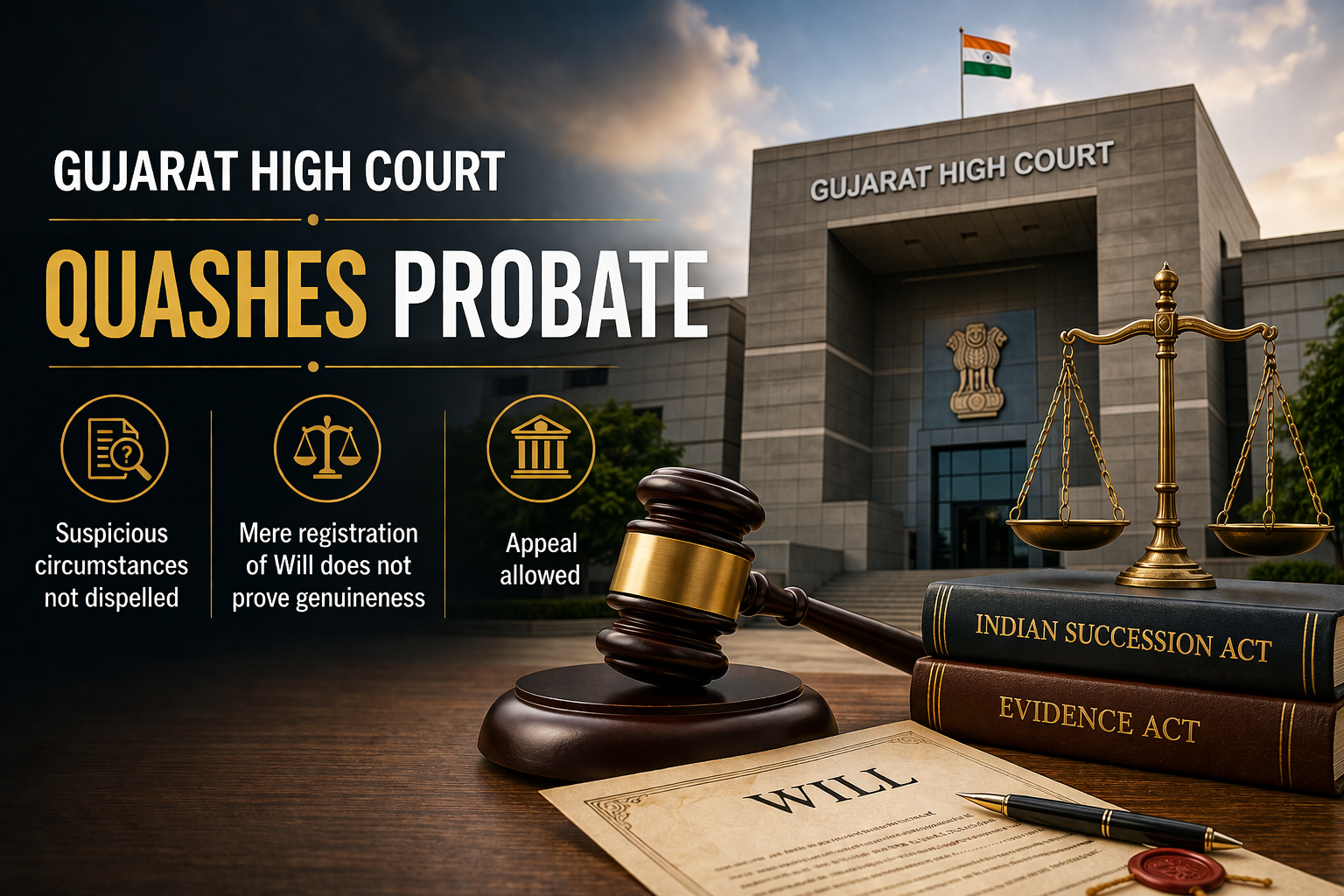
The judgment reinforces the principle that Proof of Will requires strict scrutiny, especially when suspicious circumstances exist.
Judgement Details
Court
Gujarat High Court
Date of Decision
5 May 2026
Judges
Justice J.C. Doshi
Citation
Acts / Provisions
Facts of the Case
-
The dispute revolved around the Genuineness of a Will allegedly executed by the deceased Ramchandra.
-
The plaintiff (beneficiary/propounder) claimed that the deceased executed the Will shortly before his death.
-
The deceased was suffering from Cancer (Malignancy of Jaw and Tongue) and had undergone Surgical Treatment.
-
The Will was allegedly executed 7 days prior to death and registered posthumously, raising suspicion.
-
The defendant contended that:
-
The Will was Fraudulent and Fabricated.
-
The deceased was not in a Sound and Disposing State of Mind.
-
The defendant had lawful possession and ownership of the property.
-
-
The Trial Court granted Probate in favour of the plaintiff.
-
The defendant challenged this decision before the High Court.
Issues
-
Whether the Will propounded by the plaintiff was genuine and validly executed under law?
-
Whether mere Registration of Will is sufficient to prove its genuineness?
-
Whether the plaintiff successfully dispelled the Suspicious Circumstances surrounding the execution of the Will?
-
Whether the deceased was in a Sound Mental and Physical Condition to execute the Will?
-
Whether inconsistencies in Attestation and Presence of Witnesses affect the validity of the Will?
Judgement
-
The Court emphasized that a Will carries a high degree of sanctity, requiring strict compliance with legal formalities.
-
It reiterated that Mere Registration of a Will does not prove its genuineness.
-
The Court identified multiple Suspicious Circumstances, including:
-
Execution of the Will just 7 days before death.
-
The deceased suffering from serious malignancy affecting speech and mobility.
-
Doubts regarding the deceased’s ability to travel and communicate.
-
Lack of independent evidence, especially medical proof of mental fitness.
-
Contradictions in sequence of signatures and attestation.
-
Inconsistencies regarding presence of the propounder and witnesses.
-
Posthumous Registration of the Will without satisfactory explanation.
-
-
The Court held that the plaintiff failed to remove these suspicions through proper evidence.
-
It concluded that statutory requirements under Section 63 and Section 68 were not satisfactorily fulfilled.
-
The High Court set aside the probate granted by the Trial Court.
-
The appeal was allowed in favour of the defendant.
Held
-
Probate of the Will quashed due to unresolved suspicious circumstances.
-
Mere registration does not validate a suspicious Will.
-
Burden lies on the propounder to prove genuineness beyond doubt.
Analysis
-
The judgment reinforces the principle that Proof of Will requires strict scrutiny, especially when suspicious circumstances exist.
-
It highlights the doctrine that Registration is not prove of Genuineness, a key concept in succession law.
-
The Court emphasized the importance of proving Sound Disposing Mind, particularly when the testator is seriously ill.
-
It underscores the evidentiary burden on the Propounder of the Will to remove all legitimate doubts.
-
The ruling demonstrates how Medical Evidence and Independent Witnesses play a crucial role in validating a Will.
-
It strengthens safeguards against Fraudulent or Manipulated Wills.
-
The judgment contributes to consistency in interpretation of Testamentary Succession Laws in India.