
B.S. Lalitha and Others v. Bhuvanesh and Others, 2026
Second Order VII Rule 11 Plea On Same Ground Barred By Res Judicata
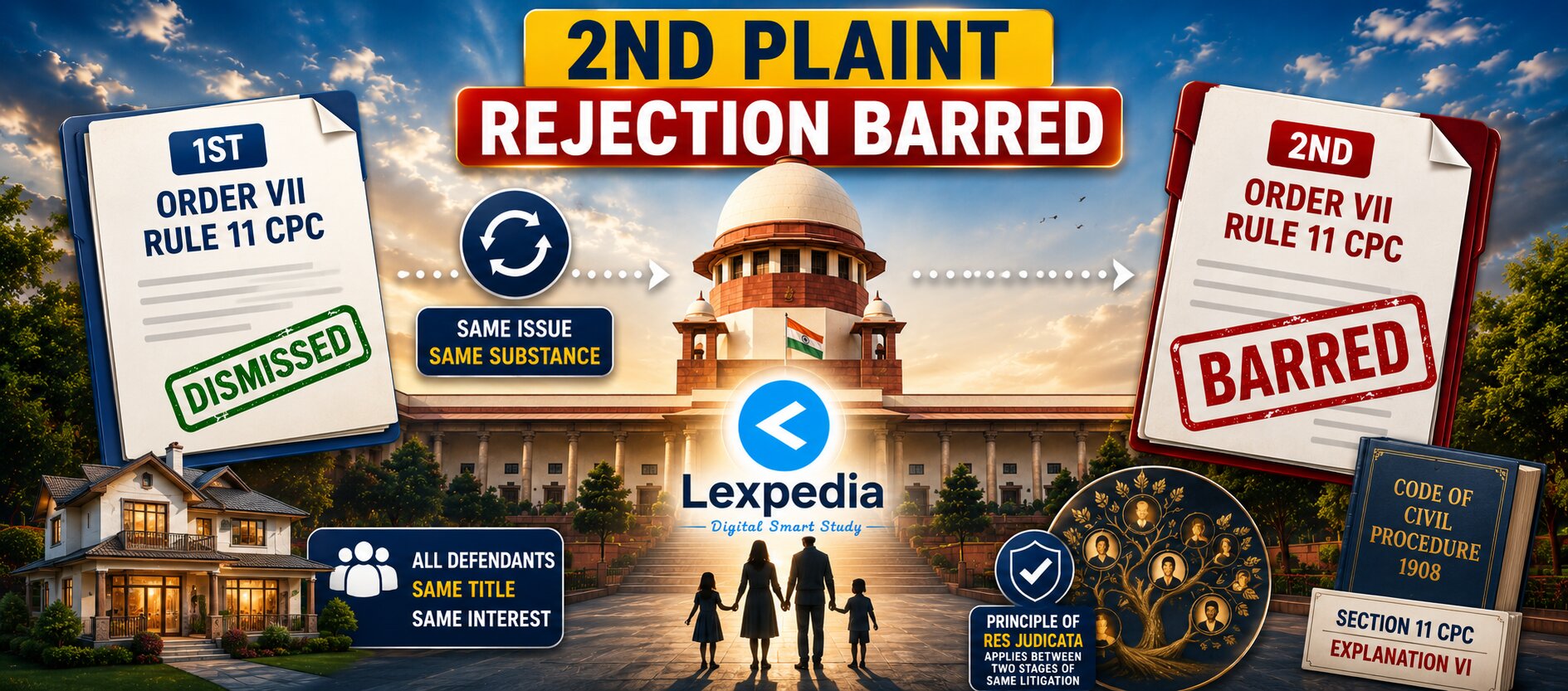
Judgement Details
Court
Supreme Court of India
Date of Decision
19 May 2026
Judges
Justice Sanjay Karol and Justice Augustine George Masih
Citation
Acts / Provisions
Facts of the Case
-
The appellant-daughter filed a partition suit claiming rights over her father’s intestate property as a Class I heir under Section 8 of the Hindu Succession Act.
-
The respondent-brothers contested the suit by filing an application under Order VII Rule 11 CPC seeking rejection of the plaint.
-
It was argued that the suit was barred by Section 6(5) of the Hindu Succession Act because a prior partition/arrangement had already taken place before December 2004.
-
The first application seeking rejection of plaint was dismissed by the Trial Court.
-
Subsequently, another defendant filed a second application under Order VII Rule 11 CPC seeking rejection of the plaint on substantially similar grounds.
-
The second application also relied upon the plea that the suit was barred by the 2005 Amendment to the Hindu Succession Act.
-
Although some additional grounds were mentioned in the second application, the core issue remained identical to the first application.
-
The Karnataka High Court allowed the second application and rejected the plaint.
-
Aggrieved by the High Court’s order, the appellant-daughter approached the Supreme Court.
-
The Supreme Court examined whether the second application was barred by the principle of res judicata despite being filed by a different defendant.
Issues
-
Whether the principle of res judicata applies between two stages of the same litigation as interlocutory res judicata?
-
Whether dismissal of an earlier application under Order VII Rule 11 CPC bars a subsequent application seeking rejection of plaint on the same grounds?
-
Whether filing a subsequent application by a different defendant avoids the applicability of res judicata?
-
Whether mere addition of new grounds in a subsequent Order VII Rule 11 application excludes the operation of res judicata when the substance of the issue remains identical?
Judgement
-
The Supreme Court held that the principle of res judicata applies not only between separate suits but also between different stages of the same litigation.
-
The Court recognized this principle as “interlocutory res judicata.”
-
The Court held that once an application under Order VII Rule 11 CPC is dismissed, a subsequent application on the same substantive grounds would be barred.
-
Justice Augustine George Masih observed that merely because the second application was filed by another defendant would not exempt the application from the operation of res judicata.
-
The Court held that all defendants were litigating under the same title and shared a common interest in defending the same partition arrangement.
-
The Supreme Court observed that the substance of both applications remained identical, namely the plea that the suit was barred under Section 6(5) of the Hindu Succession Act.
-
The Court clarified that merely adding new grounds or invoking additional clauses under Order VII Rule 11 CPC would not avoid the bar of res judicata.
-
The Court emphasized that parties cannot circumvent the finality of an adverse order by reframing the same challenge under a different procedural provision.
-
The Supreme Court held that the Karnataka High Court erred in allowing the second application seeking rejection of plaint.
-
Accordingly, the appeal filed by the appellant-daughter was allowed and the High Court’s judgment was set aside.
Held
-
The doctrine of interlocutory res judicata applies between different stages of the same litigation.
-
Dismissal of an earlier Order VII Rule 11 CPC application bars subsequent applications on the same substantive grounds.
-
Filing the subsequent application through a different defendant does not defeat the applicability of res judicata.
-
Addition of supplementary grounds does not avoid res judicata if the substance of the issue remains the same.
-
The Supreme Court restored the appellant’s partition suit.
Analysis
-
The judgment strengthens the doctrine of finality in litigation and prevents repetitive procedural challenges.
-
The Supreme Court reaffirmed that procedural law cannot be misused to endlessly delay adjudication of suits.
-
The ruling gives wider recognition to the principle of interlocutory res judicata, thereby ensuring consistency during different stages of proceedings.
-
The decision discourages litigants from filing repetitive applications through different parties to indirectly reopen settled issues.
-
The Court emphasized the importance of examining the substance of the issue rather than merely the form or drafting of subsequent applications.
-
The judgment also reinforces judicial efficiency by preventing multiplicity of proceedings on identical legal questions.
-
The ruling is significant in partition suits and inheritance disputes involving the Hindu Succession Act.
-
The decision additionally protects daughters’ inheritance claims from being defeated through repetitive technical objections.