
Ashwini Kumar Upadhyaya v. Union of India, 2026
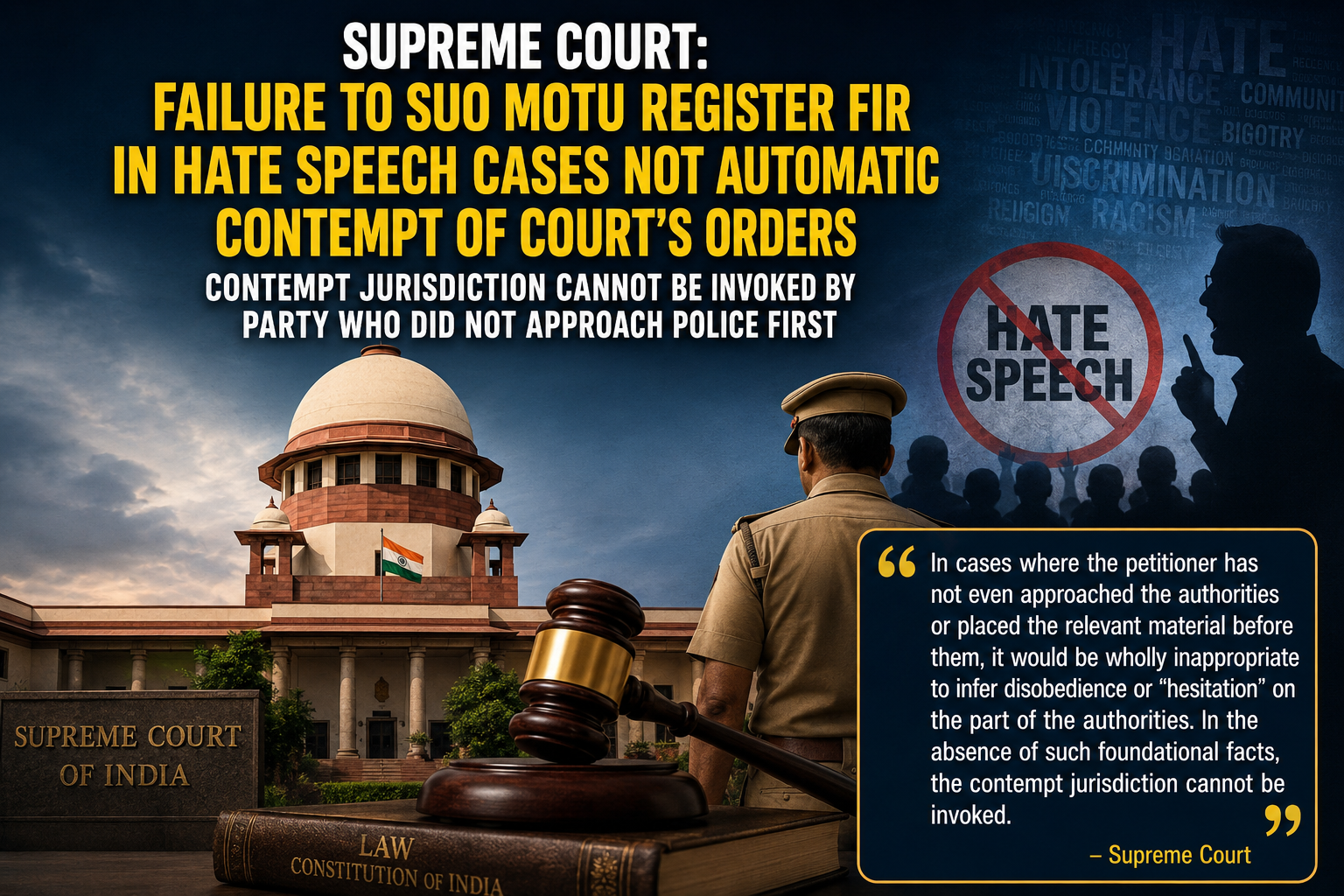
The judgment reinforces that contempt jurisdiction is strictly limited to cases of wilful disobedience.
Judgement Details
Court
Supreme Court of India
Date of Decision
6 May 2026
Judges
Justice Vikram Nath and Justice Sandeep Mehta
Citation
Acts / Provisions
Facts of the Case
-
The case arose from petitions concerning alleged hate speech incidents across India.
-
The petitioners alleged that police authorities failed to suo motu register FIRs despite earlier Supreme Court directions dated 21.10.2022 and 28.04.2023.
-
It was argued that this failure amounted to wilful disobedience of court orders and therefore constituted contempt.
-
The petitioners contended that FIR registration was mandatory even without any complaint being filed.
-
The respondents submitted that in several cases no complaint or material was ever placed before the police authorities, and therefore no action could be taken.
Issues
-
Whether failure of police to suo motu register FIRs in hate speech cases amounts to contempt of court?
-
Whether contempt jurisdiction can be invoked without prior complaint or material being placed before authorities?
-
Whether earlier directions required automatic FIR registration without any triggering information?
-
Whether contempt jurisdiction can be used to enforce general statutory duties of police authorities?
-
Whether wilful disobedience can be inferred without knowledge of the offence or court direction?
Judgement
-
The Supreme Court held that contempt jurisdiction cannot be invoked merely because FIRs were not registered suo motu.
-
The Court stated that wilful disobedience requires proof of knowledge and deliberate non-compliance.
-
It held that in absence of complaint or material, it cannot be presumed that authorities had knowledge of cognizable offences.
-
The Court found the petitioners’ interpretation of earlier directions to be overly broad and legally unsustainable.
-
It clarified that earlier directions were meant to ensure proper statutory compliance, not automatic FIR registration.
-
The Court further held that creation of offences and expansion of duties falls within the exclusive domain of the legislature.
-
The contempt petitions were therefore dismissed.
Held
-
The Supreme Court held that failure to register FIR suo motu does not automatically amount to contempt of court.
-
It held that contempt jurisdiction requires foundational facts and wilful disobedience.
-
It further held that without prior complaint or knowledge, contempt cannot be inferred.
-
The Court disposed of the petitions without any finding of contempt.
Analysis
-
The judgment reinforces that contempt jurisdiction is strictly limited to cases of wilful disobedience.
-
It clarifies that contempt cannot be used to enforce general policing or administrative duties.
-
The Court emphasized the requirement of foundational facts showing knowledge and intent.
-
It prevents misuse of contempt proceedings as a substitute for criminal law enforcement mechanisms.
-
The judgment strengthens the doctrine of separation of powers between judiciary and executive.
-
It clarifies that courts cannot expand statutory obligations of police through judicial interpretation in contempt jurisdiction.
-
The Court acknowledged that existing law is sufficient to deal with hate speech offences.
-
It maintained judicial restraint in matters involving executive functioning and policy enforcement.
-
The Supreme Court held that contempt jurisdiction cannot be expanded to cover general allegations of police inaction without proof of wilful disobedience.
-
The judgment preserves the balance between judicial authority and executive functioning.
-
It ensures that contempt law remains confined to its strict constitutional limits.