Vice President Jagdeep Dhankhar Raises Concerns Over Supreme Court's Judgment and Judicial Accountability
Lexpedia · 19 April 2025 · 3 min read
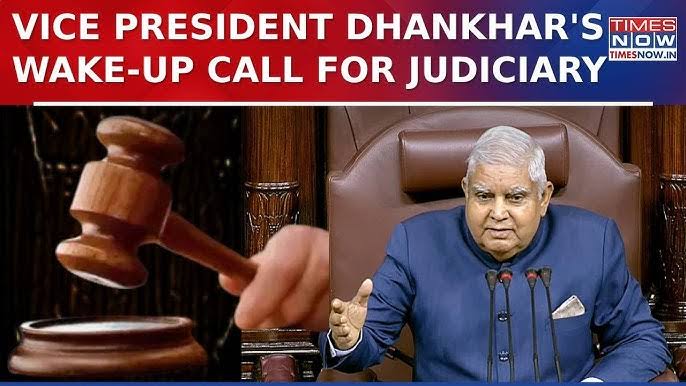
Vice President of India, Jagdeep Dhankhar, expressed serious concerns over a recent Supreme Court judgment which directed the President to decide on bills referred by the Governor within a specific timeframe. The Vice President called this decision alarming, stating that Article 142 of the Constitution, which empowers the Supreme Court to issue directions, has become a "nuclear missile" available to judges, enabling them to interfere with democratic processes. He questioned the direction given to the President to act within a time-bound manner on referred bills, suggesting that this could lead to judges assuming executive functions and encroaching on the legislative process.
Concerns Regarding the Role of Judiciary and Accountability
- According to the Vice President, such directions undermine the democratic structure by allowing judges to act like a super-parliament without accountability.
- Article 145(3), which mandates that a substantial constitutional issue be decided by a bench of at least five judges, was also discussed. The Vice President pointed out that the recent judgment that affected the President’s actions was delivered by a two-judge bench despite the fact that a constitutional matter should ideally have been heard by a larger bench.
- He further stressed that Article 145(3) needs to be amended to ensure that at least five judges are involved in making critical constitutional decisions, especially now that the Supreme Court's strength has increased to 31 judges.
Context of the Supreme Court Judgment
- The Vice President’s remarks were in response to a recent Supreme Court ruling concerning Tamil Nadu Governor's delay in granting assent to bills passed by the State Assembly.
- The judgment set specific timelines for the Governor and President to decide on referred bills, with a provision that if these timelines are not met, States can approach the courts to seek a writ of mandamus.
- The Court also ruled that if the Governor refers a bill to the President on the grounds of unconstitutionality, the President should seek the Supreme Court’s opinion under Article 143 before making a decision.
Reflections on Judicial Transparency and Accountability
- The Vice President also raised concerns regarding a controversial incident involving Justice Yashwant Varma. On March 14-15, cash was reportedly discovered at Justice Varma’s residence, and the issue went unnoticed for seven days. The Vice President questioned the delay in disclosing the incident and whether such a delay could be justified. He expressed the nation’s shock after the matter became public through a newspaper report on March 21, and criticized the lack of transparency in the investigation.
- The Vice President pointed out that no FIR was filed in the case and raised doubts about whether judicial bodies should be responsible for investigating their own members. Additionally, he flagged the issue of many judges not declaring their assets, emphasizing the need for greater transparency and accountability within the judiciary.
Implications for Judicial and Executive Roles
- Vice President Dhankhar's remarks underscore the tension between the judiciary and the executive, particularly when the courts issue directions that may be seen as overstepping constitutional boundaries.
- His criticism of the Court’s approach, especially in terms of the timing of decisions and the role of the judiciary in matters traditionally under the executive's domain, reflects concerns about the balance of power between different branches of government.
- These issues, including the handling of the Justice Varma case, have raised questions about the accountability of the judiciary and the transparency of judicial processes.