Supreme Court says State cannot shrug responsibility where government data shows some deaths after COVID-19 vaccination
Lexpedia News · 11 March 2026 · 5 min read
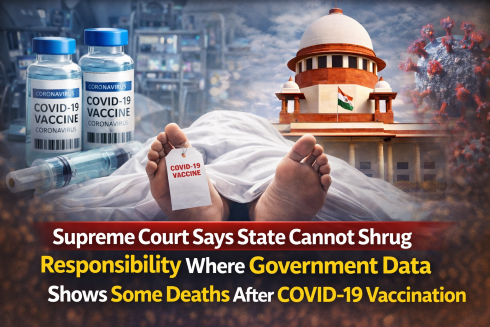
The Supreme Court of India has observed that when a vaccination programme is implemented as a State-led public health intervention, the government cannot evade responsibility towards families alleging deaths or serious adverse effects following COVID-19 vaccination.
The Court made the observation while directing the Union Government to formulate a “no-fault compensation policy” for serious adverse events following COVID-19 vaccination.
Case Title: Rachana Gangu v. Union of India, 2026
The matter was heard by a Bench of Justice Vikram Nath and Justice Sandeep Mehta.
Background of the Case
The proceedings arose from petitions filed by families who alleged that their relatives died or suffered serious medical complications after receiving COVID-19 vaccines.
One such petition was filed by the parents of two young women who reportedly died after vaccination, raising concerns about the absence of an effective mechanism for compensation or redress.
The petitioners sought directions from the Court for:
- Creation of an independent medical review system for vaccine-related deaths.
- A transparent system to identify adverse events following immunisation (AEFI).
- A compensation framework for families affected by vaccine-related injuries or deaths.
Supreme Court’s Observations
The Supreme Court clarified that it was not examining the scientific efficacy of vaccines or the approval process.
Instead, the constitutional question before the Court was whether families alleging serious harm during a nationwide vaccination programme should be left without any institutional mechanism for redress.
The Court noted that government data itself indicates that some deaths occurred after vaccination, though such cases are rare.
In such circumstances, the Court observed that the State cannot treat itself as a distant spectator when harm is alleged to have arisen during a public health intervention undertaken by the government.
The Bench emphasised that Article 21 of the Constitution (Right to Life) imposes a positive obligation on the State to ensure that affected families are not left without any accessible remedy.
Direction to the Union Government
The Supreme Court directed the Ministry of Health and Family Welfare to:
- Frame and publish a no-fault compensation policy for serious adverse events following COVID-19 vaccination.
- Continue the existing system for monitoring adverse events following immunisation (AEFI).
- Ensure that relevant data regarding such events is periodically placed in the public domain.
The Court clarified that introducing such a compensation scheme should not be treated as an admission of liability by the government.
Government’s Response
The Union Government argued that:
- COVID-19 vaccines were approved after rigorous regulatory scrutiny by expert bodies.
- India already has a three-tier AEFI surveillance system involving district, state and national committees.
It also submitted that adverse events linked to vaccines are extremely rare and that individuals can pursue civil or consumer remedies in cases involving negligence.
Court’s Reasoning
The Court noted that requiring affected families to prove negligence in each case could be extremely difficult, especially in large-scale vaccination programmes where establishing scientific causation is complex.
Therefore, it suggested a no-fault compensation framework, similar to programmes implemented in several countries such as:
- the United Kingdom
- Australia
- Japan.
Such schemes allow victims to receive compensation without lengthy litigation over fault or negligence.
Significance of the Judgment
The ruling has major implications for public health policy and constitutional law in India.
The decision highlights:
- The State’s responsibility in large-scale public health programmes.
- The importance of institutional mechanisms to address vaccine injury claims.
- The constitutional principle that public welfare measures must also provide remedies for rare adverse consequences.
Legal experts say the judgment could shape the future framework for compensation in vaccine-related injuries or deaths in India.
कोविड टीकाकरण से कुछ मौतें हुईं, सरकार जिम्मेदारी से बच नहीं सकती: सुप्रीम कोर्ट
सुप्रीम कोर्ट ने कहा है कि यदि टीकाकरण कार्यक्रम राज्य द्वारा संचालित सार्वजनिक स्वास्थ्य अभियान के रूप में चलाया जाता है, तो सरकार उन परिवारों के प्रति जिम्मेदारी से बच नहीं सकती जो टीकाकरण के बाद मौत या गंभीर दुष्प्रभाव का आरोप लगाते हैं।
अदालत ने केंद्र सरकार को कोविड-19 टीकाकरण के बाद होने वाली गंभीर प्रतिकूल घटनाओं के लिए “नो-फॉल्ट मुआवजा नीति” बनाने का निर्देश दिया।
केस: Rachana Gangu v. Union of India, 2026
मामले की सुनवाई न्यायमूर्ति विक्रम नाथ और न्यायमूर्ति संदीप मेहता की पीठ ने की।
मामले की पृष्ठभूमि
यह याचिका उन परिवारों द्वारा दायर की गई थी जिन्होंने आरोप लगाया कि कोविड-19 वैक्सीन लेने के बाद उनके परिजनों की मृत्यु हो गई या गंभीर स्वास्थ्य समस्याएँ हुईं।
याचिकाकर्ताओं ने अदालत से मांग की कि:
- टीकाकरण से संबंधित मौतों की जांच के लिए स्वतंत्र चिकित्सा तंत्र बनाया जाए
- AEFI (Adverse Events Following Immunisation) की पहचान के लिए स्पष्ट प्रणाली बने
- प्रभावित परिवारों के लिए मुआवजा नीति तैयार की जाए।
सुप्रीम कोर्ट की टिप्पणी
अदालत ने स्पष्ट किया कि वह वैक्सीन की प्रभावशीलता या वैज्ञानिक समीक्षा पर फैसला नहीं दे रही है।
मुद्दा यह है कि यदि राज्य द्वारा संचालित सार्वजनिक स्वास्थ्य कार्यक्रम के दौरान गंभीर नुकसान का आरोप लगता है, तो प्रभावित परिवारों के पास न्याय पाने का कोई प्रभावी तंत्र होना चाहिए।
अदालत ने कहा कि सरकारी आंकड़ों से भी संकेत मिलता है कि कुछ मौतें टीकाकरण के बाद हुईं, इसलिए राज्य पूरी तरह जिम्मेदारी से बच नहीं सकता।
अदालत का निर्देश
सुप्रीम कोर्ट ने केंद्र सरकार को निर्देश दिया कि:
- नो-फॉल्ट मुआवजा नीति बनाई जाए
- टीकाकरण से जुड़े प्रतिकूल प्रभावों की निगरानी जारी रखी जाए
- संबंधित डेटा समय-समय पर सार्वजनिक रूप से जारी किया जाए।
अदालत ने यह भी स्पष्ट किया कि मुआवजा नीति बनाना सरकार की कानूनी जिम्मेदारी स्वीकार करने के बराबर नहीं होगा।
फैसले का महत्व
यह फैसला महत्वपूर्ण है क्योंकि यह:
- सार्वजनिक स्वास्थ्य कार्यक्रमों में राज्य की संवैधानिक जिम्मेदारी को रेखांकित करता है
- टीकाकरण से जुड़े दुर्लभ दुष्प्रभावों के लिए संस्थागत मुआवजा व्यवस्था की आवश्यकता बताता है
- अनुच्छेद 21 के तहत जीवन और स्वास्थ्य के अधिकार की व्यापक व्याख्या करता है।