Supreme Court Issues Nationwide Directions To Expand Open Prisons Across India
Lexpedia News · 3 March 2026 · 6 min read
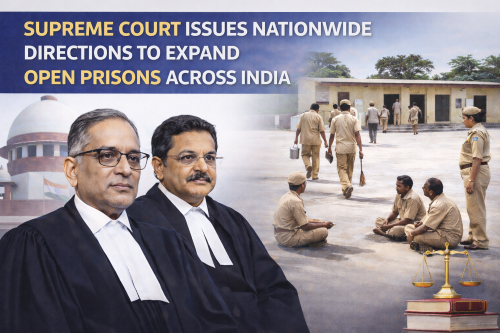
In a significant step toward prison reforms and humane incarceration policies, the Supreme Court of India has issued nationwide directions to all States and Union Territories to expand and strengthen Open Correctional Institutions (OCIs), commonly known as open prisons. The judgment was delivered by a Bench comprising Justice Vikram Nath and Justice Sandeep Mehta while hearing a writ petition concerning overcrowding and conditions in Indian prisons.
The Court observed that overcrowding in prisons has reached alarming levels, with many jails operating at over 120% capacity, leading to conditions that undermine the dignity and fundamental rights of prisoners under Article 21 of the Constitution. To address these systemic issues, the Court held that open prisons represent a reformative and sustainable solution within India’s criminal justice system.
What Are Open Prisons?
Open prisons are minimum-security correctional institutions where inmates are allowed greater freedom of movement and responsibility. Unlike traditional prisons surrounded by high walls and heavy security, open prisons operate on the principles of trust, discipline, and rehabilitation, enabling prisoners to work, develop skills, and maintain family ties while serving their sentences.
The Supreme Court emphasised that the philosophy behind such institutions aligns with the reformative theory of punishment, which focuses on rehabilitation rather than purely punitive detention.
Court’s Observations On Prison Reform
The Bench underscored that prisoners do not lose their constitutional rights merely because they are incarcerated. It stated that the State’s obligation to treat prisoners with dignity, fairness, and compassion becomes even more important when their liberty is curtailed by law.
The Court also highlighted international standards such as the United Nations Standard Minimum Rules for the Treatment of Prisoners (Nelson Mandela Rules), which recognise that incarceration should promote social reintegration and rehabilitation.
Key Directions Issued By The Supreme Court
To ensure meaningful implementation of open prison policies, the Court issued several binding directions, including:
-
Expansion of Open Correctional Institutions: States and Union Territories must establish and expand open prisons in a time-bound manner.
-
Protection of Existing Facilities: Governments were directed not to reduce existing open prison land or infrastructure.
-
Uniform Standards: Authorities must formulate minimum standards for eligibility, wages, healthcare, vocational training, education and family integration for prisoners in open prisons.
-
Inclusion of Women Prisoners: States must create dedicated facilities for women prisoners and ensure their participation in open prison schemes.
-
Rational Eligibility Criteria: States were directed to revise restrictive rules that delay or prevent prisoners from transferring to open prisons.
-
Monitoring Mechanism: Authorities must establish regular monitoring and compliance reporting mechanisms to ensure the policy is effectively implemented.
Data Reveals Under-Utilisation
During the proceedings, data placed before the Court revealed that many States either do not have open prisons at all or are severely under-utilising them. In several States, occupancy levels in open prisons range from as low as 6% to 44%, despite severe overcrowding in conventional prisons.
The Court noted that some States have also imposed excessively long eligibility requirements, requiring inmates to spend 4 to 12 years—and sometimes up to 21 years—in closed prisons before being considered for open prisons.
Economic and Social Benefits
The Supreme Court also observed that open prisons are significantly more cost-effective than conventional prisons and promote rehabilitation by allowing prisoners to work, earn wages, and maintain social and family connections.
Examples from States such as Rajasthan, Maharashtra and Kerala demonstrate that open prisons can reduce costs, improve mental health outcomes for inmates, and facilitate their reintegration into society after release.
Background Of The Case
The case originated from a writ petition filed by human rights activist Suhas Chakma, raising concerns about overcrowding in Indian prisons and the inhumane conditions faced by inmates. The petition sought structural reforms to address prison congestion and strengthen correctional policies nationwide.
The Supreme Court concluded that expanding open prisons is both constitutionally necessary and administratively practical, describing them as a vital component of a modern, reform-oriented criminal justice system.
खुले जेलों के विस्तार के लिए सुप्रीम कोर्ट के देशव्यापी निर्देश
भारत के सुप्रीम कोर्ट ने जेल सुधार की दिशा में एक महत्वपूर्ण कदम उठाते हुए सभी राज्यों और केंद्र शासित प्रदेशों को खुले जेलों (Open Correctional Institutions) का विस्तार करने के लिए देशव्यापी निर्देश जारी किए हैं। यह आदेश न्यायमूर्ति विक्रम नाथ और न्यायमूर्ति संदीप मेहता की पीठ ने जेलों में भीड़भाड़ और कैदियों की स्थिति से संबंधित एक याचिका की सुनवाई के दौरान दिया।
अदालत ने कहा कि भारत की कई जेलें 120% से अधिक क्षमता पर चल रही हैं, जिससे कैदियों की गरिमा और संविधान के अनुच्छेद 21 के तहत जीवन और व्यक्तिगत स्वतंत्रता के अधिकार का उल्लंघन होता है।
खुली जेल क्या होती है?
खुली जेलें न्यूनतम सुरक्षा वाली सुधारात्मक संस्थाएँ होती हैं जहाँ कैदियों को अपेक्षाकृत अधिक स्वतंत्रता और जिम्मेदारी दी जाती है। इन जेलों में पारंपरिक जेलों की तरह ऊँची दीवारें या कठोर सुरक्षा व्यवस्था नहीं होती। इसका उद्देश्य सुधार, पुनर्वास और समाज में पुनर्समावेशन को बढ़ावा देना है।
सुप्रीम कोर्ट की प्रमुख टिप्पणियाँ
अदालत ने कहा कि कैदी जेल में होने के बावजूद अपने संवैधानिक अधिकार नहीं खोते और राज्य की जिम्मेदारी है कि उन्हें मानवीय और गरिमापूर्ण व्यवहार मिले।
सुप्रीम कोर्ट के प्रमुख निर्देश
अदालत ने निम्नलिखित महत्वपूर्ण निर्देश जारी किए:
-
राज्यों को समयबद्ध तरीके से खुली जेलों की स्थापना और विस्तार करना होगा।
-
पहले से मौजूद खुली जेलों की जमीन या सुविधाओं को कम नहीं किया जाएगा।
-
कैदियों के लिए स्वास्थ्य, शिक्षा, रोजगार प्रशिक्षण और पारिवारिक संपर्क से जुड़े न्यूनतम मानक तय किए जाएँ।
-
महिला कैदियों के लिए विशेष सुविधाएँ विकसित की जाएँ।
-
खुली जेल में स्थानांतरण के लिए अत्यधिक कठोर पात्रता मानदंडों की समीक्षा की जाए।
-
निगरानी और अनुपालन रिपोर्टिंग प्रणाली स्थापित की जाए।
खुली जेलों का कम उपयोग
अदालत के सामने प्रस्तुत आंकड़ों से पता चला कि कई राज्यों में खुली जेलें या तो मौजूद नहीं हैं या उनका उपयोग बहुत कम हो रहा है। कुछ राज्यों में इनकी आक्युपेंसी केवल 6% से 44% के बीच है, जबकि बंद जेलों में भीड़ अत्यधिक है।
पुनर्वास और लागत में लाभ
सुप्रीम कोर्ट ने कहा कि खुली जेलें न केवल मानवीय और सुधारात्मक दृष्टिकोण को बढ़ावा देती हैं, बल्कि यह आर्थिक रूप से भी अधिक किफायती होती हैं। राजस्थान, महाराष्ट्र और केरल जैसे राज्यों में इनका सफल मॉडल देखा गया है।
मामले की पृष्ठभूमि
यह मामला मानवाधिकार कार्यकर्ता सुहास चक्रमा द्वारा दायर याचिका से उत्पन्न हुआ, जिसमें जेलों में भीड़भाड़ और कैदियों की अमानवीय स्थिति पर चिंता जताई गई थी।
सुप्रीम कोर्ट ने अपने आदेश में स्पष्ट किया कि खुली जेलों का विस्तार भारत की आपराधिक न्याय प्रणाली को अधिक मानवीय, सुधारात्मक और प्रभावी बनाने की दिशा में महत्वपूर्ण कदम है।