Mandatory menstrual leave may harm women’s careers: SC
Lexpedia News · 13 March 2026 · 4 min read
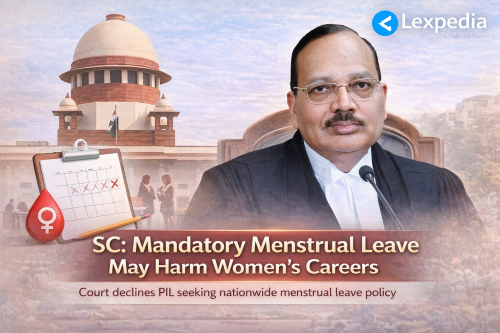
The Supreme Court of India has observed that making menstrual leave mandatory for women could unintentionally harm their career prospects and employment opportunities. The Court expressed these concerns while hearing a Public Interest Litigation (PIL) seeking a nationwide policy granting paid menstrual leave to women employees and female students.
A Bench comprising Surya Kant (Chief Justice of India) and Joymalya Bagchi said that although the intention behind such proposals may be to support women, making menstrual leave compulsory could have unintended consequences in the job market.
Court’s observations during the hearing
During the hearing, the Chief Justice cautioned that mandatory menstrual leave might reinforce stereotypes suggesting that women are not at par with men during certain periods. The Court remarked that such perceptions could affect how employers view female employees.
The Bench noted that if such leave were mandated through legislation, employers might hesitate to hire women or assign them responsibilities, which could adversely impact women’s participation in the workforce and career progression.
PIL seeking nationwide menstrual leave policy
The PIL sought directions to the Union government and state authorities to frame a law or policy recognising health problems faced by women during menstruation and to provide paid menstrual leave for working women and female students. The petitioner relied on constitutional provisions including Articles 14 and 21, arguing that menstrual health concerns deserve institutional recognition and support.
However, the Court questioned the maintainability and bona fides of the petition, noting that similar petitions had been filed earlier on the same issue. The Bench also pointed out that no woman had personally approached the Court seeking such relief, which raised questions about the locus of the petitioner.
Court asks Centre to consider policy representation
While declining to entertain the plea for a judicial mandate, the Supreme Court suggested that the Union government may examine the petitioner’s representation and consider whether a broader policy could be framed after consulting stakeholders.
The Court emphasised that decisions relating to workplace policy and labour benefits often require legislative or executive deliberation, involving consultation with employers, workers and policy experts.
Significance of the development
The Court’s remarks highlight the delicate balance between workplace welfare measures and gender equality in employment. While acknowledging menstrual health concerns, the Court indicated that mandatory leave policies could inadvertently reinforce gender bias or reduce employment opportunities for women.
The issue of menstrual leave remains part of a broader policy debate in India, with some states, educational institutions and private organisations introducing voluntary menstrual leave policies, while the question of a nationwide mandate continues to be debated.
सुप्रीम कोर्ट: अनिवार्य मासिक धर्म अवकाश से महिलाओं के करियर को नुकसान हो सकता है
Supreme Court of India ने कहा है कि यदि मासिक धर्म (menstrual) अवकाश को अनिवार्य बनाया जाता है, तो इससे महिलाओं के करियर और रोजगार के अवसरों पर प्रतिकूल प्रभाव पड़ सकता है। अदालत ने यह टिप्पणी उस जनहित याचिका (PIL) की सुनवाई के दौरान की जिसमें महिलाओं और छात्राओं के लिए भुगतान सहित मासिक धर्म अवकाश की राष्ट्रीय नीति बनाने की मांग की गई थी।
यह मामला Surya Kant (मुख्य न्यायाधीश) और Joymalya Bagchi की पीठ के समक्ष आया था।
अदालत की टिप्पणी
सुनवाई के दौरान अदालत ने कहा कि यदि मासिक धर्म अवकाश को कानून के माध्यम से अनिवार्य बना दिया गया, तो इससे यह धारणा बन सकती है कि महिलाएं कुछ समय के दौरान पुरुषों के बराबर काम नहीं कर सकतीं।
अदालत ने यह भी कहा कि इससे नियोक्ताओं के मन में यह आशंका पैदा हो सकती है कि महिलाओं को अतिरिक्त छुट्टियां देनी पड़ेंगी, जिससे नौकरी देने या जिम्मेदार पद सौंपने में झिझक पैदा हो सकती है।
जनहित याचिका की मांग
याचिका में केंद्र सरकार और राज्यों को निर्देश देने की मांग की गई थी कि वे महिलाओं को मासिक धर्म के दौरान होने वाली स्वास्थ्य समस्याओं को ध्यान में रखते हुए कार्यस्थलों और शिक्षण संस्थानों में भुगतान सहित मासिक धर्म अवकाश की नीति लागू करें।
याचिका में यह भी कहा गया था कि यह कदम संविधान के अनुच्छेद 14 और 21 के तहत समानता और गरिमामय जीवन के अधिकार से जुड़ा हुआ है।
हालांकि अदालत ने याचिका की स्वीकार्यता और याचिकाकर्ता की bona fide पर भी सवाल उठाए। अदालत ने यह भी कहा कि इस विषय पर पहले भी याचिकाएं दायर की जा चुकी हैं और इस बार भी कोई महिला स्वयं अदालत के सामने नहीं आई है।
केंद्र सरकार से नीति पर विचार करने को कहा
हालांकि सुप्रीम कोर्ट ने इस मामले में सीधे हस्तक्षेप करने से इनकार कर दिया, लेकिन उसने कहा कि केंद्र सरकार याचिकाकर्ता के प्रतिनिधित्व पर विचार कर सकती है और संबंधित पक्षों से परामर्श करके नीति बनाने पर निर्णय ले सकती है।
मामले का महत्व
यह मामला कार्यस्थल पर महिला कल्याण और लैंगिक समानता से जुड़े व्यापक नीति-विमर्श का हिस्सा है। सुप्रीम कोर्ट ने संकेत दिया कि महिलाओं के लिए लाभकारी दिखने वाले कुछ उपाय अनजाने में उनके रोजगार अवसरों को सीमित भी कर सकते हैं।
भारत में कुछ राज्य सरकारों, शैक्षणिक संस्थानों और निजी संगठनों ने स्वैच्छिक मासिक धर्म अवकाश नीति लागू की है, लेकिन राष्ट्रीय स्तर पर इसे अनिवार्य बनाने पर अभी भी बहस जारी है।