Madhya Pradesh High Court Dismisses Husband’s Plea Seeking Wife’s Virginity / Two-Finger Test
Lexpedia News · 28 January 2026 · 4 min read
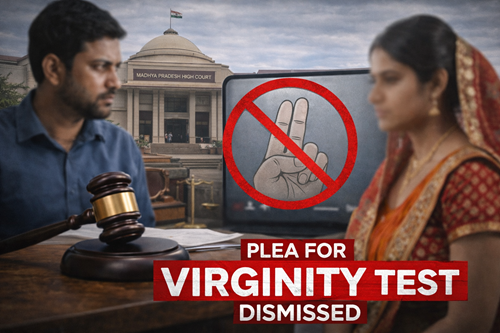
The Madhya Pradesh High Court has dismissed a husband’s plea seeking to subject his wife to a medical examination — colloquially described as a “virginity test” or “two-finger test” — in the context of their ongoing divorce proceedings, holding that such a test would amount to an invasion of privacy and is legally irrelevant to the divorce.
A single-judge bench of Justice Vivek Jain passed the order on 21 January 2026, rejecting the husband’s appeal against a Family Court order that had earlier refused to direct the wife’s medical examination. The husband had approached the High Court after his petition was dismissed by the Family Court.
The husband’s petition arose out of a divorce suit filed on the ground of cruelty. He had claimed that his wife had refused to enter into a physical relationship, and sought a medical test to determine whether she had ever engaged in sexual intercourse.
Rejecting the plea, the High Court observed that whether a person has had sexual relations or not is not a valid ground for divorce, and that a medical examination in this context would be nothing but a virginity test — a procedure that would result in a serious invasion of the wife’s privacy and is not relevant to adjudication of the divorce.
The Court noted that refusal to engage in sexual intercourse alone does not constitute cruelty under law and cannot be used as the sole basis for divorce. It clarified that Sections 11, 12 and 13 of the Hindu Marriage Act, 1955 do not recognise denial of sexual relations as a standalone ground for declaring a marriage void, voidable or for seeking divorce.
In its observations, the High Court also highlighted that using the state of the hymen as evidence of sexual history is scientifically and medically unreliable. The Court referred to judicial and medical viewpoints that the condition of the hymen cannot conclusively determine whether sexual intercourse has occurred, and that such assessments could lead to humiliation and privacy violations for the individual concerned.
The bench further noted that even allegations of sodomy — which the wife had denied, counter-alleging dowry harassment, physical and mental cruelty — cannot be reliably established long after the fact through medical examinations.
While dismissing the plea, the High Court observed that the husband may still produce other admissible evidence to support his allegations regarding refusal to engage in sexual relations, but that a medical test to infer one’s sexual history is neither necessary nor legally viable in divorce proceedings.
Legal experts say the judgment underscores the judiciary’s insistence on protecting individual privacy rights and ensuring that unscientific medical tests do not undermine dignity or substitute for legally relevant evidence in matrimonial and family law disputes.
मध्य प्रदेश हाई कोर्ट ने पत्नी की वर्जिनिटी/‘टू-फिंगर’ टेस्ट की माँग वाली याचिका खारिज की
जबलपुर: मध्य प्रदेश उच्च न्यायालय ने एक पति की याचिका को खारिज कर दिया है, जिसमें उसने अपनी पत्नी से चिकित्सीय परीक्षा करवाने की मांग की थी — जिसे आमतौर पर “वर्जिनिटी टेस्ट” या “टू-फिंगर टेस्ट” कहा जाता है — और यह कहा कि यह गोपनीयता के अधिकार का उल्लंघन होगा तथा तलाक से संबंधित निर्णय के लिए वैध नहीं है।
न्यायमूर्ति विवेक जैन की एकल पीठ ने 21 जनवरी 2026 को यह आदेश पारित किया, जिसमें उसने पारिवारिक न्यायालय के आदेश के विरुद्ध दायर अपील को खारिज कर दिया। पारिवारिक न्यायालय ने पहले ही पत्नी की चिकित्सा परीक्षा के आदेश को अस्वीकार कर दिया था।
पति ने तलाक के अनुरोध के तहत दावा किया था कि उसकी पत्नी ने शारीरिक संबंध बनाने से इंकार किया, और यह साबित करने के लिए मेडिकल टेस्ट की मांग की थी कि उसने यौन संबंध कभी नहीं बनाए।
हाई कोर्ट ने यह स्पष्ट किया कि व्यक्ति ने यौन संबंध बनाए हैं या नहीं यह तलाक का वैध आधार नहीं हो सकता, और इस तरह की चिकित्सा परीक्षा वर्जिनिटी टेस्ट के अलावा कुछ नहीं होगी — जो व्यक्ति की गोपनीयता का गंभीर उल्लंघन कर सकती है और तलाक के निर्णय के लिए उपयुक्त नहीं है।
कोर्ट ने यह भी कहा कि यौन संबंधों से इंकार केवल क्रूरता का आधार नहीं है, और यह खुद ही तलाक के लिए मान्य आधार नहीं बनता। कोर्ट ने स्पष्ट किया कि हिंदू मैरिज एक्ट, 1955 की धाराएँ 11, 12 तथा 13 तले केवल यौन संयोग से इंकार को तलाक का आधार नहीं मानतीं।
न्यायालय ने आगे यह बताया कि हाइमन की स्थिति को यौन इतिहास का प्रमाण मानना वैज्ञानिक और चिकित्सीय रूप से अविश्वसनीय है। कोर्ट ने कहा कि इस तरह की परीक्षा व्यक्ति की गरिमा व गोपनीयता को नुकसान पहुँचा सकती है।
कोर्ट ने यह भी कहा कि पत्नी द्वारा आरोपित डाउरी उत्पीड़न, शारीरिक तथा मानसिक क्रूरता और सडोमी के आरोपों को लंबे समय बाद चिकित्सा परीक्षण द्वारा साबित नहीं किया जा सकता।
हाई कोर्ट ने याचिका खारिज करते हुए कहा कि पति अन्य प्रमाणिक साक्ष्य प्रस्तुत कर सकता है, लेकिन यौन इतिहास का परीक्षण तलाक की कार्यवाही में न तो आवश्यक है और न ही कानूनी रूप से मान्य।
विशेषज्ञों के अनुसार, यह निर्णय व्यक्तिगत गोपनीयता के अधिकार की रक्षा और गैर-वैज्ञानिक चिकित्सा परीक्षणों को तलाक जैसे मामलों में साक्ष्य के रूप में स्वीकार न करने के उच्च न्यायालय के रुख को दर्शाता है।