
Landmark Judgement
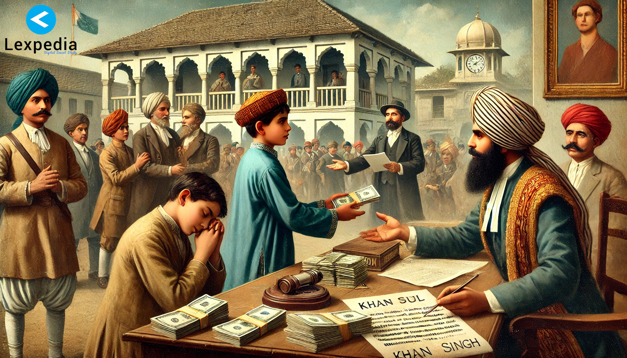
Khan Gul vs. Lakha Singh, 1928
No Estoppel Against Minors: Contractual Fraud, Misrepresentation, and Restitution in the Disputed Land Sale Between Parties
Lahore High Court·2 April 1928
Judgement Details
Court
Lahore High Court
Date of Decision
2 April 1928
Judges
Sir Shadi Lal C. J ⦁ Justice Broadway ⦁ Justice Harrison ⦁ Justice Tek Chand
Citation
AIR 1928 LAH 609
Acts / Provisions
Section 10 & 11, Indian Contract Act.
Sections 65 & 68 of the Indian Contract Act.
Section 39 & 41 of the Specific Relief Act.
Section 115 of the Indian Evidence Act.
Facts of the Case
- The first defendant entered into negotiations to sell a piece of land to the plaintiffs while still a minor, deliberately concealing his true age.
- The plaintiffs paid a total sum of Rs. 17,500/-, with Rs. 8,000 paid in cash to the Sub-Registrar, and the remaining Rs. 9,500 secured via a promissory note, payable on demand.
- The plaintiffs argued that the Rs. 17,500 had been lawfully paid to the first defendant, as the original promissory note of Rs. 9,500 was discharged by another promissory note issued to the defendant’s brother-in-law, Muhammad Hussain, at the first defendant's request.
- Additionally, the plaintiffs claimed to have paid Rs. 5,500 of the Rs. 9,500 to Muhammad Hussain and expressed willingness to pay the remaining balance.
- Despite receiving the payments, the first defendant refused to transfer ownership of the property to the plaintiffs.
- Consequently, the plaintiffs sought either possession of the property or a decree for Rs. 17,500, representing the consideration amount, along with interest or damages for breach of contract at 1% per month, totaling Rs. 1,050.
- In total, the plaintiffs requested Rs. 19,000, proposing that the sum be imposed against the other properties owned by the first defendant.
- Decision of the Trial Court: The Trial Court noted that the defendant had misrepresented his age as a result the Plaintiff believed that he was an adult. The Trial Court by applying the principle of estoppel as established in Wasinda Ram v. Sita Ram held that the defendant could not rely on his minority to avoid the contract. Thus, the Trial Court ruled in favour of the Plaintiff.
Issues
- Whether a minor who has convinced a person to sign into a contract by fraudulently claiming himself to be a major is barred from arguing his minority to escape the contract?
- Whether a party who, as a minor, entered into a contract by making a false representation about his age, whether as a defendant or plaintiff, can decline to fulfill the contract while retaining the advantage he may have gained from it in a future dispute?
Judgement
ARGUMENTS:
- The counsel for appellant urged that the facts do not show that the respondents were in any way deceived by any representation made by defendant 1. He relies on the evidence of Fakir Muhammad (P.W. 3) who states that Lakha Singh, one of the respondents had told the defendant that he (defendant) should state his age to be 19 at time of registration.
- There can be no doubt that the appellant stated his age to be 19 at the time of registration.
- Except the evidence of Fakir Muhammad there is no evidence to show us that the respondents knew or were in a position to know what the age of the appellant was.
- The appellant had previously executed other mortgages and deals of gift in which he had represented himself to be 19.
- In one case he had obtained a medical certificate showing that he was over 19 years of age.
- He admits that he stated before the Sub-Registrar that he was 19 years of age because his cousin Muhammad Hussain had asked him to give his age as 19 years.
JUDGMENT:-
- The courts concluded that the Doctrine Of Estoppel cannot apply to minors as it would cause absurdity and injustice.
- The court relied on Jenning v. Rundall which stated that protection provided to minors should be used as a shield and not as sward.
- Therefore exercising their equitable jurisdiction the courts restored the status of both the parties which they possessed before the formation of contract and stated “it would be sheer injustice if an infant keeps not only property but also the money received under the contract”.
- As the transaction is wiped out is only fair that both parties should revert and in this case, restitution is not provided because there is a contract instead it is provided there is none and both parties should revert to original status”.
- The court cited Jagar Nath Singh v. Lalta Pershad, where it was held that a minor who fraudulently induced a contract must restore the benefits received. The principle of restitution under Section 68 of the Indian Contract Act also allows for reimbursement for necessary items provided to minors but does not hold minors personally liable. Sections 33 of the Specific Relief Act, 1963 (formerly Sections 39 and 41 of the Specific Relief Act, 1877) were also considered.
- Thus, the High Court of Lahore held that the minor could not be held liable for the contract but must restore the benefits obtained. The Court applied the principles of equity and restitution to ensure fairness while upholding the protective provisions of the Indian Contract Act.
Held
- It was held by the court that there can be no Estoppels against the minor even if he has acted fraudulently and misrepresented her age. Minor is not stopped from setting up the defence of minority. The reason behind this is that there can be no estoppels against the law.
- The court held that minor cannot be held liable under the agreement on the basis of estoppels.
- The court also held that doctrine of restitution finds under Section 33 of Specific Relief Act. False representation by minor about his age gives rise to equitable liability.
- The Court held that grant of restitution is not enforcement of contract but restoration of state of affairs as they existed before the formation of contract.
Analysis
- The Court established that the doctrine of estoppels under Section 115 of Indian Evidence Act does not bind minors, affirming the voidness of transactions involving minors under the Contract Act.
- In Khan Gul vs Lakha Singh the Lahore High Court held that minors even if they misrepresent their age to induce a contract, are not bound by estoppel under Section 115 of the Indian Evidence Act.
- The court’s departure from English law showcased a nuanced application of equitable principles, allowing for the restitution of gains acquired by the minor. This verdict underscored a protective stance towards minors, ensuring fairness and justice in legal proceedings.
- The judgment’s prudent interpretation of statutes and equitable doctrines solidified its significance in shaping legal perspectives on contracts involving individuals with diminished capacity.
- In conclusion, a minor who entered into a contract by making a false representation about his age, though not liable under the contract, may be required in equity to return the benefit he received by making a false representation about his age, whether he is a defendant or a plaintiff.