
Harvey vs. Facey, 1893
Clarifying Offer and Acceptance: The Legal Dispute Over Bumper Hall Pen
Judgement Details
Court
Privy Council
Date of Decision
29 July 1893
Judges
The Lord Chancellor ⦁ Lord Watson ⦁ Lord Hobhouse ⦁ Lord McNaughton ⦁ Lord Morris [Delivery of the Judgement, Lord Morris.]
Citation
(1893) AC 552
Acts / Provisions
Facts of the Case
Parties Involved:
- Appellants: Harvey & Co., a firm of solicitors in Kingston, Jamaica.
- Respondent: L. M. Facey, the owner of a property known as Bumper Hall Pen.
In October 1893, the Mayor and Council of Kingston were in negotiations with L. M. Facey for the purchase of Bumper Hall Pen.
It was understood that Facey had expressed his willingness to sell the property for £900.
Telegram Exchange:
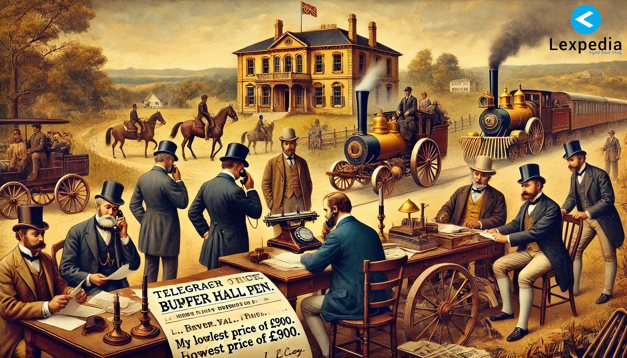
- On October 7, 1893, while L. M. Facey was travelling by train from Kingston to Porus, the Appellants sent a telegram to him that read:
“Will you sell us Bumper Hall Pen? Telegraph lowest cash price—answer paid.” - On the same day, Facey replied via telegram:
“Lowest price for Bumper Hall Pen £900.” - Interpreting this as an offer, the Appellants immediately sent a reply telegram to Facey, stating:
“We agree to buy Bumper Hall Pen for the sum of £900 asked by you. Please send us your title deed in order that we may get early possession.”
Legal Dispute:
- The Appellants claimed that this exchange of telegrams constituted a binding contract for the sale of Bumper Hall Pen.
- Facey, however, did not respond to the Appellants’ final telegram, and he proceeded with negotiations with the Mayor and Council of Kingston.
Court Proceedings:
- The Appellants filed a suit seeking specific performance of the alleged contract, claiming that Facey’s telegram stating the price was a formal offer.
- The case was first heard by Justice Curran, who dismissed the suit on the grounds that there was no concluded contract between the parties.
Appeal and Final Ruling:
- The Court of Appeal reversed Justice Curran’s decision, declaring that there was a binding agreement. However, they noted that the agreement could not be enforced because Facey’s wife had not consented to the sale.
The Appellants appealed to the Privy Council, which held that no binding contract existed.
Issues
- Was there an explicit offer from Mr. Facey to Mr. Harvey for the sale of the said property for the consideration of £900 and is it capable of acceptance?
- Was there a valid contract or not?
- Was the telegram advising the lowest price an offer capable of acceptance?
Judgement
- The Privy Council held that no binding contract existed between Harvey and Facey.
- Facey’s initial telegram stating the price was not an offer that could be accepted to form a contract. Instead, it was merely an invitation to treat.
- The court ruled that for a valid contract to exist there must be a definite offer with the intention to be legally bound.
- Facey’s telegram did not constitute an offer according to contractual requirements. It was simply quoting a price in response to Harvey’s inquiry. This did not demonstrate an intent to enter into a binding agreement.
- Since Facey’s telegram was an invitation to treat rather than an offer, Harvey’s subsequent reply purporting to accept the price did not create a contract. There was no offer that could be accepted.
- Hence, the court found no contractual relationship existed between the parties in this case.
- The Privy Council restored the original judgment of Justice Curran, ruling that no contract had been formed, and the Appellants were ordered to pay the Respondent's legal costs.
Held
- It was held by the Court in this case that invitation to offer merely invites the people of to make an offer to the acceptor and the ultimate say remains with the acceptor to form the invitation to offer to a valid contract or not.
- Thus, the acceptance to the offer here made by the customer in the said example will only amount to offer, which may or may not be accepted by the shopkeeper and if the offer accepted by the shopkeeper it will be a valid contract, implying the owner, who quotes the price of a certain property, is always the acceptor.
Analysis
In simple words this verdict held that no valid contract was formed due to lack of proper proposal / valid offer. This obvious draws our attention to the concept of valid offer as per Section 2(a) of The Indian Contract Act, 1872, which properly states that to constitute a valid offer the following Conditions must be fulfilled
The offer must show an obvious intention on the part of the offeror to be bound by it i.e., the offer must signify to the offeree his willingness to do or to abstain from doing something.
Thus X jokingly offers Y Rs. 50 for his typewriter and Y, knowing that Z is not serious, says, "I accept Z's proposal does not constitute an offer.
According to Sec 2(a), the offeror must make the offer with a view to obtaining the assent of the offeree to such act or abstinence.
- The offer must be definite, certain and concrete.
- The offer must be properly communicated to the acceptor (offeree).
- It must be made with the intention of creating a legal relationship.
Hence, all these requisites must be fulfilled to consider a valid offer. And in this case the owners of the property have every right including the right to sell the property.
So however, the respondent furnished no offer regarding the sell of his property and the appellant wrongfully assumed that for quoting the lowest price when enquired and tendered to sell the property.
At last it is proved that the mere quotation of price is not an offer but merely an invitation to offer.