Supreme Court Upholds Merit-Based Inclusion of Reserved Category Candidates in Open Category
Lexpedia · 6 January 2026 · 4 min read

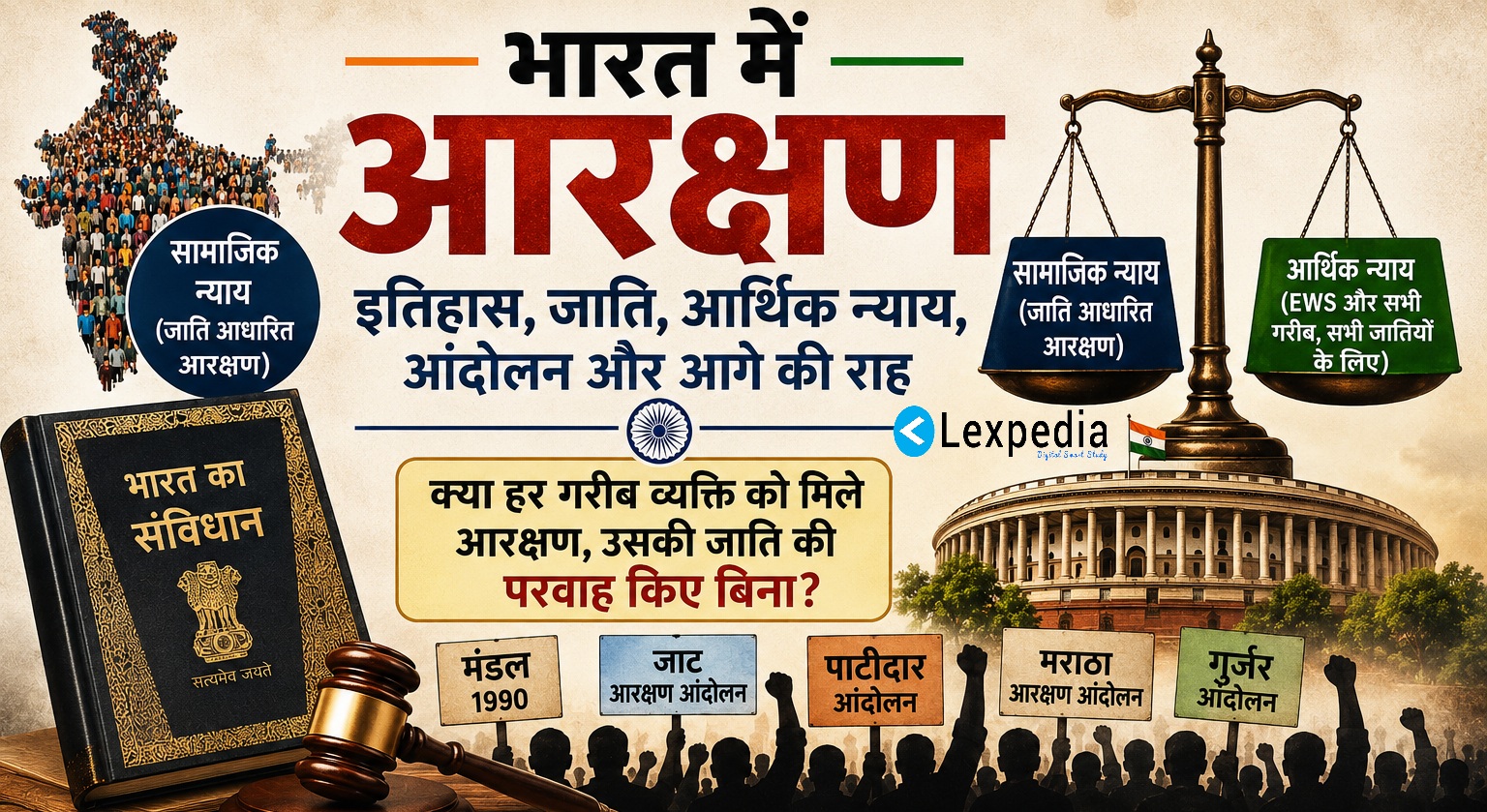
The Supreme Court has upheld a Rajasthan High Court judgment directing that candidates belonging to reserved categories who secure marks higher than the cut-off prescribed for the General or Open category must be considered in the open category even at the stage of shortlisting, and not confined to their respective reserved categories.
A Bench of Justices Dipankar Datta and Augustine George Masih dismissed appeals filed by the Rajasthan High Court administration and its Registrar, thereby affirming the Division Bench ruling of the Rajasthan High Court dated September 18, 2023.
Background of the Dispute
The case arose out of a recruitment process initiated by the Rajasthan High Court in August 2022 for 2,756 posts of Junior Judicial Assistant and Clerk Grade-II in the High Court, district courts, and allied institutions.
The selection process comprised a written examination of 300 marks followed by a computer-based typewriting test of 100 marks. Only candidates securing the prescribed minimum marks in the written examination, limited to five times the number of vacancies category-wise, were to be shortlisted for the typewriting test.
After the written examination results were declared in May 2023, it emerged that the cut-off marks for several reserved categories such as SC, OBC, MBC and EWS were higher than the cut-off for the General category. As a result, some reserved category candidates who had scored more than the General category cut-off but less than the cut-off for their own category were excluded from the shortlist for the typewriting test.
Aggrieved candidates approached the Rajasthan High Court, contending that this methodology treated the General or Open category as an exclusive compartment for unreserved candidates and violated Articles 14 and 16 of the Constitution.
High Court Ruling
The Division Bench of the High Court held that while category-wise shortlisting was permissible, meritorious reserved category candidates who secured marks higher than the General category cut-off, without availing any special concession, were entitled to be included in the open category list at the shortlisting stage itself.
The High Court directed that the General or Open category list must first be prepared strictly on merit, followed by preparation of reserved category lists, excluding those already accommodated in the open category.
It further directed revision of the merit lists and grant of opportunity to wrongly excluded candidates to appear in the typewriting test.
Supreme Court’s Reasoning
Upholding the High Court’s decision, the Supreme Court rejected the appellants’ argument that allowing such inclusion would amount to granting a “double benefit” of migration to reserved category candidates.
The Court clarified that the General or Open category is not a quota reserved for any particular class but is open to all candidates purely on the basis of merit. If a reserved category candidate, without availing any relaxation or concession, outperforms General category candidates, such a candidate must be treated as competing for open posts.
“Certainly, mere indication of one's reserved category in the application form does not automatically qualify the candidate for appointment on a reserved vacant post… For the unreserved vacant posts, the inter se merit among all the competing candidates serves as the benchmark for appointment in public service.”, observed the Bench.
Affirming the High Court’s decision and rejecting the appellants’ argument, the judgment authored by Justice Dipankar Datta noted that the applicability of the ‘doctrine of estoppel’ is not absolute in the recruitment process when there arises illegality in the process.
Doctrine of Estoppel Not Applicable
The Court said that the Respondents could not have visualised that despite outperforming the open/general category candidates, they would be denied appointment to the open category. “The illegality lies in the action of the appellants in not treating the meritorious reserved category candidates as General/Open category candidates… the plea of estoppel could not have defeated such a challenge.”, the Court observed.
Reliance on Constitutional Precedents
Reference was made to Indra Sawhney v. Union of India, 1992 Supp (3) SCC 217 and R.K. Sabharwal v. State of Punjab, (1995) 2 SCC 745 to reiterate the legal principle that a reserved category candidate who secures equal or higher merit cannot be denied equality of treatment merely on account of caste or community.
The Court reiterated that the term “open” or “general” signifies posts that are not reserved and are open to all candidates, regardless of caste, tribe, class or gender. “If such a candidate… maintains excellence in standard even in the second tier of examination… he/she would cease to be treated as a candidate belonging to any category.”, the Court added.
Case Title: Rajasthan High Court & Anr. vs. Rajat Yadav & Ors.