Supreme Court says it cannot “thrust its views” on plea to reduce five-year LL.B course to four years
Lexpedia News · 16 March 2026 · 4 min read
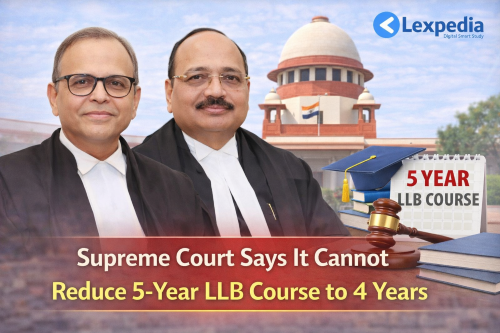
The Supreme Court of India recently observed that it cannot impose its own views on issues relating to legal education policy while hearing a Public Interest Litigation (PIL) seeking to reduce the duration of the five-year integrated LL.B course to four years.
The observations were made by a Bench comprising Chief Justice of India Surya Kant and Justice Joymalya Bagchi during the hearing of a petition filed by advocate Ashwini Upadhyay.
Petition seeking reforms in legal education
The PIL requested the Supreme Court to direct the Central Government to establish a Legal Education Commission consisting of eminent jurists, academicians, and legal experts. The commission would review and reform the framework of legal education in India, including the duration and syllabus of law courses.
According to the petitioner:
- Most professional courses in India, such as B.Tech and Chartered Accountancy, typically run for four years.
- The five-year integrated law programme after Class 12 is comparatively longer and may discourage talented students from pursuing legal studies.
The petitioner also argued that the current structure of legal education increases the financial burden on students and delays their entry into the legal profession.
Supreme Court’s observations
Responding to the submissions, the Bench expressed hesitation in interfering with policy matters relating to legal education.
The Chief Justice stated that the judiciary is only one of the many stakeholders involved in shaping legal education, and therefore it cannot impose its views on such issues.
The Court observed that questions about the structure and duration of law courses require consultation among multiple stakeholders, including:
- Academic institutions
- The Bar Council of India (BCI)
- Universities
- Legal scholars and jurists
- Policy experts and the Bar
The Bench remarked that policy decisions concerning professional education should be taken through wider deliberation rather than judicial directions.
Historical background of the five-year law course
During the hearing, the Chief Justice also referred to the history of the five-year integrated law programme in India.
He noted that the model was introduced decades ago and was not originally pioneered by the National Law School system, but earlier by Maharshi Dayanand University, Rohtak in the early 1980s.
Over the years, the five-year integrated programme has become the standard pathway for students pursuing law after Class 12.
Court questions need for judicial intervention
The Bench also questioned why a court order was required if universities themselves were dissatisfied with the current duration of the course.
The judges observed that universities and regulatory bodies like the Bar Council of India have the authority to examine and implement reforms in legal education.
Next steps in the case
After hearing the submissions, the Supreme Court indicated that the matter would require broader deliberation among stakeholders and listed the case for further consideration in April 2026.
The Court’s remarks underline the principle that educational policy reforms generally fall within the domain of academic and regulatory bodies rather than judicial intervention.
सुप्रीम कोर्ट: पाँच वर्षीय एलएलबी को चार वर्ष करने के मुद्दे पर हम अपने विचार नहीं थोप सकते
Supreme Court of India ने पाँच वर्षीय इंटीग्रेटेड एलएलबी कोर्स को चार वर्ष करने की मांग वाली जनहित याचिका (PIL) पर सुनवाई के दौरान कहा कि वह कानूनी शिक्षा से जुड़े नीतिगत मामलों पर अपने विचार नहीं थोप सकता।
यह टिप्पणी Chief Justice Surya Kant और Justice Joymalya Bagchi की पीठ ने की। यह याचिका अधिवक्ता Ashwini Upadhyay द्वारा दायर की गई थी।
याचिका में क्या मांग की गई
याचिका में केंद्र सरकार को निर्देश देने की मांग की गई कि वह एक Legal Education Commission गठित करे, जिसमें न्यायविद, शिक्षाविद और विधि विशेषज्ञ शामिल हों।
इस आयोग का उद्देश्य होगा:
- भारत में कानूनी शिक्षा प्रणाली की समीक्षा
- एलएलबी और एलएलएम कोर्स की अवधि और पाठ्यक्रम में सुधार
- विधि शिक्षा के ढांचे में व्यापक सुधार।
याचिकाकर्ता का तर्क था कि:
- भारत में अधिकांश पेशेवर कोर्स जैसे B.Tech और CA चार वर्ष के होते हैं।
- पाँच वर्ष का कानून कोर्स छात्रों को कानूनी पेशे में आने से हतोत्साहित करता है।
सुप्रीम कोर्ट की टिप्पणी
सुप्रीम कोर्ट ने कहा कि कानूनी शिक्षा से जुड़े निर्णय केवल न्यायपालिका द्वारा नहीं लिए जा सकते।
मुख्य न्यायाधीश ने कहा कि न्यायपालिका केवल एक हितधारक (stakeholder) है, जबकि इस विषय में कई अन्य पक्ष भी शामिल हैं, जैसे:
- विश्वविद्यालय
- Bar Council of India
- विधि विशेषज्ञ और शिक्षाविद
- वकील समुदाय
- नीति विशेषज्ञ
अदालत ने कहा कि इस तरह के मुद्दों पर सभी हितधारकों के बीच व्यापक विचार-विमर्श आवश्यक है।
पाँच वर्षीय कानून कोर्स का इतिहास
सुनवाई के दौरान अदालत ने पाँच वर्षीय कानून कोर्स के इतिहास का भी उल्लेख किया।
मुख्य न्यायाधीश ने कहा कि यह मॉडल 1980 के दशक में Maharshi Dayanand University, Rohtak में शुरू हुआ था, और बाद में इसे देश के कई विधि विश्वविद्यालयों ने अपनाया।
अदालत ने क्यों जताई आपत्ति
सुप्रीम कोर्ट ने यह भी पूछा कि यदि विश्वविद्यालय स्वयं इस व्यवस्था से असंतुष्ट हैं, तो वे अपने स्तर पर बदलाव क्यों नहीं करते।
अदालत ने संकेत दिया कि कानूनी शिक्षा की अवधि और संरचना तय करना मुख्य रूप से नियामक संस्थाओं और विश्वविद्यालयों का कार्य है, न कि अदालत का।
अगली सुनवाई
अदालत ने मामले को अप्रैल 2026 में आगे की सुनवाई के लिए सूचीबद्ध किया है।
यह मामला इस बात को रेखांकित करता है कि शैक्षिक नीतियों में सुधार के लिए व्यापक संस्थागत और अकादमिक विमर्श आवश्यक होता है।