Supreme Court Refuses to Entertain Plea for SC/ST Reservation in Bar Councils
Lexpedia News · 27 January 2026 · 4 min read
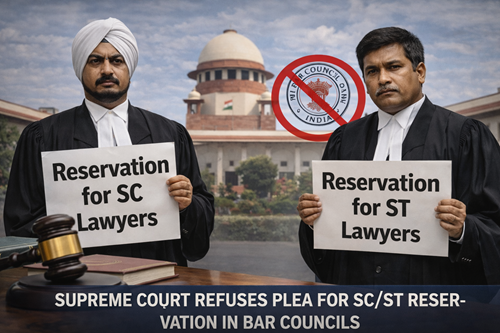
The Supreme Court of India on Tuesday declined to entertain a plea seeking reservation for Scheduled Caste (SC) and Scheduled Tribe (ST) lawyers in State Bar Councils and the Bar Council of India, holding that it was too late to consider such relief after the election process had already begun.
A Bench comprising Chief Justice of India Surya Kant, Justice R. Mahadevan and Justice Joymalya Bagchi heard a Public Interest Litigation (PIL) filed by Ram Kumar Gautam and others, who argued that SC/ST lawyers should be provided reservation in elected Bar Councils similar to measures taken for women lawyers.
The petitioners contended that while the Advocates Act, 1961 does not explicitly provide for caste-based reservation, the Supreme Court has previously intervened to enhance representation and inclusivity for women lawyers in Bar Council elections. They urged the Court to extend similar measures to SC/ST advocates.
In response, the CJI sharply criticised the timing and basis of the plea, observing that the petition was filed after State Bar Council elections had already been announced, making it inappropriate to entertain such substantive demands at that stage. “Just because the Court did something for women, you come now! You just want it on a platter!” the CJI remarked, emphasising the need for petitioners to first approach appropriate statutory authorities before seeking judicial intervention.
Chief Justice Kant noted that the relief previously referred to in connection with women lawyers did not amount to reservation per se — it was an order aimed at ensuring representation — and that the petitioners had not engaged with authorities during the prolonged period when Bar Councils existed since 1961. “We have not provided reservation for women; it is only representation,” he stated.
The Bench granted the petitioners the liberty to submit a representation to competent authorities, including the Bar Council of India, and advised that judicial review could be sought later if their representation failed to yield results. The Court also suggested that petitioners may approach it again for the next round of elections if necessary.
The Supreme Court’s refusal underscores the limited scope of judicial intervention in matters involving core electoral frameworks, particularly when legislative reform or statutory provisions would be required to alter the reservation regime within professional bodies like Bar Councils.
सुप्रीम कोर्ट ने बार काउंसिलों में SC/ST आरक्षण याचिका पर सुनवाई करने से किया इनकार
सुप्रीम कोर्ट ऑफ इंडिया ने मंगलवार को एक याचिका पर सुनवाई करने से इनकार कर दिया, जिसमें अनुसूचित जाति (SC) और अनुसूचित जनजाति (ST) वकीलों के लिए बार काउंसिलों में आरक्षण की मांग की गई थी, यह कहते हुए कि चुनाव की प्रक्रिया शुरू हो जाने के बाद ऐसा अनुरोध करना बहुत देर हो गया है।
मुख्य न्यायाधीश सूर्यकांत, न्यायमूर्ति आर. महादेवन और न्यायमूर्ति जॉयमाल्या बाग्ची की पीठ ने राम कुमार गौतम और अन्य द्वारा दायर पब्लिक इंटरेस्ट लिटिगेशन (PIL) सुनी, जिसमें याचिकाकर्ताओं ने महिलाओं के लिए Bar Council चुनावों में Representation के बाद SC/ST के लिए Reservation दिए जाने की मांग की।
याचिकाकर्ताओं का तर्क था कि जबकि एडवोकेट्स एक्ट, 1961 जाति-आधारित आरक्षण का स्पष्ट प्रावधान नहीं करता, सुप्रीम कोर्ट ने पहले महिलाओं के प्रतिनिधित्व को बढ़ाने के लिए हस्तक्षेप किया है, इसलिए SC/ST वकीलों के मामले में भी समान उपाय लागू करने चाहिए।
मुख्य न्यायाधीश ने समय और याचिका की प्रकृति पर कड़ी प्रतिक्रिया व्यक्त करते हुए कहा कि याचिका राज्य बार काउंसिल चुनावों की घोषणा के बाद दायर की गई, इसलिए इस तरह के महत्वपूर्ण बदलाव की मांग के लिए समय अनुकूल नहीं है। “बस इसलिए कि कोर्ट ने महिलाओं के लिए कुछ किया, आप अब आए! आप बस इसे थाली में चाहते हैं!” उन्होंने कहा कि याचिकाकर्ताओं को पहले प्रसंगिक वैधानिक निकायों के पास अपनी शिकायत उठानी चाहिए।
मुख्य न्यायाधीश ने यह भी कहा कि पहले महिलाओं के संदर्भ में दिए गए निर्देश आरक्षण नहीं, बल्कि प्रतिनिधित्व से संबंधित थे, और याचिकाकर्ताओं ने बार काउंसिलों के 1961 से अस्तित्व में रहने के दौरान इस मुद्दे को अधिकारियों के सामने नहीं उठाया था। “हमने महिलाओं के लिए आरक्षण नहीं दिया; यह केवल प्रतिनिधित्व है,” उन्होंने स्पष्ट किया।
पीठ ने याचिकाकर्ताओं को सक्षम अधिकारियों को प्रतिनिधित्व पेश करने की स्वतंत्रता दी और कहा कि अगर उन्हें किसी नतीजे तक नहीं पहुँचा तो वे बाद में न्यायिक हस्तक्षेप के लिए फिर से संपर्क कर सकते हैं। उन्होंने सुझाव दिया कि जरूरत पड़ी तो वे अगले चुनावों के लिए फिर से अदालत का दरवाज़ा खटखटा सकते हैं।
सुप्रीम कोर्ट का यह फैसला यह दर्शाता है कि व्यावसायिक निकायों के चुनावी ढांचे में बदलाव लाने के लिए न्यायिक हस्तक्षेप की सीमा सीमित है, विशेष रूप से जब यह परिवर्तन वैधानिक संशोधन या विधायी प्रावधानों का मामला हो।