“Judges Should Not Hesitate To Decide Rightly Even If It Costs Them Elevation”: Justice BV Nagarathna
Lexpedia News · 4 March 2026 · 4 min read
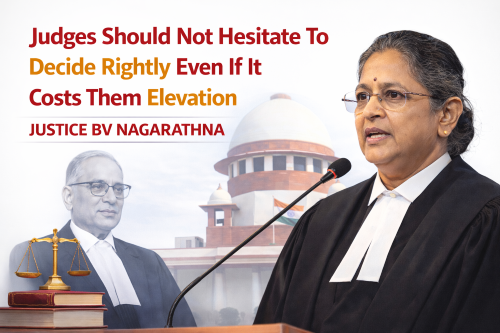
A judge must have the courage to decide cases according to the Constitution and the law, even if such decisions displease those in power or affect the judge’s chances of elevation, Supreme Court judge Justice B.V. Nagarathna said while speaking on the principles of judicial independence and constitutional duty.
Justice Nagarathna emphasised that judicial courage and integrity are essential to the meaningful exercise of judicial review. She stated that a judge’s oath of office represents a form of “judicial dharma” and must be honoured irrespective of personal or professional consequences.
According to her, if judicial decisions are shaped by fears of career setbacks or institutional displeasure, judicial review risks becoming merely symbolic rather than substantive.
Reference To Historic Judicial Dissent
Justice Nagarathna illustrated her point by referring to the historic dissent of Justice H.R. Khanna in the ADM Jabalpur v. Shivkant Shukla (Habeas Corpus) case during the Emergency.
Justice Khanna’s dissent held that fundamental rights and personal liberty cannot be suspended even during an Emergency, a view that went against the majority of the Supreme Court at that time. His dissent reportedly cost him the opportunity to become the Chief Justice of India, as he was superseded by the government.
However, Justice Nagarathna noted that constitutional history eventually vindicated Justice Khanna’s position, particularly when the Supreme Court in the landmark Justice K.S. Puttaswamy v. Union of India judgment reaffirmed the primacy of fundamental rights and explicitly overruled ADM Jabalpur.
Two Dimensions Of Judicial Independence
Justice Nagarathna explained that judicial independence operates in two important dimensions:
-
Independence from external influence – Judges must remain free from political pressure, institutional intimidation, or public opinion.
-
Independence within the judiciary – Judges must have the freedom to form their own legal views and express separate or dissenting opinions, even when they differ from colleagues on the Bench.
She highlighted that dissenting opinions are an important expression of intellectual autonomy and reflect the deepest form of judicial independence.
Judicial Duty And Constitutional Morality
Justice Nagarathna stressed that judges must remain faithful to constitutional values rather than political expediency.
She noted that the legitimacy of the judiciary depends not only on constitutional safeguards but also on how judges perform their duties with courage, conviction, and independence.
Legal observers say her remarks come at a time when debates on judicial independence, accountability, and institutional integrity are increasingly prominent in India’s constitutional discourse.
“यदि पदोन्नति प्रभावित हो या सत्ता नाराज़ हो, तब भी न्यायाधीशों को सही निर्णय लेने से नहीं हिचकना चाहिए”: न्यायमूर्ति बी.वी. नागरत्ना
सुप्रीम कोर्ट की न्यायाधीश न्यायमूर्ति बी.वी. नागरत्ना ने कहा कि न्यायाधीशों को संविधान और कानून के अनुसार निर्णय लेने में संकोच नहीं करना चाहिए, भले ही इससे उनकी पदोन्नति प्रभावित हो या सत्ता में बैठे लोग असंतुष्ट हों।
उन्होंने कहा कि न्यायाधीश के पद की शपथ “न्यायिक धर्म” है, जिसे व्यक्तिगत या पेशेवर परिणामों की परवाह किए बिना निभाया जाना चाहिए। यदि न्यायिक निर्णय कैरियर संबंधी चिंताओं के कारण प्रभावित होने लगें, तो न्यायिक समीक्षा का उद्देश्य ही कमजोर हो जाता है।
ऐतिहासिक उदाहरण: जस्टिस एच.आर. खन्ना का असहमति निर्णय
न्यायमूर्ति नागरत्ना ने ADM जबलपुर बनाम शिवकांत शुक्ला मामले में जस्टिस एच.आर. खन्ना के ऐतिहासिक असहमति (dissent) का उल्लेख किया।
आपातकाल के दौरान दिए गए इस फैसले में जस्टिस खन्ना ने कहा था कि व्यक्तिगत स्वतंत्रता और मौलिक अधिकार पूरी तरह समाप्त नहीं किए जा सकते, भले ही आपातकाल लागू हो।
इस असहमति के कारण उन्हें बाद में मुख्य न्यायाधीश बनने का अवसर नहीं मिला, क्योंकि सरकार ने उन्हें वरिष्ठता के बावजूद पदोन्नत नहीं किया।
हालांकि बाद में सुप्रीम कोर्ट ने पुट्टस्वामी बनाम भारत संघ मामले में ADM जबलपुर के फैसले को पलटते हुए जस्टिस खन्ना के दृष्टिकोण को सही ठहराया।
न्यायिक स्वतंत्रता के दो आयाम
न्यायमूर्ति नागरत्ना ने न्यायिक स्वतंत्रता के दो प्रमुख पहलुओं को बताया:
-
बाहरी प्रभाव से स्वतंत्रता – न्यायाधीश राजनीतिक दबाव, संस्थागत दबाव या जनमत से मुक्त होकर निर्णय लें।
-
न्यायपालिका के भीतर स्वतंत्रता – न्यायाधीशों को अपने विचार स्वतंत्र रूप से व्यक्त करने और असहमति वाले निर्णय (dissent) लिखने की स्वतंत्रता होनी चाहिए।
उन्होंने कहा कि असहमति वाले निर्णय न्यायिक स्वतंत्रता की सर्वोच्च अभिव्यक्ति हैं।
संवैधानिक मूल्यों पर जोर
न्यायमूर्ति नागरत्ना ने कहा कि न्यायपालिका की विश्वसनीयता इस बात पर निर्भर करती है कि न्यायाधीश संवैधानिक मूल्यों, साहस और ईमानदारी के साथ अपने कर्तव्यों का पालन करें।