Bombay High Court Pulls Up Police For ‘Casual’ Probe Into Fake High Court Orders, Orders Fresh Investigation
Lexpedia News · 9 May 2026 · 8 min read
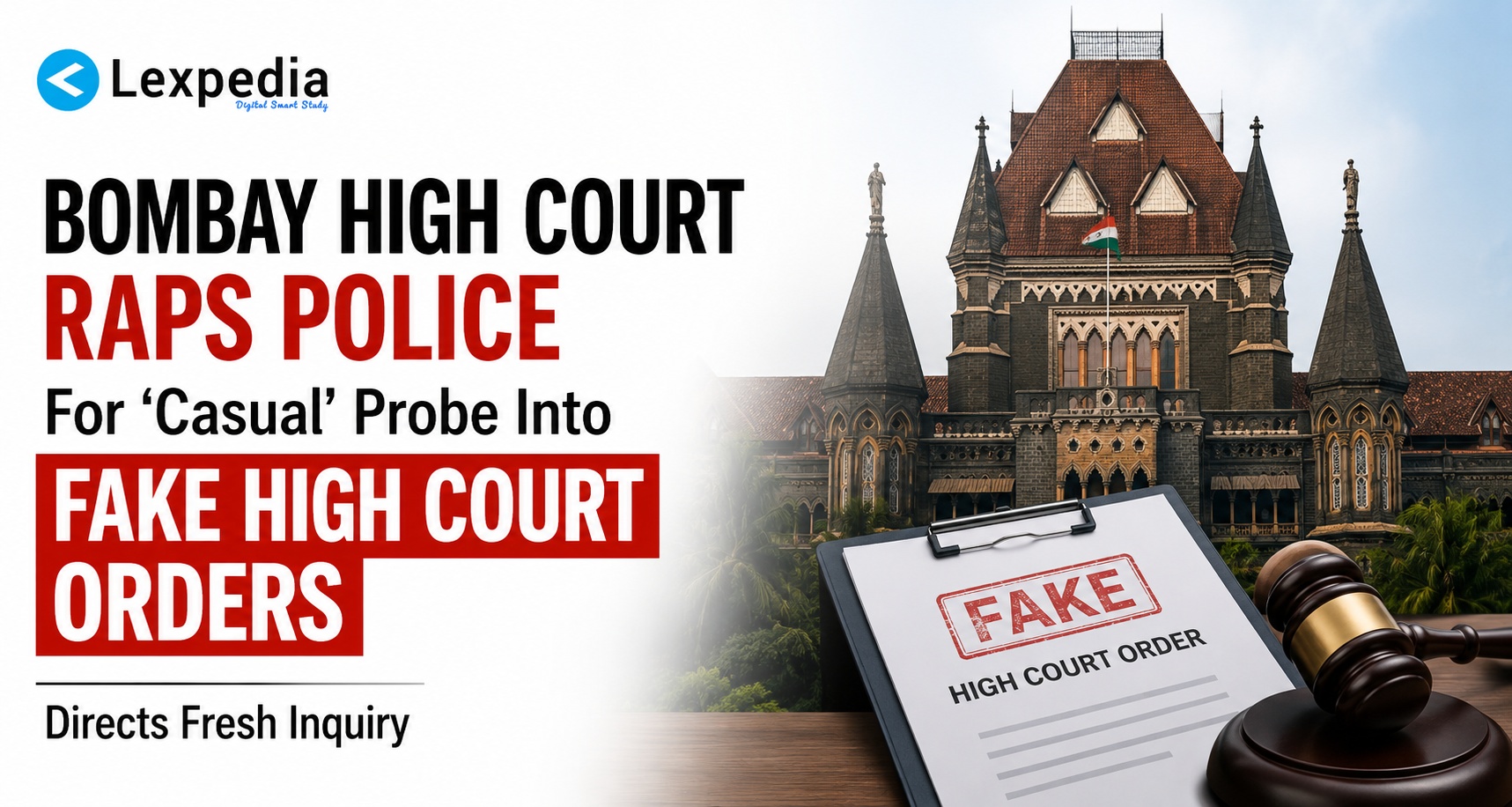
The Bombay High Court has strongly criticized the Mumbai Police for conducting what it termed a “casual” investigation into a serious case involving alleged fabrication of fake High Court orders by an advocate. The Court directed the police to carry out a fresh and more comprehensive probe into the matter.
Justice R.M. Joshi observed that the case involved fabrication of judicial orders of the High Court itself and therefore demanded an investigation of the “utmost seriousness.” The Court expressed shock at the manner in which the investigation had been conducted and questioned why the police failed to identify the actual person responsible for forging the documents.
Background Of The Case
The matter arose from allegations against advocate Vinaykumar Ashok Khatu, who was accused by his former client of handing over fabricated Bombay High Court orders and other bogus judicial documents.
According to the complaint:
- the advocate allegedly provided fake High Court orders dated October 17, 2022 and December 12, 2022,
- represented them as genuine judicial orders,
- and misled the client regarding pendency and status of proceedings before the High Court.
The matter later came under police investigation, and a chargesheet was eventually filed on January 17, 2025.
High Court Finds Prima Facie Material Of Forgery
Justice R.M. Joshi noted that there was prima facie material on record indicating that the alleged court orders were “bogus documents.”
The Court observed:
“There is prima facie material on record to show that these orders are bogus documents.”
The judge emphasized that fabrication of judicial orders strikes at the integrity of the justice delivery system and therefore required a highly professional and thorough investigation.
The Court remarked that the investigating agency should have made all possible efforts to trace:
- who prepared the forged documents,
- how they were circulated,
- and whether any larger conspiracy was involved.
Court Slams Police For Failure To Identify Real Culprit
During the hearing, the Court specifically asked the investigating officer who had actually fabricated the fake orders.
However, the investigating officer reportedly failed to provide any satisfactory answer.
Justice Joshi sharply criticized the investigation and observed:
“This is a shocking state of affair.”
The Court further said that the probe appeared to have been conducted:
- in a predetermined manner,
- only in one direction,
- and without genuine efforts to identify the real source of the forged judicial documents.
The Court’s observations indicate serious judicial concern regarding the quality and fairness of the police investigation.
WhatsApp Chats Become Crucial In The Case
One of the key aspects discussed before the Court was a set of WhatsApp chats exchanged between the accused advocate and the complainant client.
The accused argued that:
- the chats continued even after the alleged fake orders were handed over,
- and the conversations reflected discussions regarding pending High Court proceedings.
According to the accused, these chats contradicted the prosecution’s theory and supported his claim of false implication.
The prosecution, however, argued that:
- WhatsApp chats could not be treated as admissible evidence without compliance with Section 65B of the Indian Evidence Act,
- and witness statements supported allegations regarding delivery of forged court orders.
Court Questions Failure To Examine Digital Evidence
The High Court expressed dissatisfaction with the manner in which electronic evidence had been handled by the police.
Justice Joshi noted that:
- the investigating officer was aware that screenshots of WhatsApp chats had already been placed before the Court in earlier anticipatory bail proceedings,
- the chats were also part of the chargesheet,
- yet the police failed to properly examine or analyze them.
The Court also criticized the police for not conducting proper forensic analysis of the seized mobile phone.
This failure, according to the Court, demonstrated the “casual” and incomplete nature of the investigation.
Fresh Probe Ordered By Bombay High Court
Considering the deficiencies in investigation, the Court directed a further probe into the matter.
The fresh inquiry is expected to focus particularly on:
- the WhatsApp communications,
- digital evidence,
- origin of forged documents,
- and identification of persons involved in preparing fake judicial orders.
The Court’s intervention reflects growing judicial concern regarding:
- misuse of judicial documents,
- forgery of court orders,
- and lapses in criminal investigation involving sensitive legal frauds.
Seriousness Of Forged Judicial Orders
Fabrication of court orders is considered an extremely serious offence because it directly undermines:
- public confidence in the judiciary,
- authenticity of judicial records,
- and administration of justice.
Legal experts note that fake judicial orders can potentially:
- mislead litigants,
- influence ongoing proceedings,
- create fraudulent claims,
- and obstruct justice delivery mechanisms.
The Bombay High Court’s strong observations therefore signal a zero-tolerance approach toward manipulation or forgery of judicial documents.
Case Highlights Growing Concern Over Legal Fraud
The case has once again highlighted concerns regarding:
- document forgery within litigation processes,
- misuse of digital communication,
- and the need for technologically sound investigations.
In recent years, several courts have expressed concern regarding:
- fake orders,
- forged vakalatnamas,
- fabricated legal documents,
- and impersonation within judicial proceedings.
Legal observers believe the present case could lead to stricter scrutiny of:
- document authentication procedures,
- police handling of legal fraud investigations,
- and digital forensic practices.
Bail Proceedings Continue
The matter was being heard during consideration of a bail application filed by the accused advocate.
While ordering further investigation, the Court continued hearing issues related to:
- bail,
- evidentiary value of digital communications,
- and the overall role of the accused in the alleged forgery operation.
Further proceedings in the matter are expected before the Bombay High Court in the coming days.
फर्जी हाई कोर्ट आदेशों की जांच में ‘लापरवाही’ पर बॉम्बे हाई कोर्ट ने पुलिस को फटकारा, नई जांच के आदेश:
बॉम्बे हाई कोर्ट ने फर्जी हाई कोर्ट आदेशों के कथित निर्माण से जुड़े मामले में मुंबई पुलिस की “casual” जांच पर कड़ी नाराजगी जताई है। अदालत ने मामले में नई और विस्तृत जांच करने का निर्देश दिया।
Justice R.M. Joshi ने कहा कि यह मामला स्वयं हाई कोर्ट के आदेशों की जालसाजी से जुड़ा है, इसलिए इसकी जांच अत्यंत गंभीरता से की जानी चाहिए थी। अदालत ने कहा कि पुलिस वास्तविक आरोपी का पता लगाने में विफल रही।
क्या है पूरा मामला?
मामला advocate Vinaykumar Ashok Khatu के खिलाफ लगाए गए आरोपों से जुड़ा है। उनके पूर्व client ने आरोप लगाया कि उन्होंने बॉम्बे हाई कोर्ट के फर्जी आदेश और अन्य नकली न्यायिक दस्तावेज उसे सौंपे।
शिकायत के अनुसार:
- वकील ने 17 अक्टूबर 2022 और 12 दिसंबर 2022 के कथित हाई कोर्ट आदेश दिए,
- उन्हें वास्तविक न्यायिक आदेश बताकर पेश किया,
- तथा client को मुकदमे की स्थिति के बारे में गुमराह किया।
बाद में पुलिस जांच शुरू हुई और 17 जनवरी 2025 को chargesheet दाखिल की गई।
हाई कोर्ट ने कहा— रिकॉर्ड पर फर्जीवाड़े के प्रथमदृष्टया सबूत
Justice R.M. Joshi ने कहा कि रिकॉर्ड पर प्रथमदृष्टया यह दिखता है कि कथित आदेश “bogus documents” हैं।
अदालत ने कहा:
“There is prima facie material on record to show that these orders are bogus documents.”
कोर्ट ने कहा कि न्यायालयी आदेशों की जालसाजी न्याय व्यवस्था की विश्वसनीयता पर सीधा हमला है।
‘शॉकिंग’ बताई पुलिस जांच
सुनवाई के दौरान अदालत ने जांच अधिकारी से पूछा कि फर्जी आदेश वास्तव में किसने तैयार किए।
लेकिन जांच अधिकारी इसका संतोषजनक जवाब नहीं दे सके।
Justice Joshi ने कहा:
“This is a shocking state of affair.”
कोर्ट ने कहा कि जांच:
- पूर्व निर्धारित तरीके से की गई,
- केवल एक दिशा में केंद्रित रही,
- और वास्तविक आरोपी तक पहुंचने का गंभीर प्रयास नहीं किया गया।
WhatsApp Chats बने महत्वपूर्ण साक्ष्य
मामले में WhatsApp chats महत्वपूर्ण मुद्दा बनकर सामने आए।
आरोपी ने कहा कि:
- कथित फर्जी आदेश दिए जाने के बाद भी client के साथ chats जारी रहीं,
- और बातचीत में मुकदमे की pendency पर चर्चा हुई।
आरोपी के अनुसार यह उसकी झूठी फंसाए जाने की दलील को मजबूत करता है।
वहीं prosecution ने कहा कि:
- Section 65B Evidence Act के प्रमाणपत्र के बिना WhatsApp chats को स्वीकार नहीं किया जा सकता,
- जबकि गवाहों के बयान फर्जी आदेश दिए जाने की पुष्टि करते हैं।
डिजिटल साक्ष्य की जांच न करने पर अदालत नाराज
हाई कोर्ट ने पुलिस द्वारा electronic evidence की जांच पर भी नाराजगी जताई।
कोर्ट ने कहा कि:
- जांच अधिकारी को पहले से पता था कि WhatsApp screenshots पहले anticipatory bail proceedings में दाखिल किए जा चुके हैं,
- chats chargesheet का हिस्सा थीं,
- फिर भी उनका उचित विश्लेषण नहीं किया गया।
कोर्ट ने seized mobile phone की forensic जांच न करने पर भी सवाल उठाए।
नई जांच के आदेश
इन कमियों को देखते हुए अदालत ने मामले में fresh probe के आदेश दिए।
नई जांच विशेष रूप से:
- WhatsApp chats,
- digital evidence,
- फर्जी दस्तावेजों के स्रोत,
- तथा जालसाजी में शामिल व्यक्तियों
पर केंद्रित होगी।
फर्जी न्यायिक आदेश क्यों गंभीर अपराध हैं?
न्यायालयी आदेशों की जालसाजी को अत्यंत गंभीर अपराध माना जाता है क्योंकि इससे:
- न्यायपालिका में जनता का विश्वास प्रभावित होता है,
- न्यायिक रिकॉर्ड की प्रामाणिकता पर सवाल उठते हैं,
- और न्याय व्यवस्था बाधित होती है।
विशेषज्ञों के अनुसार फर्जी आदेश:
- litigants को गुमराह कर सकते हैं,
- अदालत की कार्यवाही प्रभावित कर सकते हैं,
- और न्याय प्रक्रिया को नुकसान पहुंचा सकते हैं।
कानूनी व्यवस्था में बढ़ती जालसाजी पर चिंता
यह मामला फिर से यह दिखाता है कि न्यायिक प्रक्रिया में:
- forged documents,
- fake court orders,
- forged vakalatnamas,
- तथा impersonation
जैसी घटनाओं को लेकर चिंता बढ़ रही है।
विशेषज्ञों का मानना है कि यह मामला:
- document authentication,
- police investigation standards,
- तथा digital forensic practices
को लेकर नए सुधारों की आवश्यकता को उजागर करता है।
बेल पर सुनवाई जारी
मामला आरोपी वकील की bail application की सुनवाई के दौरान सामने आया।
अदालत फिलहाल:
- bail,
- digital evidence की admissibility,
- तथा आरोपी की भूमिका
से जुड़े मुद्दों पर सुनवाई जारी रखे हुए है।