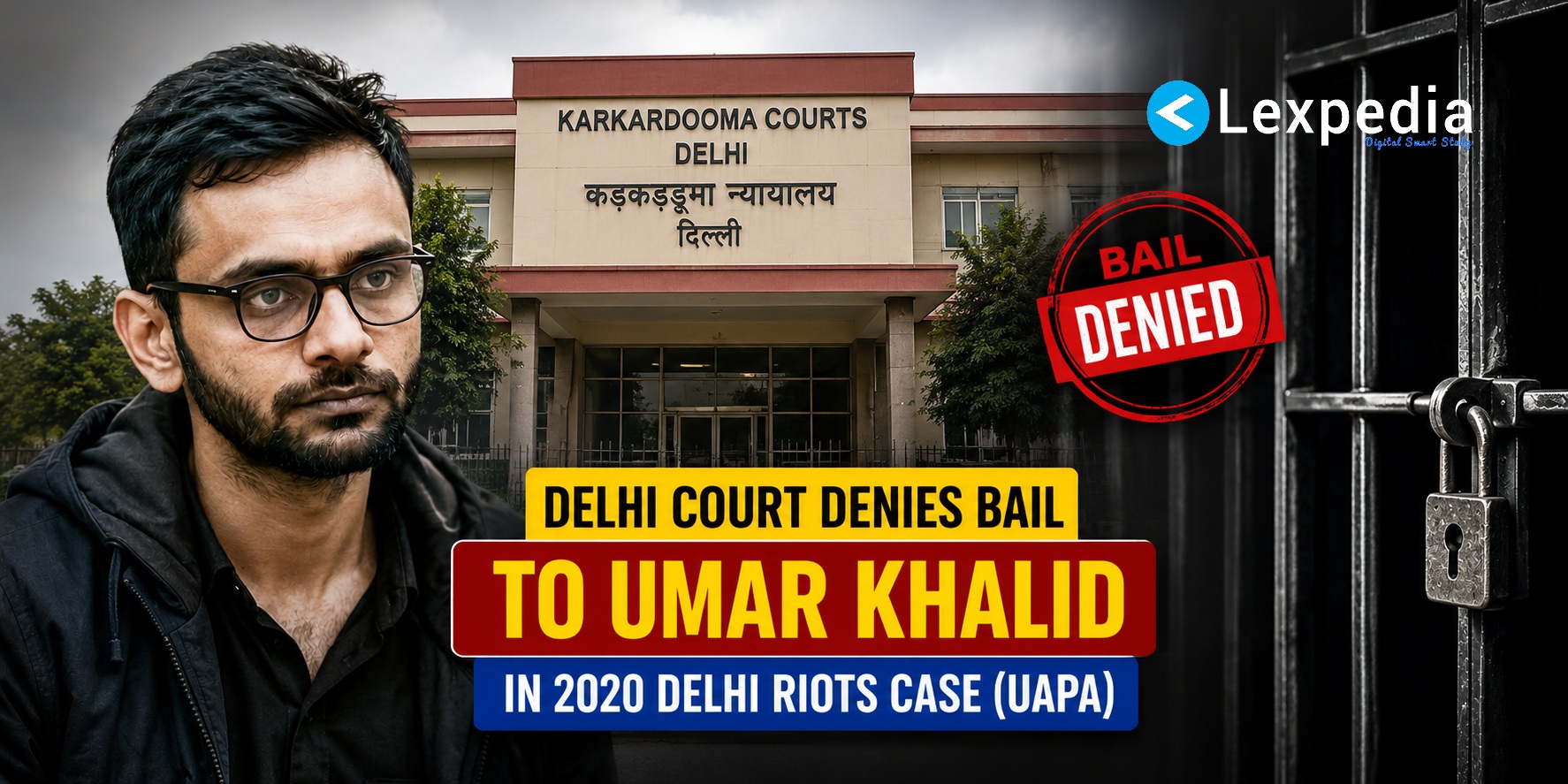
Supreme Court Denies Bail to Umar Khalid and Sharjeel Imam in Delhi Riots Larger Conspiracy Case
Lexpedia · 7 January 2026 · 4 min read
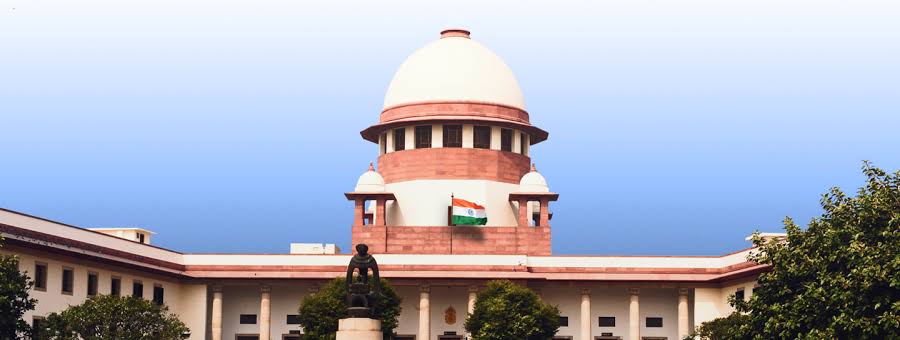
The Supreme Court of India on Monday, while dismissing the bail pleas of Umar Khalid and Sharjeel Imam in the Delhi riots larger conspiracy case, observed that delay in trial would not operate as a trump card to automatically grant bail for offences punishable under the Unlawful (Activities) Prevention Act, 1967 (UAPA).
“In prosecutions alleging offences which implicate the sovereignty, integrity, or security of the State, delay does not operate as a trump card that automatically displaces statutory restraint. Rather, delay serves as a trigger for heightened judicial scrutiny,” observed a bench of Justices Aravind Kumar and N.V. Anjaria, stating that the outcome of bail pleas in UAPA offences must be determined by a proportional and contextual balancing of legally relevant considerations, including:
-
The gravity and statutory character of the offence alleged.
-
The role attributed to the accused within the alleged design or conspiracy.
-
The strength of the prima facie case as it emerges at the limited threshold contemplated under the special statute.
-
The extent to which continued incarceration, viewed cumulatively in the facts of the case, has become demonstrably disproportionate so as to offend the guarantee of personal liberty under Article 21.
Arguments by the Accused
The Appellants/Accused argued that prolonged delay in trial entitles them to seek bail, regardless of the statutory limitations under Section 43D(5) UAPA, as prolonged incarceration, coupled with the absence of any realistic prospect of early trial, rendered continued detention constitutionally impermissible, placing the mandate of Article 21 at peril.
Reference was made to Union of India v. K.A. Najeeb, (2021) 3 SCC 713, arguing that where the trial is not likely to commence or conclude within a reasonable period, constitutional courts retain the jurisdiction to grant bail notwithstanding statutory restraints.
Court’s Rejection of the Arguments
Rejecting their arguments, the judgment authored by Justice Aravind Kumar observed that delay in trial alone cannot be the sole determinant to grant bail in UAPA offences, reasoning that claims to liberty must be examined in the totality of circumstances, particularly where allegations implicate organised criminality or matters of public interest.
The Court cited Gurwinder Singh v. State of Punjab and CBI v. Dayamoy Mahato, cautioning against mechanical invocation of prolonged incarceration as a ground for bail in cases involving serious offences under special enactments.
The Court found the Appellants’ reliance on K.A. Najeeb misplaced, stating that in Najeeb, the trial of the accused was separate, whereas in the present case, the accused are facing trial together. The Court emphasized that Najeeb does not create a mechanical rule or a trump card.
It clarified that the statutory embargo under Section 43D(5) UAPA, which bars bail if the court finds reasonable grounds to believe the accusation is prima facie true, cannot be eclipsed by mere passage of time.
“To read Najeeb as mandating bail solely on account of prolonged incarceration, irrespective of the statutory context or the nature of allegations, would attribute to the decision a consequence it neither intended nor supports. Such a construction would also neutralise a special statute enacted to address offences implicating the sovereignty, integrity, and security of the State,” the Court observed.
Interpretation of Section 15 and Section 18 UAPA
The Court examined Section 15 UAPA, observing that it encompasses forms of violence that threaten the sovereignty and security of the nation, even if they destabilise civic life without immediate physical violence.
-
Section 15 is not limited to conventional violence like bombs, explosives, firearms, but includes acts “by any other means of whatever nature”.
-
The consequence contemplated under Section 15 includes disruption of essential services or economic supplies, which do not need to be accompanied by immediate physical violence.
The Court reasoned that calls by the accused to hold “chakka jams” disrupting vital parts of the city amounted to a conspiracy to commit terrorist acts under Section 15 read with Section 18.
It clarified that Section 18 ensures criminal liability extends to those who contribute through planning, coordination, mobilisation, or other forms of concerted action.
Findings and Bail Orders
-
Bail Denied: Umar Khalid and Sharjeel Imam, as prima facie architects of the conspiracy.
-
Bail Granted: Gulfisha Fatima, Meeran Haider, Shifa Ur Rehman, Mohd Saleem Khan, and Shadab Ahmad, whose roles were merely facilitative.
The Court found reasonable grounds to believe that Sharjeel Imam and Umar Khalid’s conduct bore a prima facie nexus to a terrorist act as defined under Section 15.