Supreme Court Declines to Mandate Compulsory Voting, Holds Participation Cannot Be Enforced by Law
Lexpedia News · 16 April 2026 · 3 min read
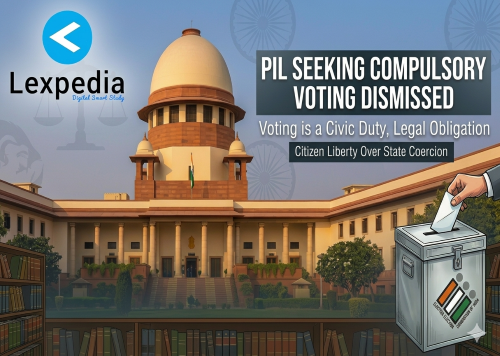
The Supreme Court of India on April 16 dismissed a Public Interest Litigation (PIL) seeking directions for the introduction of compulsory voting in India, along with penal consequences for citizens who deliberately abstain from exercising their franchise. A bench comprising Chief Justice Surya Kant, Justice Joymalya Bagchi, and Justice Vipul Pancholi held that participation in the electoral process, though fundamental to democracy, cannot be compelled through coercive legal mechanisms.
Background and Reliefs Sought
The petition, filed under Article 32 of the Constitution, sought directions to the Union Government and the Election Commission of India to:
-
Introduce a framework for compulsory voting
-
Prescribe penalties or disincentives for citizens who fail to vote without valid reasons
-
Constitute a committee to formulate guidelines governing mandatory electoral participation
The petitioner also suggested that access to certain government services or benefits could be restricted for non-voters as a means of enforcement.
Court’s Observations on Compulsion and Liberty
The Court firmly rejected the premise that voting can be made compulsory by judicial direction. Chief Justice Surya Kant observed that while every citizen in a constitutional democracy governed by the rule of law is expected to participate in elections, the State cannot compel individuals to vote. The Court highlighted that such compulsion would raise serious concerns regarding personal liberty and autonomy. In a significant oral observation, the Chief Justice questioned the enforceability of the proposal, remarking on whether the State could penalize or even arrest individuals for abstaining from voting, thereby exposing the impracticality and constitutional fragility of the petitioner's suggestions.
Voting as a Civic Duty, Not a Legal Obligation
The Bench emphasized that the right to vote, though a cornerstone of democratic governance, operates primarily within the realm of civic responsibility rather than enforceable legal duty. It noted that transforming voting into a statutory obligation backed by penalties would alter its essential character and may conflict with broader constitutional values, including freedom of choice and expression.
Preference for Awareness Over Coercive Measures
The Court underscored that the appropriate approach to increasing voter turnout lies in strengthening public awareness and civic education, rather than imposing punitive measures. It observed that low voter participation, particularly in urban areas, is a matter of concern, but the remedy must be sought through democratic engagement, awareness campaigns, and institutional reforms, not coercion.
Separation of Powers and Policy Domain
Reiterating the principle of separation of powers, the Court held that the issue of compulsory voting falls squarely within the policy domain of the legislature and executive. The judiciary, it noted, cannot direct the formulation of such policy measures, especially where they involve complex socio-political considerations and legislative judgment.
Final Order of the Court
The Supreme Court disposed of the petition, declining to grant the reliefs sought. However, it granted liberty to the petitioner to approach the appropriate authorities, including the legislature or the Election Commission, for consideration of the proposal in accordance with law.
Notably, the observations come in the backdrop of earlier concerns expressed by Chief Justice Surya Kant regarding declining voter turnout, especially in metropolitan regions. In a separate matter, the Court had informally suggested exploring mechanisms to improve electoral participation. However, in the present case, the Court clarified that compulsory voting enforced through legal sanctions is not constitutionally sustainable.
Case Title: Ajay Goel v. Union of India