Subsidy Bill of Delhi Skyrockets by Over 600% Under AAP: Legal Implications on State Finances
Lexpedia · 27 January 2025 · 3 min read
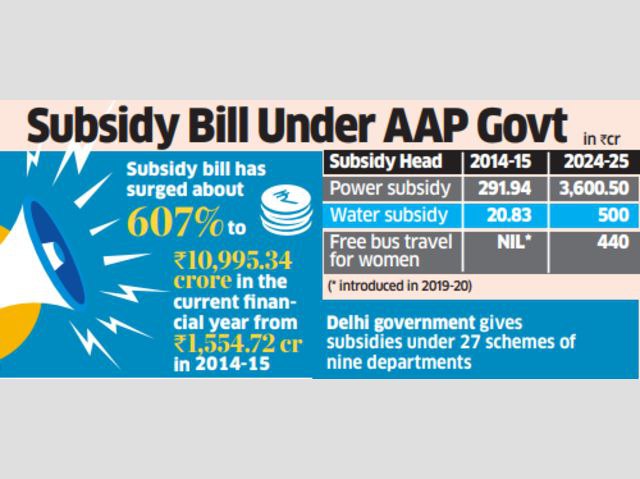
In a startling revelation, the subsidy bill of the Delhi government has surged by more than 600% over the last decade, sparking debate over the long-term sustainability of these financial commitments. This exponential rise in subsidies, which includes free water, free power, and free bus travel for women, has led to concerns about the state's financial health and its ability to manage its fiscal responsibilities.
The Surge in Subsidy Bills
In the current financial year, Delhi’s subsidy bill has ballooned to ₹10,995.34 crore, up from ₹1,554.72 crore in 2014-15—a remarkable 607% increase. The city’s finances are now facing significant pressure as it is projected to enter a revenue deficit by the end of 2025-26, the first in three decades. This marks a sharp departure from Delhi's previous history of fiscal stability.
The Rise of 27 Subsidy Schemes
The subsidy burden is spread across 27 schemes involving nine departments, including water, power, transport, and education. Notable among them are the Aam Aadmi Party's (AAP) signature policies, such as:
- Free Water: 20,000 liters per month for every household.
- Free Electricity: 200 units of free power per month, with 50% subsidies for higher usage.
- Free Bus Travel for Women: Introduced in the lead-up to the 2020 elections, further expanding the scope of state-funded schemes.
These flagship programs have grown in scale, with the power subsidy bill soaring from ₹291.94 crore in 2014-15 to ₹3,600.50 crore in 2024-25, reflecting a 1,133% increase in just 10 years. Similarly, the water subsidy has grown from ₹20.83 crore to ₹500 crore over the same period.
Political Parties’ Promises Intensify the Subsidy Burden
As the 2025 Delhi Assembly elections approach, political parties—including the Congress and BJP—have pledged to continue these subsidy schemes, further fueling the competition to provide more "freebies" to voters. The AAP government, already committed to providing ₹2,100 per month for women and priests, may see its subsidy bill escalate even further, placing additional strain on the city's finances.
Subsidies vs. Freebies: The Legal and Economic Debate
- While the provision of subsidies can be a tool for making essential goods and services more accessible, there is growing concern that many of these schemes may be slipping into the realm of freebies—political promises that offer immediate benefits without long-term economic planning.
- The Reserve Bank of India (RBI) has raised alarms over the economic consequences of such subsidies. A recent RBI research paper points out that while subsidies like public distribution systems and health programs offer economic benefits, free electricity, free water, and waivers on utility bills could distort pricing mechanisms, harm private investments, and disincentivize work.
- Moreover, excessive subsidies on natural resources, such as water, can lead to environmental degradation. The practice of offering free water and power may encourage overuse, which contributes to the depletion of vital resources like groundwater.
Legal Perspective on Fiscal Responsibility
- From a legal standpoint, the expansion of these schemes raises significant questions regarding public finance management. Experts argue that such expansive financial commitments, if not properly balanced, could jeopardize the fiscal health of the state, violating principles of fiscal prudence and sustainability outlined in the Fiscal Responsibility and Budget Management (FRBM) Act.
- Moreover, if these subsidies lead to increased debt or a significant revenue deficit, the Delhi government could face legal challenges from creditors or watchdog organizations concerned about the long-term viability of the state’s finances.
The Path Forward: Ensuring Sustainability
- As the subsidies continue to rise, Delhi must address the long-term fiscal impact of these schemes. Experts suggest that while the targeting of subsidies can be an effective tool for supporting vulnerable populations, there must be a careful balance between providing financial assistance and maintaining fiscal discipline.
- The state must also ensure that subsidies are environmentally sustainable, especially in sectors like water and energy, where misuse and overconsumption can have significant ecological consequences.
- In conclusion, while subsidies are an essential tool for social welfare, there is an urgent need for legal frameworks that ensure these schemes are implemented in a manner that is both economically responsible and environmentally sound.