‘Lalita Kumari’ Judgment Misused A Lot, Says Supreme Court On Challenge To BNSS Allowing Preliminary Enquiry Before FIR
Lexpedia News · 28 February 2026 · 6 min read
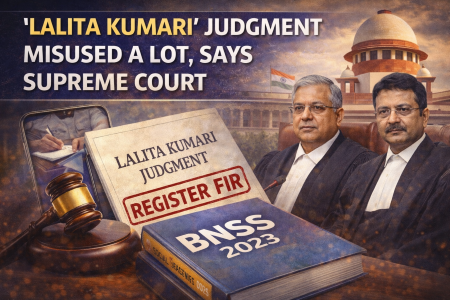
The Supreme Court of India has observed that its landmark 2013 judgment in Lalita Kumari v. State of Uttar Pradesh — which held that a First Information Report (FIR) must be registered if a complaint prima facie discloses a cognizable offence — has been “misused a lot” over the years, particularly in the context of police procedure before registering FIRs. The comments were made orally by a Bench comprising Chief Justice of India Surya Kant and Justice Joymalya Bagchi while hearing petitions challenging provisions of the Bharatiya Nagarik Suraksha Sanhita (BNSS) that allow limited preliminary enquiry before filing an FIR in certain cases.
The case before the Supreme Court involves a challenge to Section 173(3) of the BNSS, which permits the officer-in-charge of a police station, with authorization from a Deputy Superintendent of Police (DySP), to conduct a preliminary enquiry in cases punishable with imprisonment between three and seven years before registering an FIR. Petitioners argue that this provision conflicts with the Lalita Kumari mandate that police must register an FIR upon receipt of information disclosing a cognizable offence, without preliminary verification.
Background: Lalita Kumari Judgment And BNSS Provision
In Lalita Kumari v. State of UP (2013), the Supreme Court held that once information discloses a cognizable offence, the police are obligated to register an FIR immediately under Section 154 of the Criminal Procedure Code (CrPC), 1973 — without conducting a preliminary inquiry — except in limited categories where the information received does not prima facie disclose a cognizable offence.
However, the newly enacted Bharatiya Nagarik Suraksha Sanhita (BNSS), 2023 — one of the three criminal law reform statutes that replaced the CrPC — statutorily permits a preliminary enquiry in certain mid-range offences punishable with three to seven years of imprisonment before FIR registration, subject to senior police authorization.
Petitioners’ Arguments
Senior Advocate Menaka Guruswamy, appearing for the petitioner, argued that Section 173(3) of the BNSS violates the spirit of the Lalita Kumari judgment by allowing police to delay FIR registration and possibly discourage legitimate complaints. She submitted that police should not be permitted to “test the truth of allegations” before FIR registration as this can undermine citizen access to justice and conflict with the Supreme Court’s constitutional mandate.
Supreme Court’s Observations
The Bench expressed concern that the Lalita Kumari directions, though well-intended, have often been applied mechanically and misused, leading to proliferation of frivolous FIRs and consequent heavy litigation, including numerous petitions for quashing FIRs. The CJI observed that while the judicial directive required immediate FIR registration where cognizable offences were disclosed, it was frequently exploited by litigants and courts alike, resulting in procedural burden and misuse.
CJI Surya Kant remarked that sometimes judicial pronouncements are made from “ivory towers” without effectively accounting for “ground realities,” and noted that the Lalita Kumari judgment’s rigid approach has fueled serial misuse by litigants filing complaints to stymie opponents or create procedural advantage.
When Senior Advocate Guruswamy argued that the police should not conduct pre-FIR verification, the CJI asked rhetorically: “Who else will verify?” indicating practical challenges in enforcing a no-enquiry mandate in all cases. Justice Bagchi’s Input
Justice Bagchi stated that the law governing access to justice cannot remain permanently “crystallized” in a single form as set out in Lalita Kumari. He pointed out that the original Lalita Kumari judgment itself recognized exceptions where preliminary enquiry may be permissible. According to him, the BNSS merely expands that concept by linking it to the severity of punishment, and the Court has the power to assess whether such classification is arbitrary or irrational.
Court’s Rationale And Way Forward
The Bench suggested that the new law should be allowed to operate for a period of years, after which courts can assess its real-world functioning before intervening on broad principles. The Supreme Court informed the parties that further hearings would resume following the Holi vacations.
The petitioner in the main petition is Azad Singh Kataria v. Union of India, W.P.(Crl.) No. 461/2024, which is connected with another petition by the Mannargudi Bar Association challenging Section 173(3) BNSS. Senior Advocate S. Nagamuthu appears in the connected petition.
‘ललिता कुमारी’ फैसला बहुत गलत इस्तेमाल हुआ: सुप्रीम कोर्ट ने FIR से पहले प्रारंभिक जांच की अनुमति देने वाले BNSS प्रावधान को चुनौती देते हुए टिप्पणी की
भारत की सुप्रीम कोर्ट ने शुक्रवार को मौखिक रूप से कहा कि ललिता कुमारी बनाम राज्य (2013) के 2013 के फैसले का बहुत गलत इस्तेमाल हुआ है। उस फैसले में यह निर्देश दिया गया था कि यदि किसी शिकायत में प्रथम दृष्टया कोई कॉग्निज़ेबल अपराध प्रकट होता है, तो पुलिस को तत्काल FIR दर्ज करनी चाहिए, कुछ विशिष्ट परिस्थितियों को छोड़कर। यह टिप्पणी अदालत ने उन याचिकाओं पर सुनवाई के दौरान की, जो भारतीय नागरिक सुरक्षा संहिता (BNSS) की धारा 173(3) को चुनौती देती हैं, जो कुछ मामलों में FIR से पहले प्रारंभिक जांच की अनुमति देती है।
पृष्ठभूमि: ललिता कुमारी फैसले और BNSS प्रावधान
ललिता कुमारी v. यूपी के 2013 के फैसले में सुप्रीम कोर्ट ने कहा था कि अगर सूचना किसी कॉग्निज़ेबल अपराध का प्रथम दृष्टया खुलासा करती है, तो पुलिस को FIR तुरंत दर्ज करनी चाहिए, बिना प्रारंभिक जांच किए। प्रारंभिक जांच केवल उन स्थितियों में तभी हो सकती है जहां सूचना स्पष्ट रूप से अपराध नहीं बताती।
नया भारतीय नागरिक सुरक्षा संहिता, 2023 (BNSS), दिल्ली के नए आप्रवासी आपराधिक कानूनों में से एक है, जिसमें धारा 173(3) के तहत पुलिस को कुछ 3 से 7 वर्ष तक की सज़ा वाले अपराधों के लिए FIR से पहले DySP की अनुमति से प्रारंभिक जांच की अनुमति दी गई है।
याचिकाकर्ता का तर्क
सीनियर एडवोकेट मेन्का गुरुस्वामी ने कहा कि BNSS की धारा 173(3) ललिता कुमारी के निर्देशों का उल्लंघन करती है क्योंकि यह पुलिस को FIR दर्ज करने से पहले आरोपों की सत्यता जांचने का अधिकार देती है, जिससे वैध शिकायतों का निषेध हो सकता है।
सुप्रीम कोर्ट की टिप्पणियाँ
पीठ ने कहा कि ललिता कुमारी का निर्देश — जो FIR अनिवार्य रूप से दर्ज करने के लिए कहता है — कई बार गलत तरीके से लागू हुआ है और इससे अनावश्यक एवं निराधार FIRs बढ़ी हैं, जिसके परिणामस्वरूप कोर्ट में FIR रद्द करने की याचिकाएं भी बढ़ीं।
मुख्य न्यायाधीश सूर्यकांत ने कहा कि कुछ निर्णय “आइवरी टावर्स” से दिए जाते हैं, जो जमीन पर वास्तविकता को नजरअंदाज कर देते हैं, और ऐसे कठोर नियमों से प्रक्रियात्मक दुरुपयोग भी हो सकता है।
न्यायमूर्ति बागची की टिप्पणी
न्यायमूर्ति बागची ने कहा कि ललिता कुमारी खुद कुछ परिस्थितियों में प्रारंभिक जांच की अनुमति देता है, और BNSS केवल उस विचार को दंड की गंभीरता से जोड़कर विस्तारित करता है। अदालत यह भी देख सकती है कि यह वर्गीकरण मनमाना या तर्कहीन तो नहीं है।
भविष्य की प्रक्रिया
पीठ ने संकेत दिया कि नए कानून को कुछ समय तक लागू होने दिया जाना चाहिए और बाद में वास्तविक प्रभाव की जांच की जानी चाहिए। सुनवाई होली छुट्टियों के बाद जारी रहेगी।
Case Title: AZAD SINGH KATARIA Versus UNION OF INDIA, W.P.(Crl.) No. 461/2024