Supreme Court: OBC creamy layer status cannot be decided on parental salary alone
Lexpedia News · 12 March 2026 · 5 min read
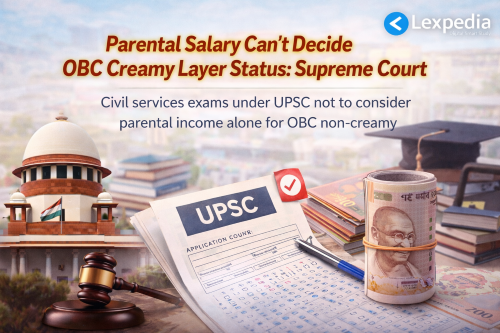
The Supreme Court of India has ruled that the determination of “creamy layer” status among Other Backward Classes (OBCs) cannot be based solely on the salary income of parents. The Court emphasised that the status and category of the posts held by the parents must also be considered while deciding whether a candidate falls within the creamy layer.
The ruling was delivered by a Bench comprising Justice P.S. Narasimha and Justice R. Mahadevan, while dismissing a batch of appeals filed by the Union of India challenging earlier High Court decisions.
Background of the case
The dispute arose from several candidates who appeared in the Civil Services Examination conducted by the Union Public Service Commission (UPSC) and sought reservation under the OBC Non-Creamy Layer category.
During verification of their eligibility, authorities treated these candidates as belonging to the creamy layer because their parents’ salaries exceeded the prescribed income limit. Many of the parents were employees of Public Sector Undertakings (PSUs), banks, or private sector organisations.
The candidates challenged the decision before various forums including the Central Administrative Tribunal and subsequently before the Madras, Delhi and Kerala High Courts. These courts ruled in favour of the candidates and held that the authorities had incorrectly applied the income test. The Union government then appealed those rulings before the Supreme Court.
What the Supreme Court said
The Supreme Court held that using parental salary alone as the deciding factor for determining creamy layer status is legally incorrect.
The Court clarified that the status of the parents’ posts and the nature of their employment are the primary criteria, while the income or wealth test is only an additional factor.
The Bench noted that the authorities had wrongly applied a pure income-based test, which resulted in several candidates being excluded from reservation benefits even though they did not fall within the intended creamy layer category.
Discrimination between government and non-government employees
The Court also observed that treating the children of PSU or private sector employees differently from those of government employees while determining creamy layer status would amount to hostile discrimination.
Such differential treatment was found inconsistent with the principles governing reservation policies for OBCs.
Reference to earlier policy framework
The Court referred to the 1993 Office Memorandum issued after the landmark case Indra Sawhney v. Union of India, which laid down the framework for identifying the creamy layer among OBCs.
Under that framework, the social status and the nature of the parents’ employment were considered the main indicators, while income served only as a supplementary factor.
Significance of the judgment
The judgment is expected to have significant implications for the implementation of OBC reservation in public employment and education.
By clarifying that income alone cannot determine creamy layer status, the Court has reinforced the principle that reservation policies are aimed at addressing social and educational backwardness rather than purely economic disadvantage.
सुप्रीम कोर्ट: केवल माता-पिता के वेतन के आधार पर OBC क्रीमी लेयर तय नहीं की जा सकती
Supreme Court of India ने एक महत्वपूर्ण फैसले में कहा है कि अन्य पिछड़ा वर्ग (OBC) में क्रीमी लेयर की स्थिति का निर्धारण केवल माता-पिता की आय या वेतन के आधार पर नहीं किया जा सकता। अदालत ने स्पष्ट किया कि इस निर्धारण में माता-पिता के पद की स्थिति और सेवा श्रेणी को भी ध्यान में रखना आवश्यक है।
यह फैसला Justice P.S. Narasimha और Justice R. Mahadevan की पीठ ने सुनाया, जिसने इस मामले में केंद्र सरकार द्वारा दायर अपीलों को खारिज कर दिया।
मामले की पृष्ठभूमि
यह विवाद उन उम्मीदवारों से जुड़ा था जिन्होंने Union Public Service Commission (UPSC) द्वारा आयोजित सिविल सेवा परीक्षा पास की थी और OBC नॉन-क्रीमी लेयर श्रेणी के तहत आरक्षण का दावा किया था।
पात्रता जांच के दौरान अधिकारियों ने इन उम्मीदवारों को क्रीमी लेयर में शामिल कर दिया क्योंकि उनके माता-पिता की वेतन आय निर्धारित सीमा से अधिक थी। इनमें से कई माता-पिता PSU, बैंक या निजी कंपनियों में कार्यरत थे।
इन उम्मीदवारों ने इस निर्णय को Central Administrative Tribunal तथा बाद में मद्रास, दिल्ली और केरल उच्च न्यायालयों में चुनौती दी। उच्च न्यायालयों ने उम्मीदवारों के पक्ष में फैसला दिया, जिसके बाद केंद्र सरकार ने सुप्रीम कोर्ट में अपील दायर की।
सुप्रीम कोर्ट की टिप्पणी
सुप्रीम कोर्ट ने कहा कि क्रीमी लेयर का निर्धारण केवल आय के आधार पर करना गलत है।
अदालत के अनुसार माता-पिता के पद की स्थिति और सेवा श्रेणी मुख्य मानदंड हैं, जबकि आय या संपत्ति का परीक्षण केवल सहायक कारक के रूप में देखा जाना चाहिए।
पीठ ने कहा कि अधिकारियों ने गलत तरीके से केवल आय आधारित परीक्षण लागू किया, जिससे कई उम्मीदवारों को आरक्षण लाभ से वंचित कर दिया गया।
सरकारी और निजी क्षेत्र के कर्मचारियों के बीच भेदभाव
अदालत ने यह भी कहा कि सरकारी कर्मचारियों और PSU या निजी क्षेत्र के कर्मचारियों के बच्चों के साथ अलग-अलग व्यवहार करना भेदभावपूर्ण होगा।
पूर्व नीति का संदर्भ
अदालत ने Indra Sawhney v. Union of India के बाद जारी 1993 के ऑफिस मेमोरेंडम का भी उल्लेख किया, जिसमें क्रीमी लेयर की पहचान के लिए दिशा-निर्देश तय किए गए थे।
इस नीति के अनुसार सामाजिक स्थिति और माता-पिता के पद का स्तर मुख्य मानदंड हैं, जबकि आय को सहायक मानदंड माना गया है।
निर्णय का महत्व
यह फैसला OBC आरक्षण नीति के कार्यान्वयन पर महत्वपूर्ण प्रभाव डाल सकता है।
सुप्रीम कोर्ट ने स्पष्ट किया कि आरक्षण का उद्देश्य केवल आर्थिक असमानता नहीं बल्कि सामाजिक और शैक्षणिक पिछड़ेपन को दूर करना है।