Reasonable Use Of Cane By Teacher For Discipline Not An Offence: Kerala High Court
Lexpedia News · 10 February 2026 · 4 min read
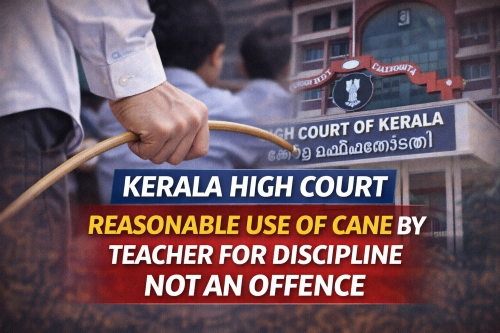
In a significant ruling concerning school discipline and criminal liability of teachers, the Kerala High Court has held that reasonable corporal punishment administered by a teacher for maintaining discipline does not automatically amount to an offence under the Bharatiya Nyaya Sanhita (BNS) or the Juvenile Justice (Care and Protection of Children) Act, 2015.
The observation came while the Court quashed criminal proceedings against a school teacher accused of beating a student with a cane. Justice C. Pratheep Kumar ruled that a cane used in a disciplinary context cannot be treated as a “dangerous weapon” under provisions dealing with voluntarily causing hurt using dangerous means.
Background Of The Case
The case arose after allegations that a teacher struck a student with a cane for disciplinary reasons. An FIR was subsequently registered under provisions relating to causing hurt and cruelty to children. Medical records reportedly noted external injuries, and the matter reached the High Court through a petition seeking quashing of criminal proceedings.
The teacher argued that:
-
The cane was used only to maintain classroom discipline.
-
There was no intention to cause injury or harm.
-
A cane cannot legally be classified as a dangerous weapon.
Accepting these submissions, the Court set aside the criminal case.
Court’s Key Observations
The High Court clarified several important points:
-
Reasonable disciplinary punishment by a teacher does not automatically attract criminal liability.
-
Teachers entrusted with students have limited authority to enforce discipline.
-
Courts must examine intention, proportionality, and circumstances before criminalising disciplinary actions.
-
A cane used for minimal disciplinary purposes does not qualify as a dangerous weapon under the BNS.
Legal Context
The Court’s observations involved interpretation of:
-
Bharatiya Nyaya Sanhita (BNS): Particularly provisions relating to causing hurt with dangerous weapons.
-
Juvenile Justice Act, 2015: Which penalises cruelty toward children, but requires proof of harmful intent or serious misconduct.
The Court noted that minimal disciplinary action without malicious intent would not ordinarily fall within criminal provisions.
Limits Highlighted By The Court
The Court clarified that the ruling does not justify corporal punishment generally. It emphasised:
-
Excessive, sadistic, or harmful punishment can still attract criminal charges.
-
Serious injury or punishment targeting sensitive body parts would be treated differently.
Significance Of The Ruling
The judgment addresses the boundary between lawful classroom discipline and criminal conduct, particularly in the context of evolving child protection laws and educational policies discouraging corporal punishment.
अनुशासन हेतु शिक्षक द्वारा सीमित शारीरिक दंड अपराध नहीं: केरल हाई कोर्ट
स्कूल अनुशासन और शिक्षकों की आपराधिक जिम्मेदारी से जुड़े एक महत्वपूर्ण फैसले में केरल हाई कोर्ट ने कहा है कि अनुशासन बनाए रखने के लिए शिक्षक द्वारा दिया गया सीमित शारीरिक दंड भारतीय न्याय संहिता (BNS) या किशोर न्याय (बालकों की देखभाल एवं संरक्षण) अधिनियम, 2015 के तहत स्वतः अपराध नहीं माना जाएगा।
यह टिप्पणी उस मामले में की गई जिसमें एक शिक्षक पर छात्र को छड़ी से मारने के आरोप में दर्ज आपराधिक मुकदमा हाई कोर्ट ने रद्द कर दिया। न्यायमूर्ति सी. प्रतीप कुमार ने कहा कि अनुशासन के लिए प्रयुक्त छड़ी को खतरनाक हथियार नहीं माना जा सकता।
मामले की पृष्ठभूमि
मामला उस घटना से जुड़ा था जिसमें शिक्षक पर छात्र को अनुशासनात्मक कारणों से छड़ी से मारने का आरोप लगा। इसके बाद चोट पहुँचाने और बच्चों पर क्रूरता से संबंधित धाराओं के तहत FIR दर्ज हुई। मेडिकल रिपोर्ट में बाहरी चोटों का उल्लेख था और शिक्षक ने हाई कोर्ट में मुकदमा रद्द करने की मांग की।
शिक्षक का तर्क था:
-
दंड केवल अनुशासन बनाए रखने के उद्देश्य से दिया गया था।
-
किसी गंभीर चोट या दुर्भावना का उद्देश्य नहीं था।
-
छड़ी को खतरनाक हथियार नहीं माना जा सकता।
अदालत ने इन तर्कों को स्वीकार करते हुए आपराधिक कार्यवाही रद्द कर दी।
अदालत की प्रमुख टिप्पणियां
हाई कोर्ट ने कहा:
-
अनुशासन हेतु उचित दंड स्वतः अपराध नहीं है।
-
छात्रों की देखरेख में शिक्षक को सीमित अनुशासनात्मक अधिकार होते हैं।
-
आपराधिक दायित्व तय करते समय मंशा, परिस्थितियों और दंड की गंभीरता देखी जानी चाहिए।
-
अनुशासन के लिए प्रयुक्त छड़ी को खतरनाक हथियार नहीं माना जा सकता।
कानूनी संदर्भ
अदालत ने निम्न कानूनों की व्याख्या की:
-
भारतीय न्याय संहिता (BNS): खतरनाक हथियार से चोट पहुँचाने से संबंधित प्रावधान।
-
किशोर न्याय अधिनियम, 2015: बच्चों पर क्रूरता के मामलों में लागू कानून।
कोर्ट ने कहा कि दुर्भावना के बिना दिया गया न्यूनतम अनुशासनात्मक दंड स्वतः अपराध नहीं होगा।
अदालत की सावधानीपूर्ण टिप्पणी
कोर्ट ने स्पष्ट किया:
-
अत्यधिक या क्रूर दंड अपराध हो सकता है।
-
गंभीर चोट पहुँचाने या अमानवीय व्यवहार के मामलों में कानून लागू होगा।
फैसले का महत्व
यह फैसला स्कूल अनुशासन और बच्चों की सुरक्षा के बीच संतुलन से जुड़े कानूनी प्रश्नों को स्पष्ट करता है और शिक्षकों की अनुशासनात्मक भूमिका पर न्यायिक दृष्टिकोण को रेखांकित करता है।