
Mohori Bibee vs Dharmodas Ghose, 1903
Agreements entered into by minors are void ab initio, meaning they are void from the outset.
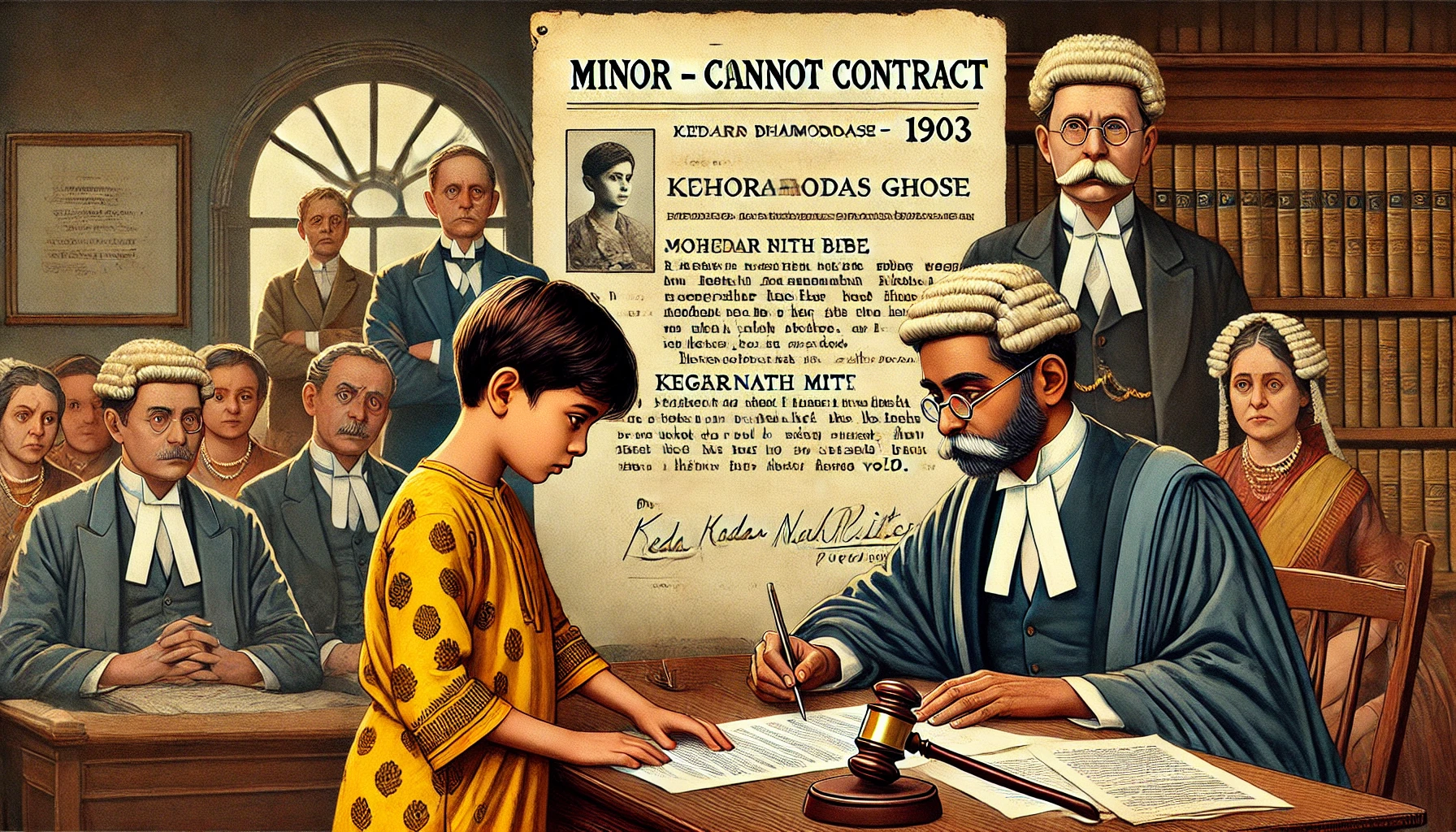
Judgement Details
Court
Judicial Committee of the Privy Council
Date of Decision
4 March 1903
Judges
Lord McNaughton ⦁ Lord Davey ⦁ Lord Lindley ⦁ Sir Ford North ⦁ Sir Andrew Scoble ⦁ Sir Andrew Wilson DECISION by: Sir Ford North
Citation
[1903] UKPC 12, (1903) LR 30 IA 114
Acts / Provisions
Facts of the Case
The case of Mohori Bibee v. Dharmodas Ghose (1903) is a landmark decision in Indian contract law, establishing that agreements entered into by minors are void ab initio, meaning they are void from the outset.
Key Facts:
Parties Involved:
- Plaintiff: Dharmodas Ghose, a minor under the age of 18, who owned certain immovable properties.
- Defendant: Brahmo Dutt, a moneylender in Calcutta, represented by his attorney, Kedar Nath Mitter.
- Dharmodas Ghose and his mother initiated legal action against Brahmo Dutta, arguing that the mortgage executed during Dharmodas's minority was void and improper, requiring the contract's revocation.
Transaction Details:
- Dharmodas Ghose, a minor, mortgaged his property to secure a loan from his uncle, Brahmo Dutt. The mortgage was later sold to the plaintiff, Mohori Bibee. On July 20, 1895, Dharmodas Ghose executed a mortgage deed in favor of Brahmo Dutt to secure a loan of Rs. 20,000 at an interest rate of 12% per annum.
- At the time of the transaction, Brahmo Dutt was absent from Calcutta, and his attorney, Kedar Nath Mitter, managed the dealings.
- Dharmodas Ghose’s mother informed Brahmo Dutta that her son was a minor and couldn’t make contracts regarding his land. Kedar Nath, acting on behalf of Brahmo Dutta, knew about Dharmodas Ghose’s age and incapacity to enter such contracts.
Knowledge of Minority:
Prior to the execution of the mortgage deed, Dharmodas's mother and legal guardian, Jogendranandini Dasi, had informed Kedar Nath Mitter about her son's minority status, asserting that he was legally incompetent to enter into such contracts.
Legal Proceedings:
Subsequently, Dharmodas Ghose, through his mother as next friend, initiated a lawsuit against Brahmo Dutt, seeking a declaration that the mortgage was void and unenforceable due to his minority at the time of the agreement.
Judicial Findings:
- Lower Courts: Both the Court of First Instance and the High Court of Judicature at Fort William ruled in favor of Dharmodas Ghose, declaring the mortgage void due to his minority.
- Privy Council Appeal: Upon appeal, the Privy Council upheld the decisions of the lower courts, reaffirming that a contract with a minor is void ab initio.
Issues
- Whether the deed was void under Section 2, 10(5), 11(6) of the Contract Act or not?
- Whether the mortgage initiated by the defendant was voidable or not?
- Whether the defendant was obligated to return the loan amount he had received under the deed or mortgage or not?
Judgement
Appellant’s Agruments:
The appellant argues that the respondent was actually of legal age at that time. The appellant and their representative had no knowledge that the respondent was a minor. They assert that the respondent provided false information about his age and, as a result, should not be entitled to any relief.
Respondent’s Arguments:
Brahmo Dutta and his agent, Kedar Nath in Mohori Bibee vs Dharmodas Ghose were aware of the true age of the respondent.
Given that the respondent was a minor when he entered into the mortgage, the contract is considered void.
JUDGMENT:-
- After considering the facts of the case, Privy Council held that the agreement entered into with minor is void ab initio i.e. void from the very beginning.
- The court further held regarding the contentions of the defendant that, firstly law of estoppel will not apply since the attorney of Brahmodutt had knowledge of fact of minority of Dharmodas.
- Secondly, Section 64 and 65 of Indian Contract Act will not apply as there wasn't an agreement at the first place and for the application of Sections 64 and 65 the Contract Act must be between competent parties.
- Therefore, a precedent of minor's agreement are void ab initio had been laid down in the present case.
Held
It was held by the court that if the other party had knowledge about the minority of the other party, the agreement is void from the day of execution.
Analysis
The appellant contends that Section 115 of Indian Evidence Act (1872), applies in this case. This section states that if one person intentionally causes another person to believe something to be true through their actions, declarations, or omissions and that person acts on that belief, neither party nor their representatives can later deny the truth of that matter in any lawsuit or proceeding.
The appellant in Mohori Bibee vs Dharmodas Ghose argues that the respondent must repay the amount advanced to him in accordance with Section 64 and Section 38 of the Indian Contract Act (1872) and Section 41 of the Specific Relief Act (1877).
Section 38 of the Indian Contract Act, 1872, stipulates that if a promisor offers to perform their part of the contract to the promisee and the offer is not accepted, the promisor is not held responsible for non-performance and they do not lose their rights under the contract.
Section 41 of the Indian Contract Act, 1872, specifies that when a promisee accepts performance of a promise from a third party, they cannot subsequently enforce that promise against the original promisor.
Section 64 of the Indian Contract Act, 1872, states that when a person who has the option to void a contract chooses to rescind it, the other party to the contract is not obligated to fulfill any promises contained in the contract where they are the promisor.